Mastering System Design Step-by-Step
Introduction to System Design
What Is System Design?
Think of building a skyscraper. You wouldn't just start mixing concrete and welding steel beams together. You'd start with a detailed blueprint. That blueprint would show the foundation, the electrical wiring, the plumbing, and how all the floors connect. It ensures the final structure is strong, safe, and functional.
System design is the blueprint for software. It's the process of defining the architecture, components, and data flows for a system to meet specific requirements. It's about making high-level decisions that determine how the system will work long before writing the first line of code. Good design leads to systems that are reliable, can grow without breaking, and are easier to update over time.
System Design is the process of architecting a system so that all functional and non-functional requirements are met, including APIs, use cases, and integrations.
This planning doesn't happen in a vacuum. It's a key phase in a well-established process for building software from scratch.
The Software Blueprint
The entire process of creating software, from idea to launch and beyond, is often mapped out in what’s called the System Development Life Cycle (SDLC). It’s a framework that breaks down the complex task of building software into manageable stages. While there are different models, the core phases are generally the same.
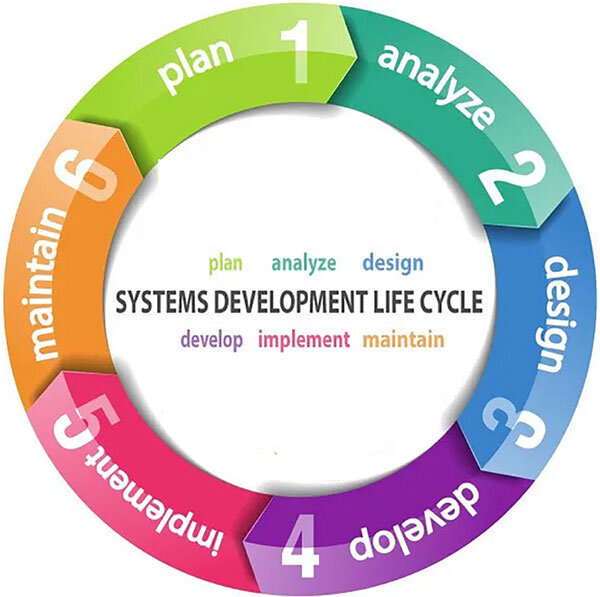
The typical stages are:
- Plan & Analyze: Figure out what the system needs to do. What problems will it solve? Who are the users?
- Design: Create the blueprint. This is where system design lives. Architects decide on the technology, the structure, and how different parts will communicate.
- Develop: Write the code based on the design documents.
- Test: Check that everything works as intended and find bugs.
- Implement: Roll out the system for users.
- Maintain: Fix issues, make updates, and keep the system running smoothly.
Skipping or rushing the design phase is like building that skyscraper without a plan. You'll end up with a shaky foundation and costly problems down the road.
Two Ways to Build
One of the first big decisions in the design phase is choosing the fundamental structure of the system. Two common approaches are monolithic and distributed systems. They represent two very different philosophies for how to organize code and services.
A monolithic system is like an all-in-one appliance, say, a combo microwave-oven-toaster. Everything is built into a single, unified unit. The user interface, business logic, and data access are all intertwined in one large codebase. This is often simpler to develop and deploy at first. However, if the toaster part breaks, the whole appliance might need to be replaced. Similarly, updating one small part of a monolithic application requires redeploying the entire thing. Scaling up means running more copies of the whole application, even if only one part is getting heavy traffic.
A distributed system is more like having a separate microwave, oven, and toaster. Each component, or service, is independent and communicates with the others over a network. For example, the user interface is one service, the payment processing is another, and the product catalog is a third. If you need to upgrade the toaster, you can do it without touching the oven. This makes the system more flexible and resilient. If one service fails, the others might still function. To handle more traffic, you can add more instances of just the service that's under heavy load.
The choice between monolithic and distributed architecture is one of the most fundamental in system design, with major implications for scalability, maintenance, and team organization.
Most modern, large-scale applications like Netflix or Amazon use a distributed approach. It allows their massive engineering teams to work on different services independently and helps them serve millions of users at once. However, for a smaller project, a monolithic architecture might be a perfectly good starting point.
Understanding these foundational concepts is the first step in designing effective systems. It's not about memorizing solutions, but about learning to think through the trade-offs of every decision.