Mastering Supply Chain Management
Introduction to Supply Chain Management
What is a Supply Chain?
Think about your smartphone. It wasn't made in one place. The processor might have come from Taiwan, the screen from South Korea, and the battery from China. It was assembled in another country, shipped across an ocean, trucked to a warehouse, and finally delivered to the store where you bought it. That entire journey is a supply chain.
A supply chain is the network of all the individuals, organizations, resources, activities, and technology involved in the creation and sale of a product. It starts with sourcing raw materials from a supplier and ends with delivering the finished product to the end user. Supply Chain Management (SCM) is the active management of these activities to maximize customer value and achieve a sustainable competitive advantage.
Supply chain management plays a very significant role in most organizations because it directly affects efficiency, costs, and customer satisfaction.
Essentially, it's about getting the right product, to the right place, at the right time, in the right quantity, and at the right cost. When SCM is done well, companies can lower their costs, improve product quality, and get products to consumers faster. When it's done poorly, you see empty shelves and unhappy customers.
The Links in the Chain
Every supply chain, whether for a cup of coffee or a car, is made up of a few core components or activities. While we'll dive deeper into these later, it's helpful to understand the basic flow.
Here’s a quick look at these five stages:
- Plan: This is the strategy phase. Companies forecast demand, plan production, and figure out what resources they'll need.
- Source: This involves identifying and selecting suppliers to provide the raw materials and services needed to create the product.
- Make: This is the manufacturing or production step where the product is actually built, tested, and packaged.
- Deliver: Often called logistics, this stage covers everything from warehousing and order fulfillment to shipping products to customers.
- Return: This is the reverse flow, managing the return of defective, excess, or unwanted products from customers.
From Local to Global
Supply chains haven't always been so complex. For most of history, they were very local. A baker got flour from a nearby mill, which got wheat from a local farmer. The entire chain was within a few miles.
The Industrial Revolution started to stretch these chains. Factories could produce goods at a massive scale, needing more raw materials from further away and shipping finished products across the country by rail. But the biggest change came with globalization.
With modern shipping and communication, companies can now source parts, assemble products, and sell to customers anywhere in the world. Globalization opened up access to cheaper labor, new materials, and vast new markets. This created incredibly efficient, cost-effective supply chains.
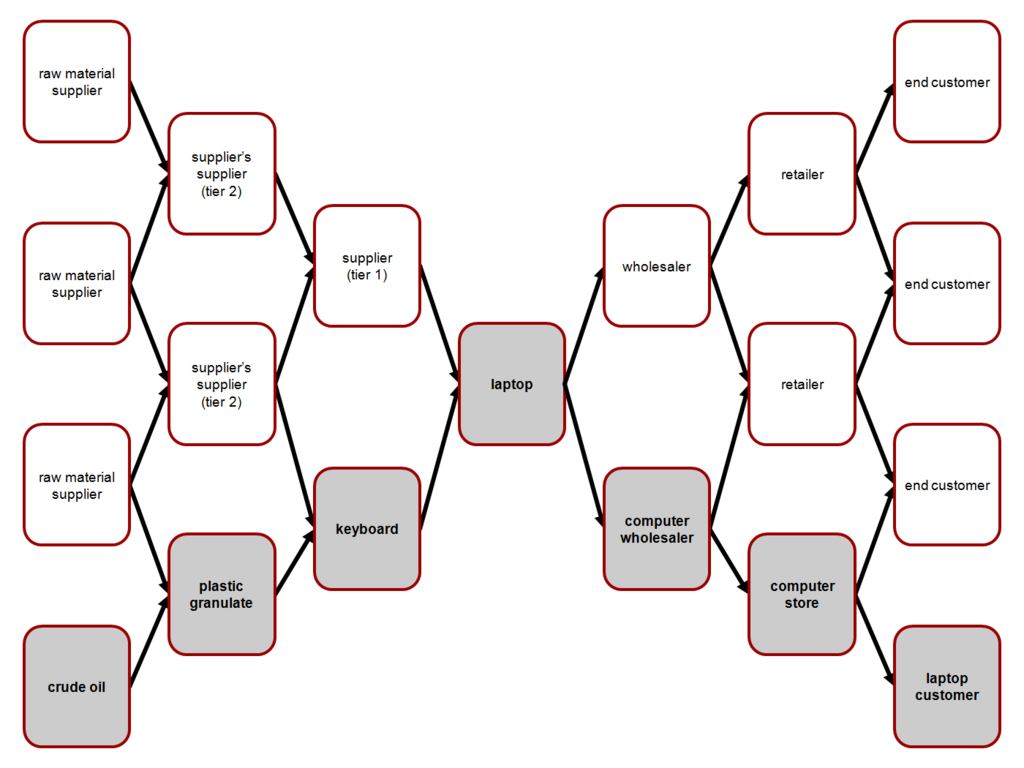
However, this complexity also brings new challenges. A factory shutdown in one country can halt production in another. A shipping delay in a single port can cause a ripple effect across the entire globe. Managing a global supply chain means balancing the benefits of worldwide sourcing with the risks of disruption.
Now, let's check your understanding of these fundamental concepts.
Which of the following best describes a supply chain?
A company is trying to decide which vendors to buy raw materials from for their new product. Which of the five stages of a supply chain is this activity part of?
Understanding these core ideas is the first step in mastering how products travel from an idea to your hands.