Mastering Supply Chain Management
Introduction to Supply Chain Management
What is a Supply Chain?
Think about the smartphone in your pocket or the coffee you drank this morning. Neither of these things simply appeared. They are the end result of a long journey involving many people, companies, and locations. This entire network, from the origin of raw materials to the final product in your hands, is a supply chain.
Supply Chain Management spans all movement and storage of raw materials, work-in-process inventory, and finished goods from point of origin to point of consumption.
Supply chain management (SCM) is the art and science of managing this flow. It's about getting the right product to the right place, at the right time, in the right quantity, and at the right cost. When done well, it's an invisible, seamless process. When it fails, you see empty shelves at the grocery store or year-long waits for a new car.
The Core Components
Every supply chain, whether for a simple t-shirt or a complex airplane, involves five key stages. These stages work together to create a smooth, efficient journey for a product.
Each of these steps involves intricate coordination. Planning determines the strategy for the entire chain. Sourcing finds the best suppliers for raw materials or components. Manufacturing converts those materials into finished products. Delivery, also known as logistics, gets the products to the customer. Finally, the returns process manages any products that need to come back, whether for defects, recycling, or other reasons.
Think of it as a relay race. Each runner (or stage) must perfectly hand off the baton to the next for the team to succeed.
The Main Objectives
Why do companies invest so much in managing their supply chains? The goals are straightforward but powerful.
First is customer satisfaction. A great supply chain ensures that when a customer wants a product, it's available. It arrives on time and in good condition. This reliability builds trust and loyalty.
Second is cost reduction. By optimizing every step, from storage to transportation, companies can eliminate waste and cut unnecessary expenses. Buying materials in the right quantities, choosing efficient shipping routes, and minimizing inventory all contribute to a healthier bottom line.
Finally, there's efficiency. A well-run supply chain is a lean, fast-moving system. It improves cash flow by turning raw materials into revenue more quickly. This agility allows a company to react faster to market changes, new trends, or unexpected disruptions.
Supply chain management plays a very significant role in most organizations because it directly affects efficiency, costs, and customer satisfaction.
The Key Players
A supply chain is a network of organizations, each with a distinct role. The success of the entire chain depends on how well these stakeholders collaborate. Let's look at the main players using the example of a simple wooden chair.
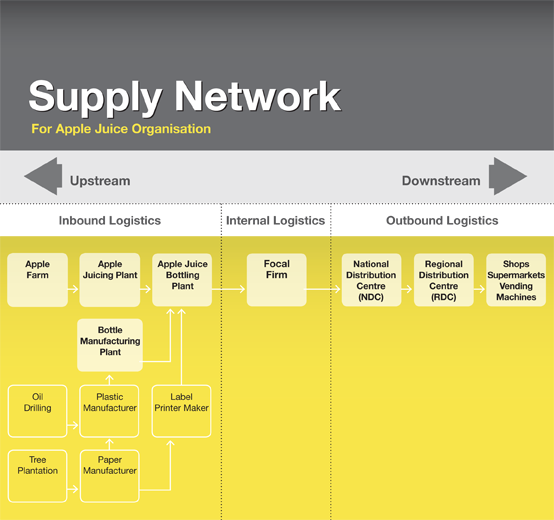
- Suppliers: These are the source. For our chair, this includes the lumber company that harvests the trees and the company that makes screws and glue.
- Manufacturers: They transform the raw materials into a finished product. A furniture maker takes the wood, screws, and glue and builds the chair.
- Distributors (or Wholesalers): These are intermediaries who buy products in bulk from manufacturers and sell them to retailers. A large distribution company might store thousands of chairs in a warehouse before sending them out to various stores.
- Retailers: This is the storefront where the final customer buys the product. It could be a large furniture store or a small local shop.
- Customers: You! The end user who purchases the chair. The customer's demand is what drives the entire supply chain into action.
Throughout this process, information and money are also flowing. Retailers send sales data back to distributors and manufacturers to inform them about demand. Money flows from the customer back through each player, all the way to the original suppliers.
Now you're ready to test your knowledge of these core concepts.
What is the core function of Supply Chain Management (SCM)?
Which of the following is NOT one of the five key stages of a supply chain?
Understanding these fundamentals shows how interconnected our global economy is. Nearly every product we use is the result of a carefully managed and complex supply chain.