Mastering Structured Data With Real-World Examples
Structured Data Fundamentals
What Is Structured Data?
Structured data is information that's organized in a highly specific way. Think of a spreadsheet or a well-organized address book. Everything has its own designated spot. This type of data conforms to a predefined model, known as a schema, which dictates the format and rules for the data.
In structured data, every piece of information is like a book on a library shelf: it has a specific location and follows a clear cataloging system. You know exactly where to find it and what it represents.
The most common format for structured data is tabular, with rows and columns. Each column represents a specific attribute (like "First Name" or "Email Address"), and each row represents a single record (like a specific person's contact information). This predictable organization is what makes structured data so powerful and easy for computers to work with.
schema
noun
A blueprint or model that defines the structure, data types, and relationships for a set of data. It acts as the rulebook that data must follow.
The Data Spectrum
Data doesn't always come in a neat package. To understand structured data better, it helps to see it as part of a spectrum that also includes unstructured and semi-structured data.
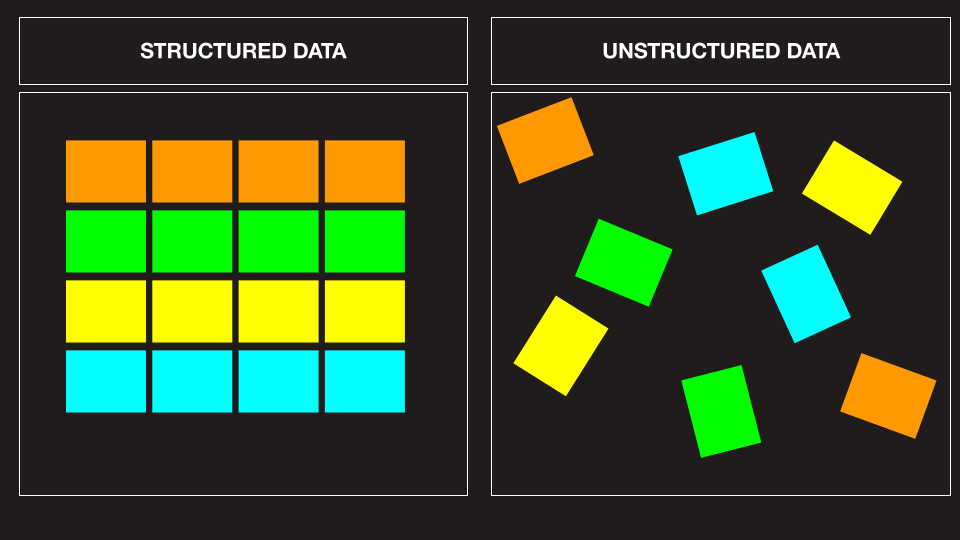
Unstructured Data is the opposite of structured data. It has no predefined model or organizational hierarchy. Think of the text in an email, a photo, a video file, or a social media post. It's free-form and messy, making it difficult for computers to search and analyze without special tools.
Semi-structured Data sits in the middle. It doesn't fit into the rigid rows and columns of a traditional database, but it contains tags or other markers to separate semantic elements and enforce hierarchies. Examples include JSON and XML files, which are common on the web.
| Feature | Structured Data | Semi-structured Data | Unstructured Data |
|---|---|---|---|
| Format | Tabular (rows & columns) | Hierarchical (tags, keys) | Free-form |
| Schema | Predefined and strict | Flexible, self-describing | None |
| Example | Customer database, flight schedules | A JSON file, an email | A PDF document, an image file |
Why Structure Matters
The main advantage of structured data is its simplicity and efficiency. Because the format is known ahead of time, it’s incredibly easy for both humans and machines to access and process.
Think about searching for a friend's phone number. If your contacts are structured (Name, Number, Email), you can find it in seconds. If they were all jotted down randomly on a piece of paper, the search would be much slower.
This leads to several key benefits:
- Easy to Query: Languages like SQL (Structured Query Language) are designed specifically to manage and retrieve information from structured databases. Queries are fast and straightforward.
- Machine Learning Ready: Most machine learning algorithms require data to be in a structured format. Clean, organized data is the foundation for building accurate predictive models.
- High Data Integrity: The schema enforces rules, ensuring that data is consistent and reliable. You won't find a date in a column meant for names, which prevents errors and improves data quality.
- Simple Scalability: Structured data systems are well-understood and can be scaled up efficiently to handle vast amounts of information.
This combination of accessibility and reliability is why structured data remains the backbone of most business applications, from financial systems to inventory management.
What is the defining characteristic of structured data?
Which of the following is the BEST example of structured data?