Mastering Structural Equation Modeling
Introduction to SEM
Beyond Simple Relationships
In research, we often want to understand how different concepts are related. For example, how does a student's home environment affect their test scores? Or how does customer satisfaction influence brand loyalty? Traditional statistics like regression can answer simple questions, but what if the reality is more complex? What if the home environment influences a student's motivation, and it's the motivation that really impacts their test scores?
This is where Structural Equation Modeling (SEM) comes in. It's a powerful statistical framework used to test and estimate complex relationships between variables. Think of it as a combination of two other techniques: factor analysis and multiple regression. SEM allows researchers to examine a whole network of relationships at once, rather than just looking at individual pieces in isolation.
Latent Variable
noun
A variable that cannot be directly observed or measured, but is inferred from other variables that are observed. Examples include intelligence, motivation, or anxiety.
One of SEM's key strengths is its ability to work with both observed variables (things you can directly measure, like age or test scores) and latent variables. This allows researchers to build models that more closely resemble their complex theories about the world.
How SEM Came to Be
Structural Equation Modeling didn't appear overnight. It grew from the combination of several different statistical traditions in the 20th century.
Its earliest roots are in path analysis, developed by the geneticist Sewall Wright in the 1920s to study the influence of heredity and environment. Around the same time, psychologists like Charles Spearman were developing factor analysis to identify underlying latent traits, like general intelligence.
Later, economists developed methods for solving systems of simultaneous equations to model complex economic systems. In the 1970s, researchers, most notably Karl Jöreskog, began to integrate these separate streams into a single, flexible framework. This synthesis became what we now know as SEM.
A More Realistic Approach
Compared to more traditional statistical methods, SEM offers several key advantages. The biggest one is its ability to test an entire theory or model, complete with multiple interconnected relationships, all at once.
Another crucial difference is how it handles error. Most statistical methods assume that our variables are measured perfectly, without any error. But in the real world, that's rarely true. A score on a depression questionnaire, for instance, is not a perfect measure of a person's actual depression. SEM acknowledges this by explicitly including measurement error in the model. This leads to more accurate and realistic estimates of the relationships between variables.
| Feature | Traditional Regression | Structural Equation Modeling (SEM) |
|---|---|---|
| Number of Outcomes | Typically one dependent variable at a time | Can analyze multiple dependent variables at once |
| Variable Types | Primarily uses observed variables | Uses both observed and latent variables |
| Measurement Error | Assumes variables are measured perfectly | Explicitly models and accounts for measurement error |
| Model Complexity | Tests individual relationships | Tests a complete network of relationships (an entire model) |
By modeling measurement error, SEM provides a more rigorous test of a researcher's theory.
Applications Across Fields
Because of its flexibility, SEM is used in a wide range of disciplines.
In psychology, a researcher might model how personality traits (latent variables) influence specific behaviors (observed variables). In marketing, SEM can be used to understand the drivers of customer loyalty, modeling factors like perceived quality, satisfaction, and trust.
In education, a model could test how school funding and teacher quality (latent variables) together impact student achievement across multiple subjects. Even in ecology, researchers use SEM to model the complex web of interactions within an ecosystem.
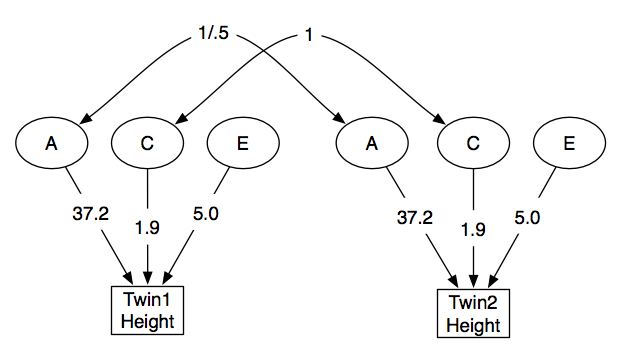
This ability to represent and test complex, theory-driven models makes SEM an indispensable tool for researchers trying to understand the intricate systems that shape our world.
Let's test your understanding of these foundational ideas.
What is the primary purpose of Structural Equation Modeling (SEM)?
A key advantage of SEM is its ability to explicitly account for measurement error in variables.
Essentially, SEM allows us to move beyond simple, one-way relationships and build statistical models that better reflect the complexity of reality.