Mastering Strength and Hypertrophy Integration
Hypertrophy Mechanisms
Two Paths to Growth
You already know that mechanical tension and metabolic stress are the big triggers for muscle growth. But what's actually happening inside the muscle cell when you lift? The term 'hypertrophy' isn't a single event. It describes two distinct types of growth within the muscle fibers.
Myofibrillar hypertrophy is an increase in the number and size of the contractile proteins, actin and myosin. Think of these as the tiny 'ropes' within your muscle that pull on each other to generate force. More ropes mean a stronger, denser muscle. This type of growth is primarily driven by lifting heavy loads and creating high levels of mechanical tension.
Sarcoplasmic hypertrophy, on the other hand, is an increase in the volume of the fluid and non-contractile components inside the muscle cell. This includes glycogen (stored carbohydrates), water, and various minerals. This 'cell swelling' makes the muscle look bigger and fuller, but doesn't directly contribute to its maximum force output in the same way. It's often stimulated by metabolic stress from higher-repetition training.
| Feature | Myofibrillar Hypertrophy | Sarcoplasmic Hypertrophy |
|---|---|---|
| Primary Driver | High Mechanical Tension | High Metabolic Stress |
| What Grows | Contractile Proteins (Actin & Myosin) | Sarcoplasm (Fluid, Glycogen, etc.) |
| Primary Outcome | Increased Strength and Density | Increased Muscle Fullness and Size |
| Typical Rep Range | 1-8 | 8-20+ |
In reality, these two processes aren't mutually exclusive. Most training programmes will stimulate a mix of both. However, understanding the distinction helps explain why a powerlifter and a bodybuilder can train differently yet both achieve significant muscle size.
The Molecular Switch
How does a muscle cell 'know' it's under tension? It converts the physical force of a lift into a chemical signal through a process called mechanotransduction. Specialized proteins within the muscle fiber act as sensors. When they detect strain, they kick off a cascade of biochemical reactions.
At the heart of this cascade is a protein complex called mTOR, which acts as the master regulator of muscle protein synthesis. Think of it as the foreman on a construction site. When mTOR is activated by the tension from resistance training, it signals the cell's machinery to start building new proteins. This ramps up the rate of muscle protein synthesis, the process of creating new contractile units.
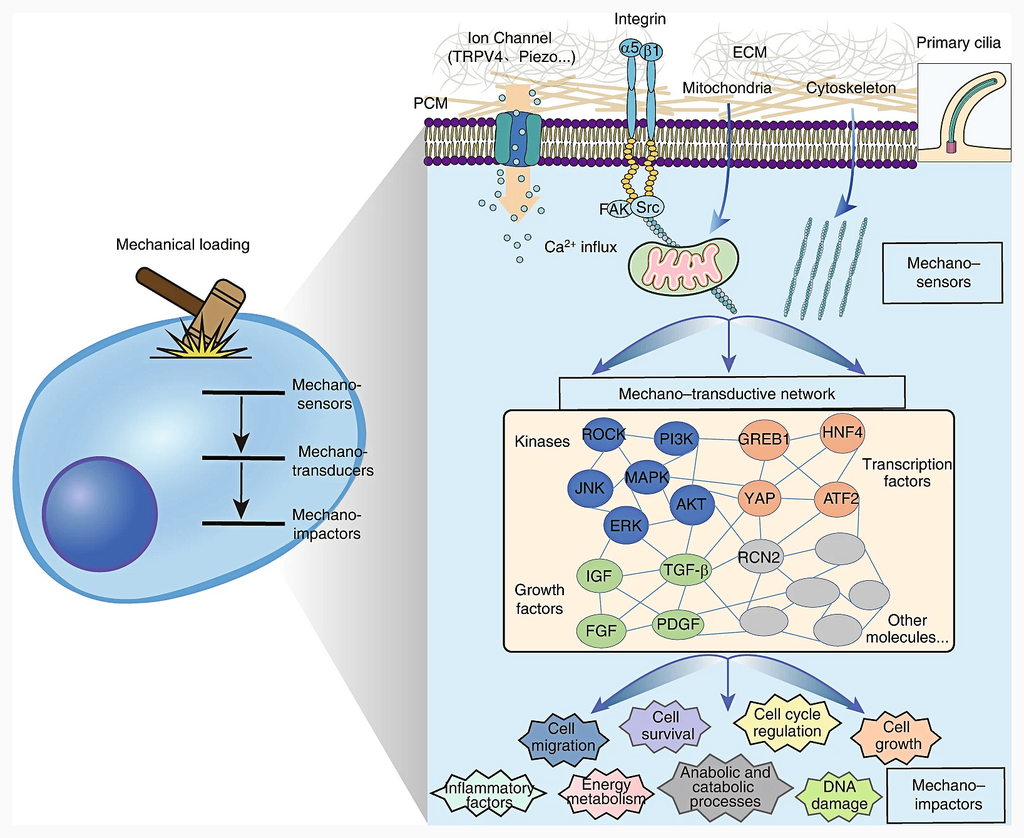
This activation isn't just about building bigger fibers. It also calls in reinforcements. When you train hard enough to cause micro-tears in the muscle fibers, the body initiates a repair process. Specialized stem cells called satellite cells, which lie dormant on the outside of muscle fibers, are activated. They multiply and then fuse to the damaged muscle fibers, donating their nuclei. Each nucleus can only manage a certain area of the cell, so adding new nuclei allows the muscle fiber to grow larger and stronger than it was before. This is a critical part of long-term muscle adaptation and repair.
The Role of Stress
Metabolic stress contributes to hypertrophy in a different way. When you perform higher reps, you create a buildup of metabolic byproducts like lactate and hydrogen ions. This environment, combined with the restriction of blood flow to the working muscle (known as occlusion), creates significant 'cellular swelling'.
The muscle cell perceives this swelling as a threat to its integrity. In response, it reinforces its structure to better withstand the pressure in the future. This is a key driver of sarcoplasmic hypertrophy. This process also triggers the release of various hormones, including growth hormone and testosterone, which can further support muscle growth systemically.
Both high tension and high metabolic stress are powerful stimuli. A well-rounded programme uses both to maximise the different pathways that lead to muscle growth.
Let's test your understanding of how muscles grow at a cellular level.
Which type of hypertrophy is characterised by an increase in the non-contractile fluid and components within the muscle cell, such as glycogen and water?
What is the name of the process by which a muscle cell converts the physical force of a lift into a chemical signal?