Mastering Strategic Thinking
Decision-Making Fundamentals
The Art of a Good Decision
Every day is a series of choices. Some are small, like what to eat for breakfast. Others are huge, like changing careers or moving to a new city. While we can't predict the future, we can improve how we make these choices. This is where decision analysis comes in. It’s simply the process of breaking down a decision into smaller, more manageable parts. Instead of relying on a gut feeling alone, you use a structured approach to think through your options and their potential outcomes. The goal isn't to find a magical, perfect answer. It's to make a thoughtful choice based on the information you have, increasing the odds of a better result.
Good decision-making isn't about being right all the time. It's about having a sound process for making the choice in the first place.
Not All Decisions Are Equal
Decisions come in different shapes and sizes, and understanding their category helps us give them the right amount of attention. They generally fall into three types: strategic, tactical, and operational.
Strategic Decision
adjective
A high-level choice that sets the long-term direction or goals of an organization or individual.
Strategic decisions are the big ones. They have long-term effects and shape the future. For a company, this might be deciding to launch a new product line. For you, it could be choosing a college major. These choices are infrequent and often made with incomplete information about the future.
Tactical decisions are about how to execute the strategy. They are medium-term choices that put the big plan into action. If the company's strategy is to launch a new product, a tactical decision would be setting the marketing budget or choosing a manufacturing partner. If your strategy is to major in computer science, a tactical decision is which programming courses to take this semester.
Operational decisions are the daily choices that keep things running. They are frequent, structured, and have immediate consequences. For the company, it's a customer service rep deciding how to handle a specific complaint. For you, it's deciding to finish your programming assignment tonight instead of tomorrow.
| Decision Type | Time Horizon | Scope | Example |
|---|---|---|---|
| Strategic | Long-term (Years) | Broad / Big Picture | Deciding to change career paths |
| Tactical | Medium-term (Months) | Departmental / Project-level | Creating a plan to gain new job skills |
| Operational | Short-term (Days/Weeks) | Narrow / Task-oriented | Completing an online course module today |
Why Is Deciding So Hard?
If making decisions were easy, we’d all do it perfectly. But several common hurdles get in the way. Sometimes we face information overload, where there are so many details that we can’t see the forest for the trees. This can lead to analysis paralysis, where we get so stuck researching and evaluating that we never actually make a choice.
Our own minds can also trip us up. We all have unconscious biases, which are mental shortcuts that can lead us astray. On top of that, strong emotions like fear of failure or excitement about a potential reward can cloud our judgment. And finally, there's the simple fact of uncertainty. We rarely know exactly how our choices will turn out, and this ambiguity can make it hard to commit to a path.
A Better Way to Choose
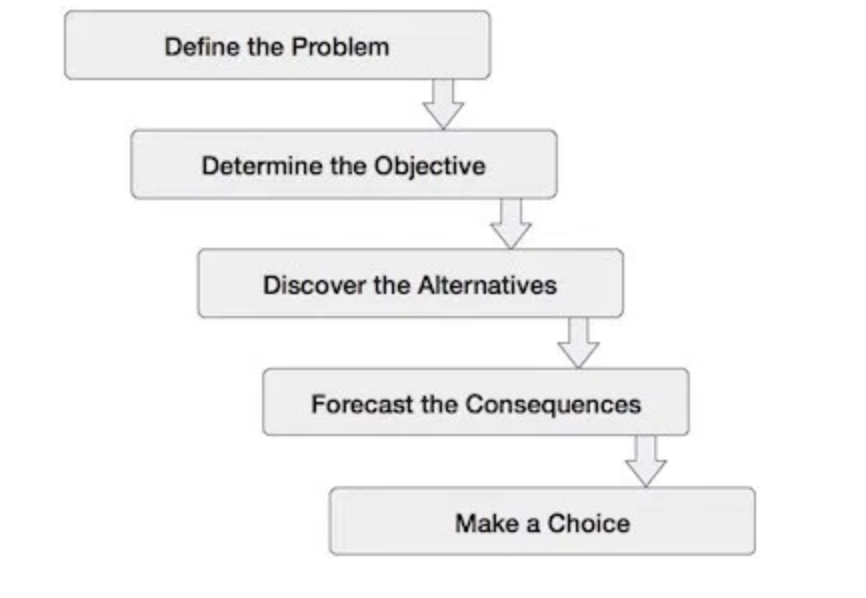
This is why adopting a structured approach is so powerful. When you follow a process, you bring clarity and logic to the situation. It forces you to define the problem, consider your options, and think about what you truly want to achieve. This systematic method helps counteract emotional impulses and hidden biases, leading to more objective and consistent decisions.
Furthermore, having a clear process makes it easier to explain your reasoning to others, whether it's your team at work or your family at home. This builds trust and gets everyone on the same page. Ultimately, a structured approach doesn't just improve your chances of a good outcome; it gives you the confidence that you made the best possible decision with the information you had.
When we approach a problem through a rational decision-making process, we access our conscious mind and work sequentially, following a logical progression that leverages the analysis of facts to make a carefully reasoned decision.
Let's test your understanding of these core concepts.
A student choosing which courses to take next semester to fulfill their major requirements is making what kind of decision?
What is the primary goal of using decision analysis?
By understanding the types of decisions and the common pitfalls, you've taken the first step toward making more deliberate and effective choices.