Mastering Strategic Productivity
Advanced Prioritization Frameworks
From Matrix to Action
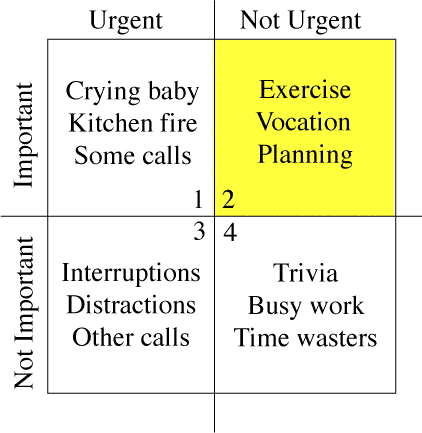
You're likely familiar with categorizing tasks by urgency and importance. The next step is to turn that categorization into a clear action plan. This is where the 4D Method comes in. It's a direct, verb-focused system for processing your to-do list: Do, Defer, Delegate, and Delete.
Each action corresponds to a quadrant of the Eisenhower Matrix, transforming a passive sorting exercise into an active decision-making framework.
| Quadrant | Category | Action |
|---|---|---|
| I | Urgent & Important | Do it now. |
| II | Not Urgent & Important | Defer by scheduling it. |
| III | Urgent & Not Important | Delegate it. |
| IV | Not Urgent & Not Important | Delete it. |
This isn't just about sorting tasks. It's a commitment to a specific outcome for every item that demands your attention. 'Do' tasks are the fires you must put out today. 'Defer' tasks are the strategic projects you must protect time for on your calendar. 'Delegate' tasks are opportunities for others to grow, freeing you up for higher-impact work. And 'Delete' tasks are the clutter you must eliminate to maintain focus.
Calculate Your Time's ROI
To effectively apply the 4D Method, you need an objective way to evaluate tasks, especially when deciding what's truly important. Think of your time like a financial investment. Every hour you spend should generate a return. The goal is to invest your time in tasks with the highest Return on Investment (ROI).
Let's compare two tasks:
- Task A: Prepare a slide deck for an internal team update. Impact score: 3. Time: 2 hours. ROI = 3/2 = 1.5.
- Task B: Draft a proposal for a new client. Impact score: 9. Time: 4 hours. ROI = 9/4 = 2.25.
Task B offers a higher return on your time, even though it takes longer. This calculation helps you move beyond gut feelings and prioritize work that creates real value. Low-ROI tasks are prime candidates for delegation or deletion.
Apply the 80/20 Rule
The Pareto Principle, or the 80/20 rule, states that for many outcomes, roughly 80% of consequences come from 20% of the causes. In a professional context, this means a small fraction of your tasks likely generates the vast majority of your results.
Your job is to identify that vital 20%. These are your high-ROI activities, the work that truly moves the needle. The remaining 80% is often 'low-value' work, the necessary but less impactful tasks that can consume your schedule. This is the work that disguises itself as productivity but doesn't contribute significantly to your core objectives.
Regularly audit your workflow. At the end of each week, look back at your completed tasks. Ask yourself: Which of these activities generated the most significant results? Which ones could have been delegated or eliminated without negative consequences? This constant analysis helps you refine your focus and dedicate more energy to the critical 20%.
By prioritizing tasks based on their significance rather than their immediacy, leaders can move from being reactive to strategic, ensuring their time is spent on high-impact activities that align with their goals.
Strategic Delegation and Deletion
Knowing you should delegate or delete tasks is easy. Doing it is hard. It often comes with friction, like guilt about offloading work or fear of missing something important.
To delegate effectively, reframe it as an opportunity for your team. Match the task to the person who could benefit most from the experience. Provide clear instructions, define what success looks like, and grant them the autonomy to complete the work. This not only frees up your time but also develops the skills of those around you.
Deleting tasks is an exercise in strategic elimination. It requires the confidence to say "no." If a task has a low ROI and doesn't align with your core priorities, question its existence. Can it be automated? Can it be stopped altogether? Often, tasks are done out of habit, not necessity. Eliminating them is the ultimate productivity gain—you're getting time back with zero effort.
These advanced frameworks require a shift from being busy to being effective. By actively deciding what to do, defer, delegate, and delete, and by focusing on the 20% of work that delivers 80% of the results, you take control of your workflow and direct your energy toward what truly matters.
What is the primary purpose of the 4D Method (Do, Defer, Delegate, Delete)?
The Pareto Principle suggests that roughly 80% of your results come from ____% of your efforts.