Mastering Strategic Leadership
Advanced Decision-Making Frameworks
Beyond Pros and Cons
When facing complex business decisions, a simple list of pros and cons won't cut it. Strategic choices, like entering a new market or acquiring a competitor, involve multiple conflicting criteria. You need a structured way to handle this complexity. The Analytic Hierarchy Process (AHP) is one such framework. It breaks down a decision into a logical structure, allowing you to weigh different factors and compare options systematically.
AHP starts by building a hierarchy. At the top is your main goal. The next level contains the criteria you'll use to judge your options. The bottom level lists the alternatives you're considering.
The real power of AHP comes from pairwise comparison. Instead of trying to rank all your criteria at once, you compare them two at a time. For instance, you’d ask: "Which is more important, cost or user-friendliness, and by how much?" You'd repeat this for every pair of criteria, using a scale (e.g., 1 for equal importance, up to 9 for extreme importance of one over the other). This process forces clear, deliberate judgements.
| Cost | User-Friendliness | Integration | |
|---|---|---|---|
| Cost | 1 | 3 | 5 |
| User-Friendliness | 1/3 | 1 | 2 |
| Integration | 1/5 | 1/2 | 1 |
This matrix shows that Cost is considered moderately more important than User-Friendliness (a score of 3) and strongly more important than Integration (a score of 5). The fractional values are reciprocals. From these comparisons, you can derive a priority weight for each criterion. The same pairwise process is then applied to the alternatives, evaluating them against each criterion separately. Finally, the scores are combined to produce an overall ranking, revealing the best option based on your stated priorities.
The Human Element
Frameworks like AHP provide logical structure, but they rely on human judgment. This is where emotional intelligence (EQ) becomes critical. Your ability to understand and manage your own emotions, and to recognise and influence the emotions of others, directly impacts the quality of your decisions.
A high EQ helps you during the decision-making process in several ways. Self-awareness prevents your personal biases from skewing how you weigh criteria. Self-regulation helps you remain objective under pressure. Social awareness, or empathy, allows you to accurately forecast how a decision will affect your team, customers, and other stakeholders.
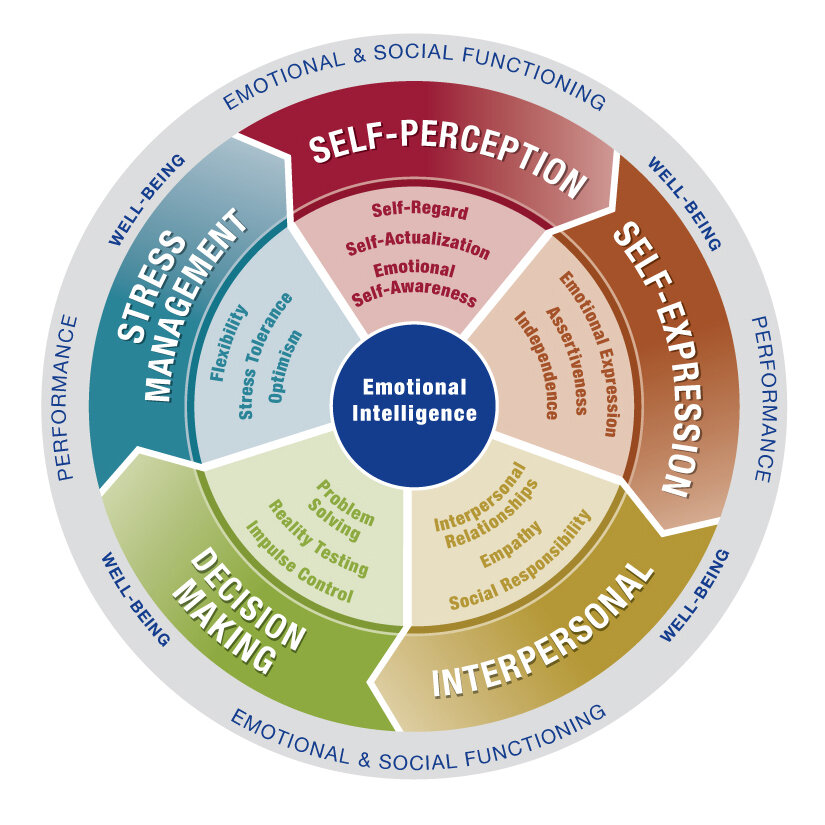
Consider the components in the model above. When making a strategic decision, Problem Solving and Reality Testing (under Decision Making) are obviously important. But so are Emotional Self-Awareness (Self-Perception) and Empathy (Interpersonal).
Imagine a leader deciding on a company-wide restructuring. A purely analytical approach might identify the most cost-effective plan. But a leader with high EQ would use empathy to consider the anxiety and morale impact on employees. They would use Impulse Control to avoid reacting defensively to pushback and Assertiveness to communicate the decision with clarity and confidence, not aggression.
A leader using AHP to decide on the restructuring might define criteria like 'Cost Savings' and 'Efficiency Gains'. An emotionally intelligent leader would add criteria like 'Employee Morale' and 'Retention Risk', ensuring the human impact is formally weighed in the final decision.
A Case Study in Synthesis
Let's look at a scenario. A successful tech company, "Innovate Inc.," is considering acquiring a smaller startup, "Spark AI," known for its groundbreaking machine learning algorithm. The decision is complex.
The Framework: The leadership team uses a decision matrix, a simpler cousin of AHP. Their criteria are: Strategic Fit, Technical Value, Integration Cost, and Cultural Alignment.
The EQ Integration:
- During criteria weighting: The CTO is excited by the tech and wants to give 'Technical Value' the highest weight. The CEO, using self-awareness, recognizes her own bias for rapid growth. She uses
Reality Testingto push the team to give 'Integration Cost' and 'Cultural Alignment' equal consideration, knowing that these are where most acquisitions fail. - During evaluation: When evaluating 'Cultural Alignment', the team doesn't just look at data. They meet with Spark AI's founders. The Head of HR pays close attention to the non-verbal cues and emotional responses (
Empathy) during discussions about values and work styles. She senses a potential clash between Innovate's structured environment and Spark's more chaotic, creative culture. - The Decision: The pure quantitative analysis suggests the acquisition is a good move. However, the qualitative insights gathered through high EQ raise a major red flag about cultural friction. Instead of a full acquisition, they propose a strategic partnership first. This allows them to collaborate and benefit from the technology while giving both cultures time to align, reducing the risk of a costly failure.
This synthesis of a rational framework with emotional intelligence leads to a more nuanced, robust, and ultimately wiser strategic choice.
Time to check your understanding of these advanced concepts.
What is the primary function of pairwise comparison in the Analytic Hierarchy Process (AHP)?
In an AHP pairwise comparison matrix for decision criteria, 'Price' is given a score of 3 against 'Quality'. What does this indicate?
Integrating structured frameworks with emotional intelligence allows you to navigate ambiguity with confidence. It transforms decision-making from a purely analytical exercise into a holistic leadership skill.