Mastering Straight Line Geometry
Gradient Dynamics
Measuring Steepness
Any two points on a flat surface define a straight line. But how steep is that line? We need a precise way to measure this, moving beyond vague terms like “gentle” or “sharp.” In mathematics, we call this measure the gradient, or slope. It’s a single number that tells us exactly how tilted a line is.
The core idea is to compare the vertical change (the “rise”) to the horizontal change (the “run”) between any two points on the line. If you walk from one point to another, how much did you go up or down compared to how much you went forward? This ratio of rise to run gives us the gradient. It’s a consistent value for any two points chosen on the same straight line.
A line's gradient is the ratio of its vertical change to its horizontal change.
The Slope Formula
To calculate the gradient, we formalize the “rise over run” concept. Given two points, and , on a Cartesian plane, we can find the rise by subtracting the y-coordinates and the run by subtracting the x-coordinates. The formula, usually represented by the letter , is:
Let’s find the gradient of a line passing through the points and .
- Assign coordinates: Let be and be .
- Calculate the rise (\\[\[\[\Delta\]\]\]y): .
- Calculate the run (\\[\[\[\Delta\]\]\]x): .
- Find the ratio: .
The gradient of the line is 2. This means that for every 1 unit you move to the right along the line, you move 2 units up.
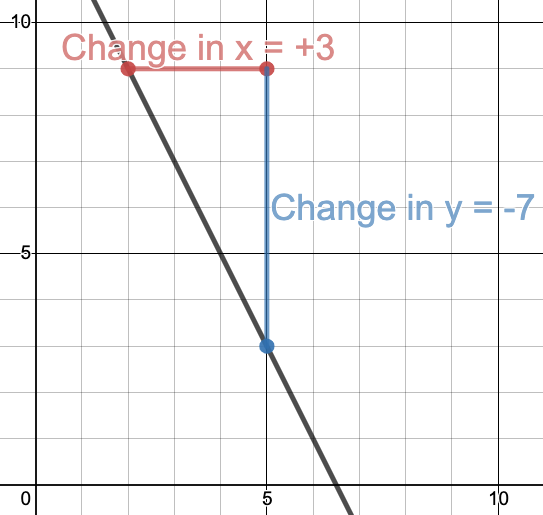
What the Gradient Tells Us
The sign and magnitude of the gradient give us immediate information about the line's direction and steepness. There are four distinct cases.
| Gradient Type | Direction (Left to Right) | Example |
|---|---|---|
| Positive () | Uphill | A ramp going up. |
| Negative () | Downhill | A ski slope. |
| Zero () | Horizontal | A flat floor. |
| Undefined | Vertical | A cliff face. |
A zero gradient occurs on a horizontal line. The y-coordinates of any two points are the same, so the rise () is zero. Since divided by any non-zero number is , the gradient is zero.
An undefined gradient occurs on a vertical line. Here, the x-coordinates are the same, making the run () zero. Since division by zero is undefined in mathematics, the slope is also undefined. It represents infinite steepness.
Gradient as a Rate of Change
Beyond pure geometry, the gradient is one of the most fundamental ways to describe a between two variables. When a graph models a real-world situation, the gradient gains a physical meaning.
For a graph plotting a quantity against a quantity , the gradient represents the rate of change of with respect to .
Think of road steepness, often expressed as a percentage. A sign that says “6% Grade” means that for every 100 feet you travel horizontally, the road elevation changes by 6 feet. The gradient is , or . Engineers and architects use this constantly, from designing highways to ensuring wheelchair ramps comply with accessibility laws, which mandate a maximum gradient for safety.
Now, let's test your understanding of how to calculate and interpret gradients.
What does the gradient of a straight line represent?
What is the gradient of a line passing through the points and ?
Understanding the gradient is a crucial first step. It's the numerical language we use to describe how one quantity changes in relation to another, a concept that extends far beyond simple lines on a graph.