Mastering STEM and Lecture Notes
Understanding Note-Taking
Why Take Notes?
Taking notes isn't just about writing down what you hear. It's an act of learning. When you take notes, you force your brain to engage with the material, decide what's important, and put it into your own words. This process helps you understand concepts more deeply and remember them longer.
Think of it as building a mental framework. Instead of just having a pile of facts, you're creating a structured map of the information. This is especially critical in subjects with a lot of detail, like science and math, or in fast-paced lectures where you need to capture key ideas quickly.
Good notes are a record of your learning journey. They become your personal study guide, tailored to how you understand the world. They show you not just what was said, but what you thought about it.
The Cornell Method
The Cornell Method is a simple yet powerful system for organizing your notes. It divides your page into three distinct sections, each with a specific purpose. You create these sections before the lecture begins.
Here’s how it works:
- Main Notes Area: During the lecture, take notes in this large, right-hand column. Don't worry about being perfect. Use short sentences, abbreviations, and lists to capture as much as you can.
- Cue Column: Soon after the lecture, review your notes. In the smaller, left-hand column, pull out main ideas, keywords, or potential test questions. This step forces you to process the information.
- Summary Area: At the bottom of the page, write a one or two-sentence summary of the entire page's content. If you can summarize it, you probably understand it.
This method turns your notes into an active study tool. You can cover the main notes area and try to recall the information just by looking at your cues.
Outlining and Mind Mapping
Not all topics are best captured with the same structure. Two other popular methods are outlining and mind mapping. Your choice depends on the subject and your personal learning style.
Outlining is perfect for topics that are presented in a clear, hierarchical structure. You use indentation to show the relationship between main topics, sub-topics, and supporting details. It's logical, clean, and easy to review.
I. Photosynthesis A. Inputs 1. Sunlight 2. Water 3. Carbon Dioxide B. Outputs 1. Glucose (Sugar) 2. Oxygen
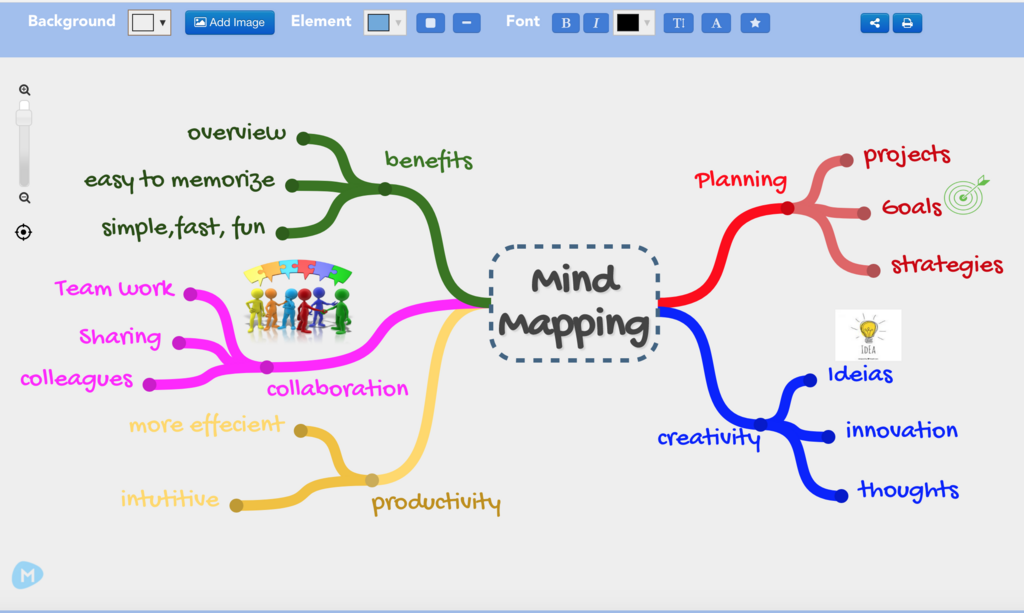
Mind Mapping is a more visual and flexible approach. You start with a central idea in the middle of the page and draw branches outward for major topics. From those branches, you can add smaller sub-branches for details. Mind mapping is great for brainstorming, connecting disparate ideas, and for visual learners who like to see how everything fits together on one page.
Active Listening in Lectures
The biggest challenge in taking notes is often the lecture itself. Professors might speak too quickly, go off on tangents, or present information in a disorganized way. The key to overcoming this is active listening.
Active listening means you're not just a passive recorder. Your goal is to understand the concepts as they're being explained. Don't try to write down every single word. Instead, listen for the main arguments and the evidence that supports them.
How do you spot what's important?
- Pay attention to repetition. If a professor says something more than once, it's a strong signal that it's a core concept.
- Listen for verbal cues. Phrases like "The most important thing to remember is..." or "This will be on the test" are obvious hints. Also listen for introductory phrases like "There are three main reasons for..."
- Watch the slides. Anything written on a slide, especially if it's bolded or bulleted, is usually a key point.
Your notes should be a record of what you understood, not just what was said. It's okay to pause, think, and then write. A few well-understood points are more valuable than pages of verbatim transcription.
Now, let's test your understanding of these note-taking strategies.
What is the primary purpose of taking notes, as described in the text?
In the Cornell Method, the main, large column on the right is used for taking notes during the lecture, while the bottom section is for a brief summary.
Experiment with these methods to find what works best for you. The right technique can make studying more efficient and learning more effective.