Mastering Square Roots and Algorithms
Iterative Approximation Methods
The Quest for Precision
We know that the square root of 9 is 3, because . But what about the square root of 10? Or 2? There's no whole number that multiplies by itself to get these values. The answers are irrational numbers, with decimal expansions that go on forever without repeating.
Finding these values isn't just an academic puzzle. It's a practical problem that engineers, scientists, and programmers face constantly. For centuries, mathematicians have developed clever ways to approximate these roots with incredible accuracy. One of the oldest and most elegant methods comes from ancient Babylon.
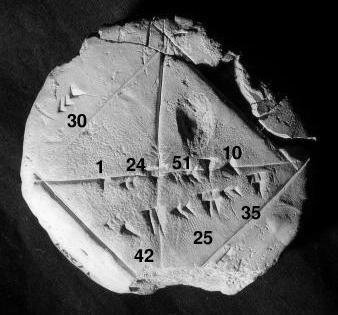
The Babylonian Method
The Babylonian method, also known as Hero's method after the Greek mathematician , is a brilliant way to find successively better approximations of a square root. It's an iterative algorithm, which means we repeat the same steps over and over, getting closer to the true value each time.
The logic is simple. To find the square root of a number , you start with a guess, let's call it . If is the true square root, then will equal . If your guess is too low, then will be too high. If your guess is too high, then will be too low. In either case, the true square root lies somewhere between your guess and the value . So, to get a better guess, you just take their average.
Let's Approximate √2
Let's use the Babylonian method to find the square root of 2. A good initial guess is important, but the method will converge even with a simple one. We'll start with . Here, .
| Iteration | Current Guess () | Calculation: | New Guess () |
|---|---|---|---|
| 1 | 1 | 1.5 | |
| 2 | 1.5 | 1.41666... | |
| 3 | 1.41666... | 1.414215... | |
| 4 | 1.414215... | 1.41421356... |
After just a few steps, we've produced an extremely accurate approximation. The actual value of is approximately 1.41421356237... As you can see, the result from our fourth iteration is already correct to eight decimal places.
This rapid improvement is called . Each step roughly doubles the number of correct digits. This efficiency is why algorithms based on this ancient method are still used in modern computers.
An important part of approximation is deciding when to stop. You could continue iterating forever, but for most practical purposes, you stop when the difference between one guess and the next is smaller than your required margin of error.
Let's try one more example: approximating to three decimal places. We know and , so the answer is between 2 and 3. Let's start with a better initial guess, say .
If we round to three decimal places, our first iteration gave us 2.650 and our second gave us 2.646. Since the third decimal place changed, we should do one more step to be sure.
Now that the result is stable to three decimal places, we can stop. We've found that . This simple, iterative process allows us to find the root of any positive number to any desired degree of accuracy.
What is the primary purpose of the Babylonian method, also known as Hero's method?
According to the Babylonian method, if your guess for the square root of a number is too high, what will be true about the value of ?