Mastering SQL for Professional Data Analysis
Relational Logic Refined
The Logic Behind the Tables
In professional database work, writing a query starts long before you type SELECT. It begins with understanding the structure of the data. The power of a relational database isn't just in storing data, but in how it connects related pieces of information across different tables. This web of relationships is maintained by keys.
A Primary Key (PK) is a column (or set of columns) with a unique value for every row in a table. It's the table's unique identifier, like a national identification number for a person. No two rows can have the same primary key, and it cannot be empty (NULL).
A Foreign Key (FK) is a column in one table that refers to the Primary Key in another table. It's the link, or the relationship, between the two tables. For example, an Orders table would have a CustomerID column that points to the CustomerID primary key in the Customers table. This ensures that every order is linked to a valid, existing customer.
This diagram isn't just a picture; it's a blueprint for writing queries. Seeing the FK-PK links tells you exactly how to JOIN tables to get the information you need, like finding all orders placed by a specific customer.
Keeping Data Trustworthy
Having a logical structure is only half the battle. A database must also guarantee that the data remains accurate and reliable, especially when multiple changes happen at once. This guarantee is known as a transaction. Every set of operations you perform, from a simple INSERT to a complex bulk update, is wrapped in a transaction that must follow four rules, collectively known as properties.
| Property | What It Means | Simple Analogy |
|---|---|---|
| Atomicity | All operations in a transaction succeed, or none of them do. | A bank transfer. Money must be debited from one account AND credited to another. If either step fails, the entire transfer is rolled back. |
| Consistency | The database remains in a valid state before and after the transaction. | You can't book a seat on a flight that doesn't exist. The transaction will fail if it violates the database's rules, like a foreign key constraint. |
| Isolation | Concurrent transactions do not interfere with each other. | Two people trying to book the last seat on a flight. Isolation ensures that only one transaction succeeds, preventing a double booking. |
| Durability | Once a transaction is committed, it will remain so, even in the event of a power loss or system crash. | Once you receive a confirmation for your online purchase, that record is saved permanently. A server reboot won't make your order disappear. |
These properties are especially critical when performing complex Data Manipulation Language (DML) operations. An (or MERGE) operation, for example, updates a row if it exists or inserts it if it doesn't. ACID ensures this two-step logic happens as a single, indivisible action, preventing race conditions where two processes might try to insert the same record simultaneously.
Why So Many Tables?
A common question when viewing a complex schema is, "Why not just put everything in one giant table?" The answer is normalization. Normalization is the process of organizing columns and tables in a relational database to minimize data redundancy and improve data integrity.
Think of it as tidying up a messy spreadsheet. Instead of repeating a customer's name and address for every single item they buy, you store customer information once in a
Customerstable and simply reference their ID.
This process is broken down into stages called normal forms. For most practical applications, understanding the first three is essential.
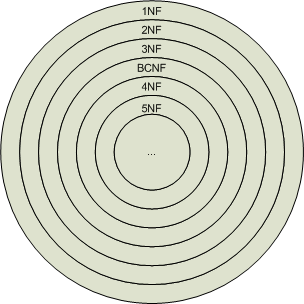
First Normal Form
noun
(1NF) Ensures that every column in a table contains atomic (indivisible) values, and each row is unique. A cell cannot hold a list of values.
Imagine a table where an ItemsOrdered column contains "Laptop, Mouse, Keyboard". This violates 1NF. To fix it, you'd create a separate OrderItems table where each item gets its own row.
Second Normal Form
noun
(2NF) Requires the table to be in 1NF and all non-key attributes to be fully dependent on the entire primary key. This rule applies to tables with composite primary keys.
If our OrderItems table had a composite key of (OrderID, ProductID) and also included ProductName, that would violate 2NF. ProductName depends only on ProductID, not the full key. The fix is to keep ProductName in the Products table where it belongs.
Third Normal Form
noun
(3NF) Requires the table to be in 2NF and all attributes to be dependent only on the primary key, not on other non-key attributes. This eliminates transitive dependencies.
Suppose we added a CustomerCity column to the Orders table. This would violate 3NF. The customer's city depends on the CustomerID, which is a non-key attribute in the Orders table. The city should only be stored in the Customers table. Normalizing to 3NF prevents anomalies, like a customer's city being updated for one order but not another.
Ready to test your understanding of these relational concepts?
What is the primary role of a Foreign Key (FK) in a relational database?
The main goal of database normalization is to put all of a company's data into one large table for easy access.
Understanding these principles of structure, integrity, and normalization is the difference between simply writing queries and designing efficient, reliable database solutions.