Mastering Spoken English Fundamentals
Pronunciation Basics
The Building Blocks of Sound
When we speak, we're really just making a series of sounds. Mastering English pronunciation starts with understanding these individual sounds. Think of them like LEGO bricks: you combine them in different ways to build words.
Every sound in English falls into one of two categories: vowels or consonants. The main difference is how you use your breath and mouth to produce them. Getting these fundamentals right is the key to speaking clearly and being understood.
Vowel Sounds
Vowel sounds are made with an open vocal tract. This means that when you say a vowel, the air flows freely from your lungs out through your mouth without being blocked by your tongue, teeth, or lips. The shape of your mouth and the position of your tongue are what change the sound.
vowel
noun
A speech sound produced by the comparatively open configuration of the vocal tract, with the tongue not touching the lips, teeth, or roof of the mouth.
Although the English alphabet has only five vowel letters (a, e, i, o, u), they represent about 20 different vowel sounds. This is one of the biggest challenges for learners. Vowels can be short, like the 'a' in cat, or long, like the 'a' in cake. Small changes in your tongue or lip position create entirely different sounds and words.
For example, the words sit and seat are only different because of their vowel sound. The first has a short, relaxed vowel, while the second has a long, tense vowel where your mouth is stretched more to the sides.
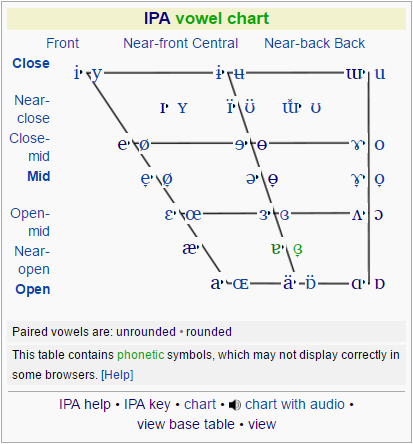
This chart shows how different vowels are formed in the mouth. Vowels on the left like /i/ (as in "see") are made with the front of the tongue, while vowels on the right like /u/ (as in "too") are made with the back. Vowels at the top are made with the tongue high in the mouth, and vowels at the bottom are made with the tongue low.
Consonant Sounds
Consonants are the opposite of vowels. To make a consonant sound, you block or restrict the airflow in some way using your tongue, teeth, or lips. This obstruction is what creates the sound.
consonant
noun
A speech sound that is articulated with complete or partial closure of the vocal tract.
One important feature of consonants is voicing. A consonant is either voiced (your vocal cords vibrate) or voiceless (they don't). This is the only difference between sounds like /s/ and /z/, or /p/ and /b/.
Try this: Place your fingers gently on your throat. Now, say "ssssss" like a snake. You shouldn't feel much vibration. Next, say "zzzzzz" like a bee. Feel that buzz? That's voicing. The 's' is voiceless, and the 'z' is voiced.
Common Challenges
Certain sounds in English can be tricky because they might not exist in your native language. Let's look at a few common ones.
| Sound (IPA) | Example Word | Common Mistake | Tip |
|---|---|---|---|
| /θ/ (voiceless) | think | Pronouncing it as 's', 't', or 'f'. | Place the tip of your tongue lightly between your front teeth and blow air. |
| /ð/ (voiced) | this | Pronouncing it as 'z' or 'd'. | Same tongue position as /θ/, but this time, vibrate your vocal cords (feel the buzz!). |
| /r/ | red | Rolling the 'r' or using a sound from the back of the throat. | The English /r/ is soft. Curl the tip of your tongue up and back slightly, without touching the roof of your mouth. |
| /l/ | light | Pronouncing it from the back of the throat. | Press the tip of your tongue against the ridge just behind your top teeth. |
Finally, clusters of consonants, like the 'str' in street or the 'xths' in sixths, can be difficult. The key is to practice them slowly. Say each sound in the cluster separately, then gradually speed up until you can say them smoothly together.
What is the primary physical difference in how vowel and consonant sounds are produced?
The main pronunciation difference between the words sit and seat is due to a change in the...