Mastering Smoke on the Water Guitar Riff
Guitar Basics
Know Your Instrument
Before you can play, it helps to know your way around the guitar. Think of it like learning the names of the pieces on a chessboard. Each part has a specific job.
The most important parts for now are the strings, frets, and tuning pegs.
The strings create the sound. Most guitars have six. The thinnest one, closest to the floor when you're playing, is the 1st string. The thickest one, closest to the ceiling, is the 6th string.
The frets are the metal bars on the neck. When you press a string down behind a fret, you shorten the string's vibrating length, which changes its pitch to a higher note.
Getting in Tune
An out-of-tune guitar sounds wrong, no matter how well you play. Tuning is the first step every single time you pick up the instrument. The goal is to make each open string (played without pressing any frets) vibrate at a specific pitch.
Standard tuning, from the thickest string (6th) to the thinnest (1st), is E-A-D-G-B-E. A simple way to remember this is with a mnemonic like Eddie Ate Dynamite, Good Bye Eddie.
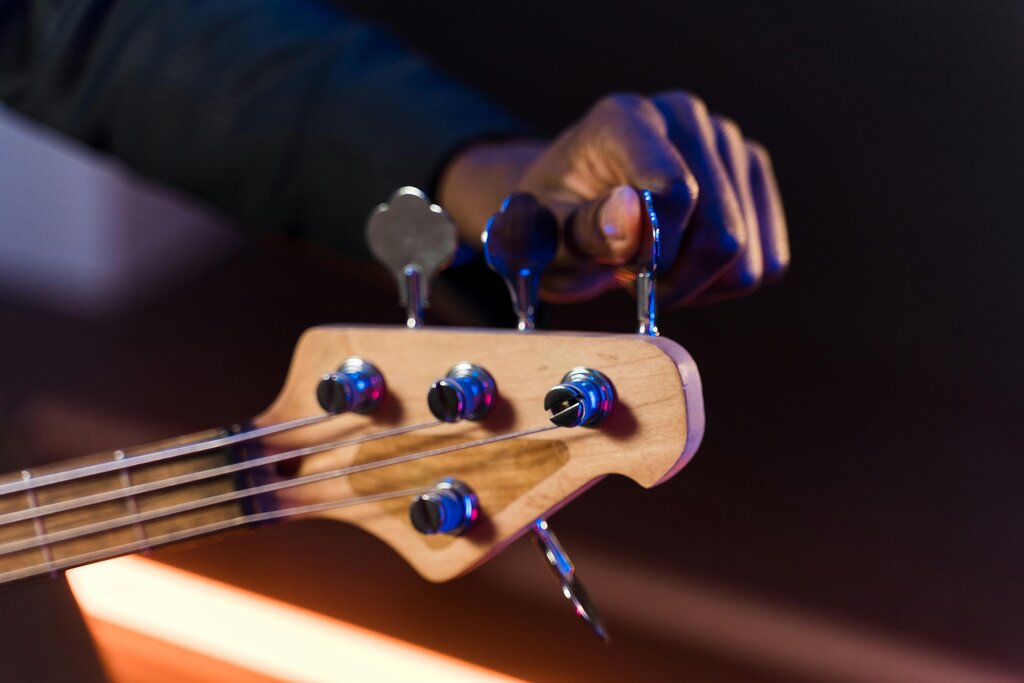
The easiest way to tune is with an electronic tuner. This can be a clip-on device, a pedal, or an app on your phone. To use one, pluck a single string and let it ring out. The tuner will tell you if the note is sharp (too high) or flat (too low).
- If the note is flat, turn the string's tuning peg to tighten it. This raises the pitch.
- If the note is sharp, turn the peg to loosen the string. This lowers the pitch.
Make small adjustments until the tuner shows you're right on the target note. Do this for all six strings.
Making Notes
Now let's make some noise. Playing guitar involves two distinct actions working together: fretting notes with one hand and picking the strings with the other.
Fretting
Fretting is the job of your non-dominant hand (your left hand, if you're right-handed). This hand presses the strings onto the fretboard.
To get a clear sound, you need to press down firmly, right behind the fret, not on top of it. Use the very tip of your finger, not the flat pad. Keep your finger curved, like you're holding a ball. This prevents your finger from accidentally touching and muting the other strings.

Try this: Place your index finger on the 3rd fret of the 5th string (the A string). Press down just behind the metal fret wire and try to get a clean note when you pluck it. If you hear a buzzing sound, you might need to press harder or adjust your finger position closer to the fret.
Picking
Picking is done with your dominant hand. This is the hand that strikes the strings to make them vibrate. You can use your thumb, your fingers, or a pick (also called a plectrum).
For rock songs like "Smoke on the Water," a pick is essential for getting the right attack and tone. Hold the pick between your thumb and the side of your index finger. Only a small tip of the pick should stick out.
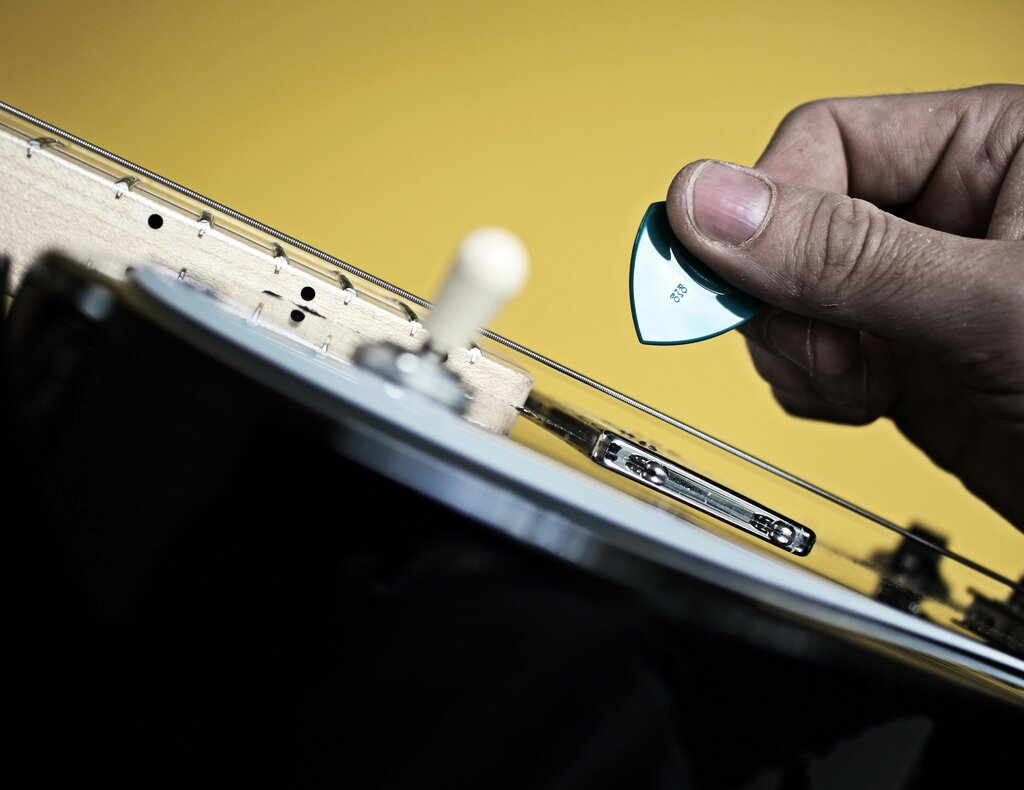
When you strike a string, use a relaxed wrist motion. The movement should come from your wrist, not your whole arm. Try picking down towards the floor, then up towards the ceiling. This is called alternate picking, and it's a fundamental skill.
Practice picking each of the six open strings one by one, aiming for a consistent, even sound on every pluck.
The key is coordination. Your fretting hand chooses the note, and your picking hand plays it. Start slowly, focusing on making each note ring out clearly.
Let's check your understanding of these core concepts.
What is the standard tuning for a six-string guitar, from the thickest string (6th) to the thinnest (1st)?
If your electronic tuner indicates a string is "flat," what should you do?
With these basics down, you have the foundation you need to start learning your first riffs.