Mastering Single Beam Spectrophotometry
Single Beam Architectures
The Straight-Line Approach
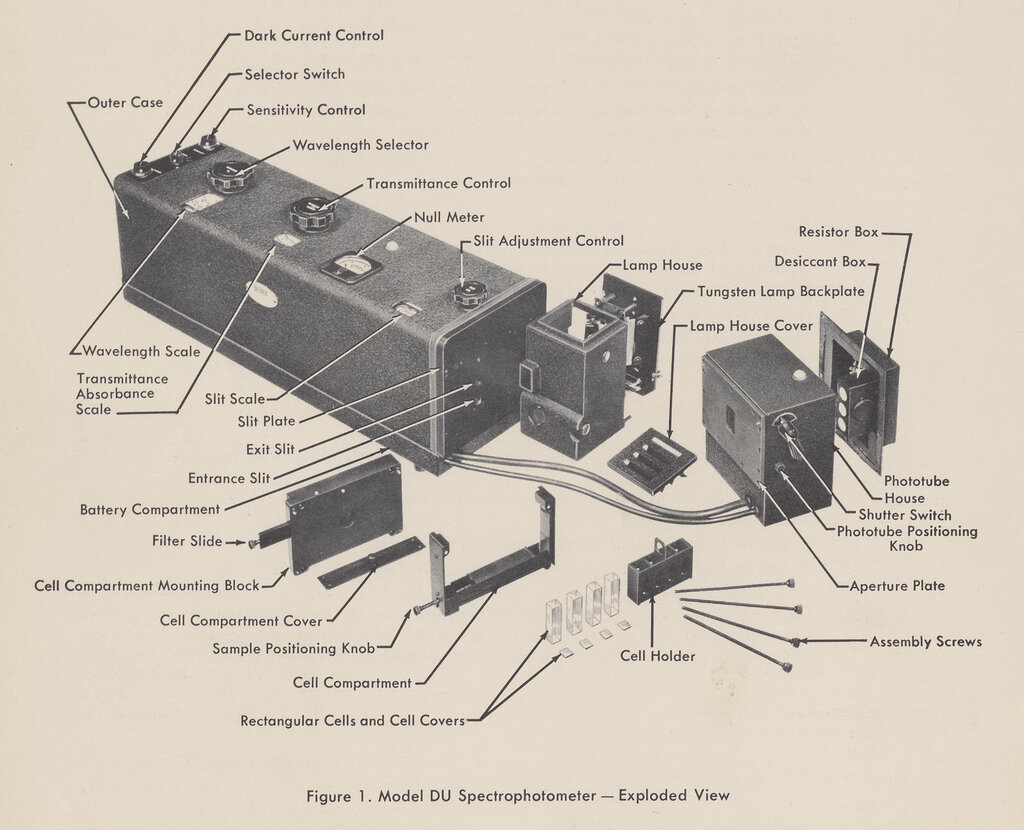
A single-beam spectrophotometer is designed for simplicity. Its components are arranged in a direct, linear path, often called an optical bench. This layout ensures that the maximum amount of light energy travels from the source to the detector, a key advantage of this design.
The journey of light follows a specific sequence:
- Light Source: A lamp, typically tungsten or deuterium, produces a broad spectrum of light.
- Monochromator: This device, often a prism or diffraction grating, isolates a specific, narrow wavelength of light from the source.
- Sample Cell: The selected wavelength of light passes through the sample, which is held in a small, transparent container called a cuvette.
- Detector: A photosensitive detector measures the intensity of the light that successfully passes through the sample.
A Two-Step Measurement
Because there is only one light path, a single-beam instrument cannot measure the sample and a reference at the same time. Instead, it uses a sequential process. First, you must establish a baseline.
You start by measuring a 'blank'—a cuvette containing the solvent used to dissolve your sample. This measurement allows the instrument to define 100% transmittance (or zero absorbance) for that specific solvent at that wavelength. Essentially, you're telling the instrument to ignore any light absorbed by the solvent and the cuvette itself.
After setting the baseline with the blank, you replace it with the cuvette containing your sample. The instrument then performs a second measurement. Any decrease in light intensity detected is attributed solely to the substance you're analyzing. The final reading is a comparison of the sample's light transmission to the blank's.
Simplicity and Its Challenges
The main advantage of the single-beam design is its high light throughput. With fewer optical components like beam-splitters, more of the original light energy reaches the detector. This results in a strong signal and good sensitivity, especially at the extremes of the instrument's wavelength range.
The design's simplicity also makes it robust and less expensive. However, this comes with a significant trade-off. The time delay between measuring the blank and the sample introduces a potential error known as source drift., which can affect the accuracy of your results.
Source drift refers to slow, random fluctuations in the intensity of the light source, often caused by small changes in voltage or the aging of the lamp. Because the blank and sample are measured minutes apart, any drift in the lamp's output between these two readings will be incorrectly interpreted as part of the sample's absorbance. For highly precise work, this requires frequent re-calibration with the blank to ensure the baseline hasn't shifted.
Imagine trying to weigh flour, but your kitchen scale's reading slowly wanders up and down. If you zero the scale, then wait five minutes to weigh your flour, the final measurement might be off because the scale's zero point has drifted.
Now, let's test your understanding of how single-beam systems work.
What is the correct sequence of components in the optical path of a single-beam spectrophotometer?
What is the primary advantage of the single-beam spectrophotometer design?
While simple, the single-beam architecture forms the foundation for many spectroscopic instruments and its principles are essential for understanding more complex designs.