Mastering Sine and Cosine in Vector Geometry
Reference Angle Identification
Beyond the X-Axis
In introductory examples, vectors often start at the origin and make a neat angle with the positive x-axis. The real world is rarely so tidy. Vectors can be attached to objects on slopes, hung from ceilings, or oriented in any direction. The key to breaking them down, or decomposing them, isn't memorizing a formula, but correctly identifying the reference angle and its relationship to the vector's components.
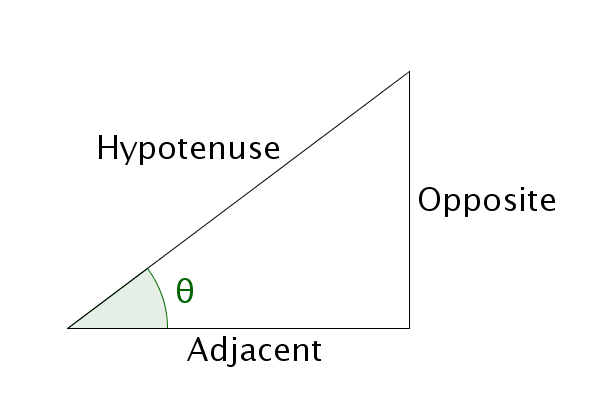
Your choice of reference angle dictates which trigonometric function you'll use for each component. There is no universal rule that cosine always goes with the x-component. It all depends on where the angle is measured from.
Horizontal vs. Vertical Angles
Problems often describe an angle in one of two ways: relative to the horizontal or relative to the vertical. An angle of elevation is a classic example of an angle measured from the horizontal. But you might also be given an angle measured from a vertical line, like a lamp post or the y-axis.
Look at the diagram above. If we choose to work with angle (measured from the horizontal), then the horizontal component is adjacent to , and the vertical component is opposite.
But if we use angle (measured from the vertical), the relationship flips. Now, the vertical component is adjacent to , and the horizontal component is opposite.
Notice how the functions switched. The component adjacent to the angle uses cosine, and the component opposite uses sine. This is the only rule you need to remember.
| Angle Used | Horizontal Component () | Vertical Component () |
|---|---|---|
| θ (from horizontal) | (Adjacent) | (Opposite) |
| φ (from vertical) | (Opposite) | (Adjacent) |
Finding Your Angle in Diagrams
In physics, diagrams can get crowded. Forces, accelerations, and dimensions are all layered on top of each other. Often, the angle you're given isn't inside the vector triangle you need to solve. This is where basic geometry comes in handy.
When a straight line intersects two parallel lines, it creates pairs of equal angles. For force diagrams, the most useful of these are . If you can identify a Z-shape in your diagram, the angles in the corners of the 'Z' are equal. This is extremely common when dealing with forces on an inclined plane.
In the inclined plane diagram, the angle of the incline, , is the same as the angle between the gravitational force vector () and the component perpendicular to the plane ().
Once you've transferred the angle into your force triangle, you can apply the same logic as before. Relative to this angle , the parallel component () is opposite, and the perpendicular component () is adjacent.
Mastering this skill—finding the right angle and identifying the adjacent and opposite sides relative to it—is more than half the battle in any vector problem.