Mastering Seventh Grade Mathematics
Integer Operations Mastery
Beyond Zero
You're already familiar with whole numbers (0, 1, 2, 3...) and how to add, subtract, multiply, and divide them. Now, let's expand our toolkit. Integers include all the whole numbers, their negative counterparts (..., -3, -2, -1), and zero itself. Think of them as steps on an infinitely long ladder, with zero as the middle rung.
Integer
noun
A whole number that can be positive, negative, or zero. It cannot be a fraction or a decimal.
A number line is the best way to visualise this. Positive numbers live to the right of zero, and negative numbers live to the left. The further a number is from zero, the greater its magnitude.
Absolute Value
Sometimes, we only care about a number's distance from zero, not its direction. This is called its or magnitude. A submarine 100 metres below sea level (-100 m) is the same distance from the surface as a kite flying 100 metres high (+100 m). Both have an absolute value of 100.
We show absolute value by putting two vertical bars around the number.
Operating with Integers
Adding and subtracting integers is like moving along the number line. Adding a positive number moves you to the right. Adding a negative number (or subtracting a positive number) moves you to the left.
Think of a bank account. If you have £50 and deposit £20, you move right on the number line to £70. If you spend £30, you move left to £20. What if you have £20 and spend £30? You move 30 steps left, past zero, landing on -£10. You're overdrawn.
Subtracting a negative number is the same as adding a positive. For example, $5 - (-3)$ is the same as $5 + 3$, which equals 8. Imagine you owe someone £3 (a debt of -£3). If they cancel that debt, it's like they gave you £3.
Multiplication and division follow a simple set of rules based on the signs. When the signs are the same, the result is positive. When the signs are different, the result is negative. This pattern was observed by mathematicians like centuries ago, who noticed that the product of two differences, like , required a consistent system for signs.
| Operation | Example | Result |
|---|---|---|
| (+) × (+) | 3 × 4 = 12 | Positive |
| (–) × (–) | -3 × -4 = 12 | Positive |
| (+) × (–) | 3 × -4 = -12 | Negative |
| (–) × (+) | -3 × 4 = -12 | Negative |
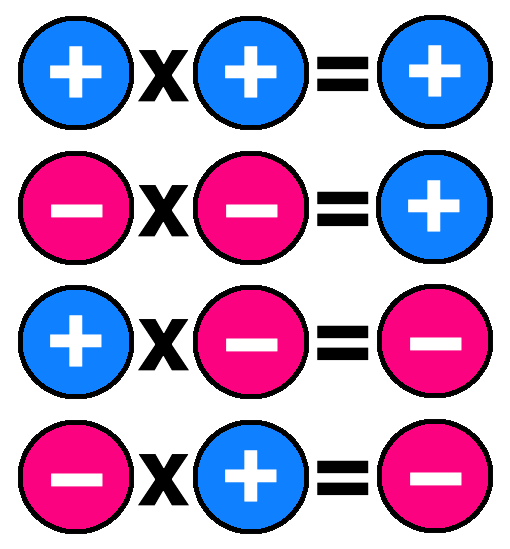
The exact same rules apply to division. For example, -12 div 3 = -4, but -12 div -4 = 3.
Integers in the Real World
Integers are everywhere.
- Temperature: A temperature of -5°C is colder than 2°C. If it drops by 10 degrees from 2°C, the new temperature is .
- Elevation: A diver at 20 metres below sea level is at an elevation of -20 m. If they ascend 5 metres, their new position is m.
- Finance: If you have £100 in your account and you write a cheque for £120, your balance becomes . Your account is overdrawn by £20.
Connecting integer operations to real-life scenarios like money, temperature, or altitude makes abstract concepts more concrete.
Understanding how to work with these numbers is fundamental for everything from managing your money to understanding scientific data.
Ready to test your knowledge?
Which of the following best describes the set of integers?
What is the absolute value of -15, written as ?
Mastering integers opens the door to more advanced topics in mathematics, especially algebra. They provide the complete number line, giving us a way to describe quantities on both sides of zero.