Mastering S.E.R.E. Tactics and Resilience
Tactical Stealth Principles
From Surviving to Evading
Basic wilderness survival focuses on staying alive. Tactical survival focuses on staying free. This is the core of the 'Return with Honor' methodology. It's a fundamental shift in mindset. In a tactical environment, nature isn't your only challenge; an active adversary is looking for you. Every survival task, from finding water to building a shelter, must be executed with one primary goal: to remain undetected.
In this context, survival isn't just about enduring the elements. It's about managing your signature. Detection equals capture.
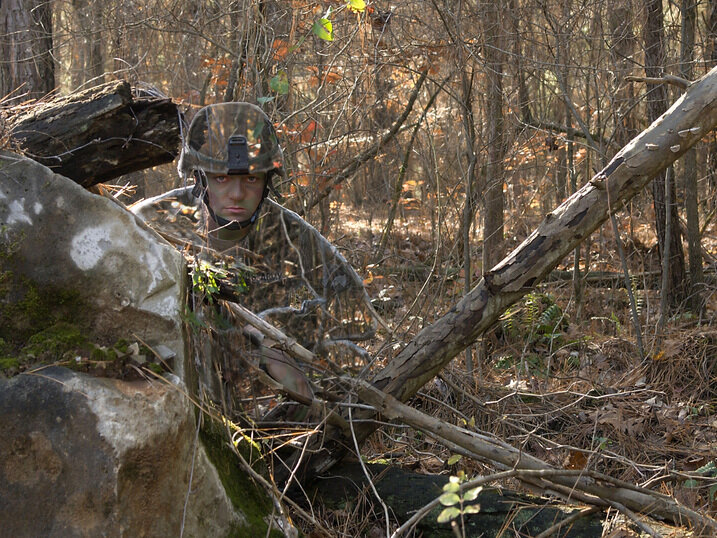
A signature is any sign of your presence. It can be visual, like a poorly camouflaged shelter. It can be olfactory, like the smell of woodsmoke. Or it can be auditory, like the snap of a twig underfoot. To evade capture, you must learn to erase your trace from the landscape. This requires a disciplined approach to every action, guided by a simple but effective framework.
The BLISS Framework
To minimize your signature, use the BLISS acronym as a mental checklist for every decision. It forces you to consider how every action appears to a potential observer.
| Acronym | Principle | Application |
|---|---|---|
| B | Blend-in | Match your shape, color, and texture to the immediate surroundings. Break up the distinct human silhouette. |
| L | Low-profile | Stay as close to the ground as possible. Use natural depressions and avoid skylines. |
| I | Irregular-shape | Nature avoids perfect lines and angles. Make shelters and hides mimic natural formations, not geometric shapes. |
| S | Small | Keep your footprint minimal. A small shelter, a small fire, and small movements are harder to detect. |
| S | Secluded | Choose locations that offer natural concealment and are off of obvious paths and clearings. |
Applying this framework consistently is the difference between blending into the terrain and standing out against it. It's an active, constant process of threat assessment.
Shelter and Fire Without a Trace
Your shelter is your most significant potential signature. A standard A-frame tarp shelter screams 'human presence.' Instead, select a site that already provides most of your cover, like a dense thicket, a rock overhang, or the root ball of a fallen tree. Augment this natural cover with local debris—leaves, branches, soil—to create a low-profile shelter that looks like a natural part of the landscape.
Fire is another major liability. The light, smoke, and smell can give away your position from miles away. When a fire is absolutely necessary for warmth or boiling water, you must conceal it. The best method for this is a Dakota Fire Pit.
Unlike a surface fire, a Dakota pit hides the flames below ground level, masking the light and containing the smoke. It also burns hotter and more efficiently with less wood, a key advantage when gathering fuel must also be done stealthily.
Even with a Dakota pit, you must manage the signature. Use only dry, dead hardwood, as it produces the least smoke. Keep the fire small. When you're done, extinguish it completely, fill in the holes, and scatter natural debris over the area to make it look undisturbed. The goal is to leave no evidence you were ever there.
Water procurement follows the same rules. Avoid drawing water from open sources in the middle of the day. Approach streams and ponds from concealed positions, preferably during low-light hours. If you must purify by boiling, use the Dakota pit. Otherwise, use chemical tablets or a filter, which create no signature at all.
Ready to test your knowledge?
What is the primary distinction between basic wilderness survival and tactical survival?
Which of the following is the most significant visual signature you might create in a survival situation?
Mastering these stealth principles is about building disciplined habits. By constantly thinking through the BLISS framework, you can turn the landscape from a place of exposure into an asset for concealment.