Mastering Sea Navigation
Introduction to Sea Navigation
What is Navigation?
At its core, navigation is about answering two simple questions: "Where am I?" and "How do I get where I want to go?" It’s the process of planning a route, figuring out your current location, and then directing your vessel to its destination. Whether you're crossing a vast ocean or just sailing along the coast, these two questions are your constant companions.
Think of it like driving a car in a new city without a map or GPS. You might know your destination is
The fundamental principle of navigation is to determine your position and then set a course to follow. Everything else builds on this foundation.
Early sailors didn't have satellites or complex electronics. They used what they had: the sun, the stars, the wind, and the ocean itself. They learned to read the patterns of the waves and follow the flight of birds. While our tools have become incredibly sophisticated, the basic principles remain the same.
Today, maritime academies worldwide still teach celestial navigation as a backup skill, following IMO Model Courses and STCW (Standards of Training, Certification and Watchkeeping for Seafarers) guidelines.
Knowing Your Place
Why is it so critical to know exactly where you are? An error of just a few miles can be the difference between reaching a safe harbor and running aground on hidden rocks. Inaccurate position fixing can lead you into dangerous shipping lanes, territorial waters, or severe weather systems. Safety at sea starts with knowing your precise location.
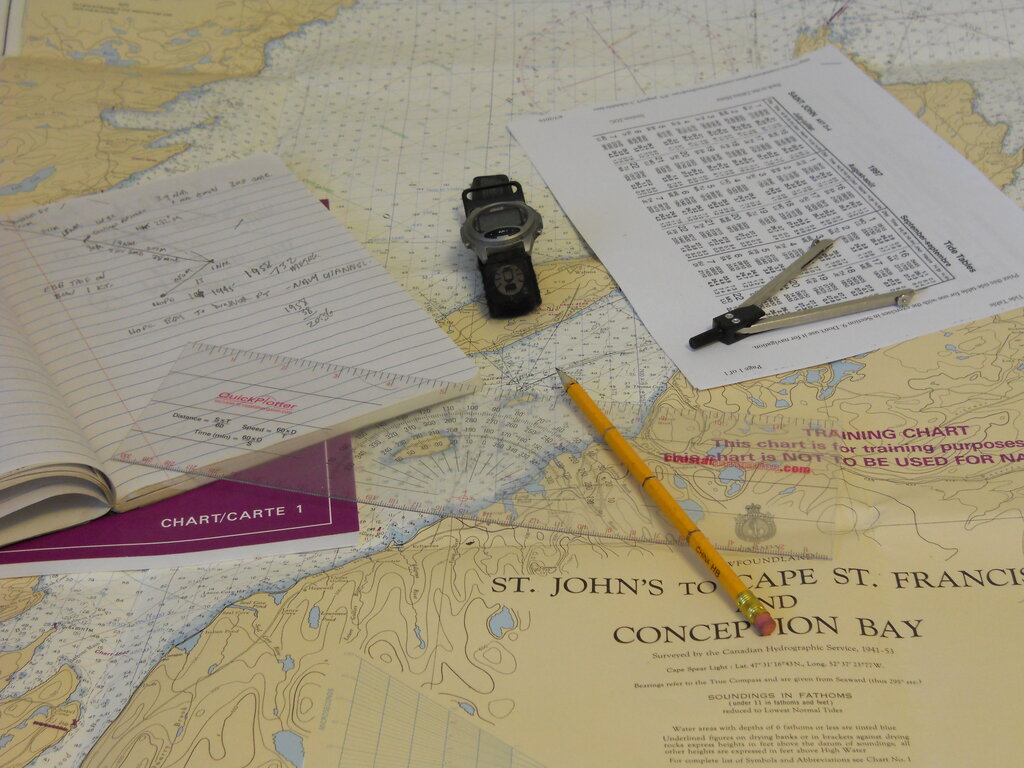
This process is called 'position fixing.' A 'fix' is a confirmed location of your vessel on a chart. To get a reliable fix, navigators traditionally use information from at least two different sources. This cross-referencing helps confirm the accuracy of the position.
For example, a navigator might take a bearing on a known lighthouse and another on a prominent headland. Where those two lines of position intersect on the nautical chart is the boat's fix. With modern technology, we might use signals from multiple GPS satellites. The principle is the same: intersecting lines from known points give us our location.
Tools of the Trade
Navigators have a toolbox of methods and instruments, ranging from ancient techniques to modern digital systems. They often use multiple tools together for accuracy and as a backup in case one system fails.
Here’s a quick overview of the main categories:
| Technique | Description | Key Tools |
|---|---|---|
| Piloting | Navigating using visible references on land or sea, like lighthouses, buoys, and distinct coastal features. Primarily used near the coast. | Nautical charts, compass, binoculars |
| Dead Reckoning | Estimating your position by starting from a known point and calculating your course, speed, and the time traveled. It's the basis of all navigation. | Compass, log (for speed), clock, charts |
| Celestial Navigation | Using the sun, moon, planets, and stars to determine your position. A timeless skill that works anywhere on Earth, day or night (with visible bodies). | Sextant, chronometer, nautical almanac |
| Electronic Navigation | Using electronic equipment to determine your position. This is the most common method today due to its high accuracy and ease of use. | GPS, radar, electronic chart plotters |
Without GPS or advanced tools, sailors depended on natural cues, such as observing the stars, sun, and horizon, to determine their position and course.
A good navigator never relies on a single tool. What if the GPS fails? What if clouds obscure the stars? By understanding the principles behind each technique, you can use the best method for the situation and always have a backup plan. This blend of old and new skills is what makes a truly competent mariner.
Ready to check your understanding?
At its most fundamental level, navigation is the process of answering which two questions?
According to the text, why is an accurate 'position fix' so critical for a sailor?
Mastering these fundamentals is the first step on a long and rewarding journey. With a solid grasp of what navigation is, why it's important, and the tools involved, you're ready to explore the specific techniques that will get you safely across the water.