Mastering Scientific Research Methods
Advanced Hypothesis Construction
Beyond the Educated Guess
You already know that a hypothesis is more than just a random guess. It's an informed prediction based on observation. But to move from a good idea to rigorous science, we need a sharper tool. The key isn't proving an idea right, but proving it wrong.
This concept is called falsifiability. Championed by the philosopher Karl Popper, it's what separates scientific inquiry from other ways of thinking. A truly scientific claim is one that can be tested and potentially proven false. For example, the statement "all swans are white" is scientific because finding just one black swan would falsify it. In contrast, the statement "an invisible, undetectable dragon lives in my garage" isn't scientific because there's no experiment you could run to disprove it.
For Popper, the hallmark of a scientific theory is falsifiability: it must make risky, testable predictions that could in principle be refuted by observation.
This principle forces us to make specific, measurable predictions. It’s the foundation for how we structure formal hypotheses in any scientific field.
The Null and Alternative
Every formal test starts with two competing statements: the null hypothesis and the alternative hypothesis. Think of it as a scientific debate where you're trying to knock down the default argument.
The Null Hypothesis () is the default assumption, the position of "no effect" or "no difference." It states that any variation you see in your data is due to random chance. It’s the statement you are trying to find evidence against.
The Alternative Hypothesis ( or ) is what you, the researcher, actually believe to be true. It's the claim that there is an effect or a difference, and it's not just due to chance. Your goal is to gather enough evidence to reject the null hypothesis in favor of the alternative.
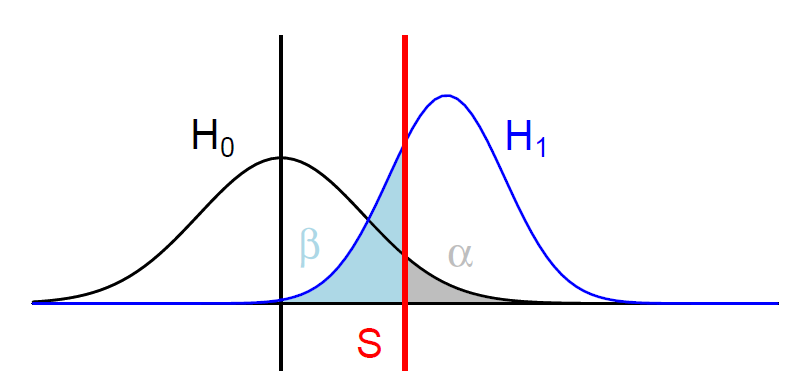
Let’s say you're testing a new fertilizer. The null hypothesis would be that the new fertilizer has no effect on plant growth compared to the standard fertilizer. The alternative hypothesis would be that it does have an effect.
Direction Matters
Your alternative hypothesis can be either directional or non-directional. This choice affects how you design your experiment and interpret your results.
A non-directional hypothesis states that there will be a difference between groups, but doesn't specify which way the difference will go. It uses a "not equal to" logic.
For our fertilizer example, a non-directional hypothesis would be: "The new fertilizer will have an effect on plant growth compared to the standard one." This means you're open to the possibility that it could be better or worse.
A directional hypothesis is more specific. It predicts the direction of the effect. You're not just saying there's a difference; you're saying one group will have a higher or lower value than the other.
A directional version would be: "The new fertilizer will increase plant growth compared to the standard one." This is a bolder, more specific claim.
Choosing a directional hypothesis is often preferred when you have strong prior evidence suggesting a specific outcome. It provides a more powerful statistical test, but it also means you're ignoring the possibility of an effect in the opposite direction.
From Vague Idea to Testable Statement
The final step is to refine a broad question into a precise, testable hypothesis. This involves operationalizing your variables, which means defining them in concrete, measurable terms.
Let's start with a vague observation: "Plants grow better with more light."
This is a good start, but it's not testable. What kind of plant? What does "better" mean? How much is "more light"? We need to get specific.
| Vague Concept | Operationalized Variable |
|---|---|
| Plants | Phaseolus vulgaris (common bean) seedlings |
| Grow better | Increase in biomass (grams) over 30 days |
| More light | 12 hours of 5000K LED light daily |
| Control group | Plants exposed to ambient, natural sunlight for the same duration |
By operationalizing, we transform the idea into a structure that can be tested. We can now construct a formal, falsifiable hypothesis using an "If-Then" format to link our independent variable (light condition) and dependent variable (biomass).
If Phaseolus vulgaris seedlings are exposed to 12 hours of 5000K LED light daily, then their biomass will increase by at least 20% more than seedlings exposed only to natural sunlight over a 30-day period.
Now, we can clearly state our null and alternative hypotheses:
: There is no difference in biomass gain between the LED group and the natural sunlight group.
: The LED group will have at least 20% greater biomass gain than the natural sunlight group.
This hypothesis is specific, measurable, and falsifiable. If the experiment shows a 5% increase, or even a 15% increase, we must reject our alternative hypothesis. This level of rigor is what allows science to build knowledge reliably.
According to the principle of falsifiability, which of the following statements is a truly scientific claim?
In a scientific experiment, what is the primary role of the null hypothesis ()?
By moving from simple questions to structured, falsifiable hypotheses, you equip yourself with the core logic of scientific investigation.