Mastering Science Reading
Scientific Language Basics
The Language of Science
Science has a language all its own. It's built on precise terms, universal measurements, and shorthand symbols. This isn't to make things complicated; it's to make them clear. When a scientist in Japan reads a paper by a researcher in Brazil, they need to know they're talking about the exact same thing. This shared language makes global collaboration possible.
Think of it like a recipe. If one cook uses "a pinch" of salt and another uses a gram, the results will be wildly different. Scientific language ensures everyone is using the same recipe, with the same measurements, to get reliable results every time.
Building Blocks of Scientific Words
Many scientific terms look intimidating because they come from Greek and Latin roots. But this is actually a feature, not a bug. Once you learn a few common prefixes (beginnings) and suffixes (endings), you can deconstruct complex words and figure out their meaning.
For example, the word "biology" combines the Greek root bio- (life) with -logy (the study of). So, biology is simply the study of life.
| Part | Meaning | Example |
|---|---|---|
| photo- | light | photosynthesis (making things with light) |
| therm- | heat | thermometer (measures heat) |
| hydro- | water | hydrolysis (breaking down with water) |
| micro- | small | microscope (tool to see small things) |
| macro- | large | macromolecule (a large molecule) |
| -ology | the study of | geology (the study of the Earth) |
| -meter | measure | barometer (measures pressure) |
By learning these building blocks, you gain a key to unlock the meaning of hundreds of scientific terms. You can start seeing patterns everywhere.
A Universal Measuring Stick
Just as words need precise meanings, measurements need precise standards. Imagine the confusion if scientists measured length in feet, cubits, and paces all in the same report. To avoid this, scientists around the world use the International System of Units, or SI. It’s the modern form of the metric system.
This system provides a single, universal standard for fundamental quantities like length, mass, and time. Using SI units ensures that an experiment conducted in one lab can be accurately replicated in another, anywhere on Earth.
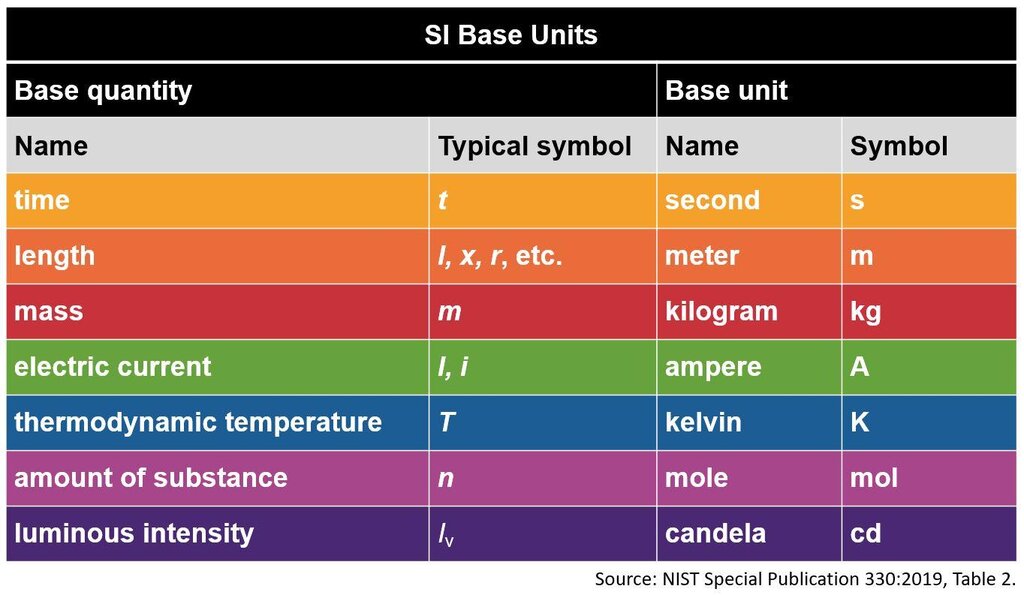
The table above shows the seven base units. For example, length is always measured in meters (m), mass in kilograms (kg), and time in seconds (s). All other units, like speed (meters per second) or volume (cubic meters), are derived from these seven fundamental pillars.
Symbols as Shortcuts
Symbols and notations are the shorthand of science. They allow scientists to express complex ideas and relationships quickly and without ambiguity. Writing "H₂O" is much faster than writing "a molecule containing two hydrogen atoms and one oxygen atom."
These symbols are universal. A chemical formula or a mathematical equation means the same thing in any language. They pack a huge amount of information into a small space.
| Symbol | What it Represents | Field |
|---|---|---|
| The speed of light | Physics | |
| Fe | The element iron | Chemistry |
| Change in a quantity | Math, Physics, Chemistry | |
| DNA | Deoxyribonucleic acid | Biology |
| Newton's Second Law of Motion | Physics |
Learning to read these symbols is like learning to read a new alphabet. It opens up a deeper understanding of the scientific world and the principles that govern it.
Ready to test your knowledge of scientific language?
Why is a universal, precise language considered essential in the scientific community?
The use of Greek and Latin roots in scientific terminology is a 'feature, not a bug' because it allows someone to:
Understanding these basic elements—terminology, units, and symbols—is the first step toward scientific literacy. With this foundation, you're better equipped to read, interpret, and discuss science.