Mastering SAT Math
Foundations of Algebra
Beyond Whole Numbers
Algebra builds on the arithmetic you already know, but it expands the toolkit to handle all kinds of numbers, not just simple integers. A big part of this is working confidently with rational numbers, which are just numbers that can be written as a fraction. This includes integers, fractions, and decimals.
When adding or subtracting fractions, the key is to find a common denominator. You can't add thirds and fourths directly, just like you can't add apples and oranges. You need to convert them to a common unit, like twelfths.
Multiplication and division are more straightforward. To multiply fractions, you just multiply the numerators together and the denominators together. To divide, you flip the second fraction (find its reciprocal) and then multiply.
These same rules apply when you see variables in fractions, which is common in algebra.
The Rules of Exponents
Exponents are a shorthand for repeated multiplication. Instead of writing , we can just write . As expressions get more complex, we need a few rules to keep things organized.
| Rule Name | Algebraic Rule | Example |
|---|---|---|
| Product Rule | ||
| Quotient Rule | ||
| Power of a Power | ||
| Zero Exponent | ||
| Negative Exponent |
A negative exponent doesn't make the number negative. It means you take the reciprocal. For example, is , not .
Solving for the Unknown
The heart of algebra is solving equations to find the value of an unknown variable. A linear equation is one where the variable isn't raised to any power higher than one. Think of an equation as a balanced scale. Whatever you do to one side, you must do to the other to keep it balanced.
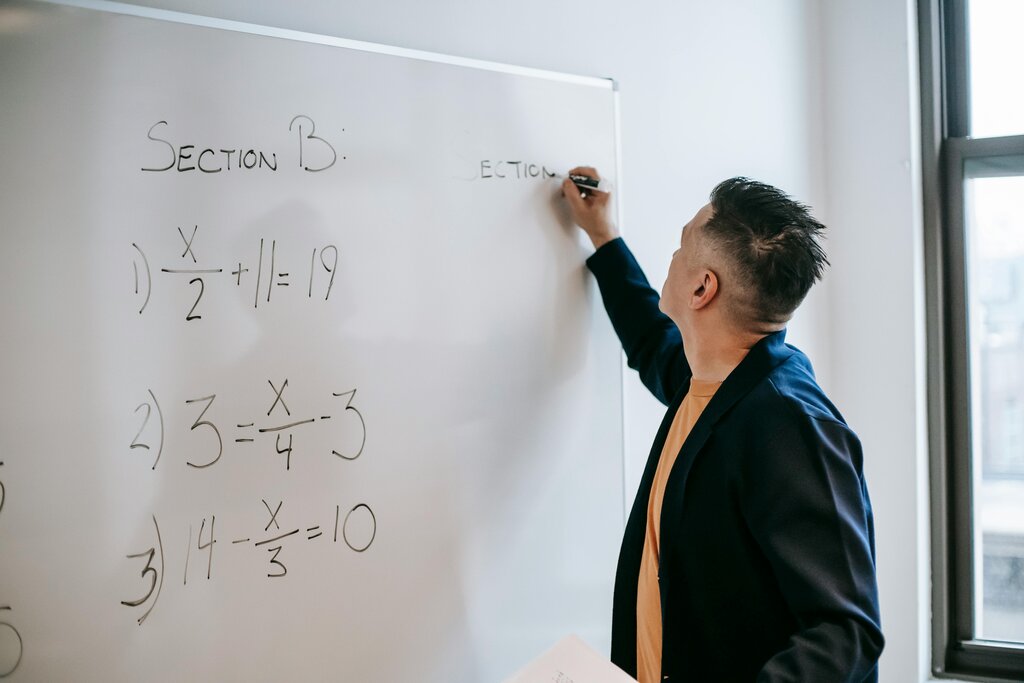
Your goal is to isolate the variable, like , on one side. To do this, you undo the operations around it. You undo addition with subtraction, and multiplication with division. Let's solve for in the equation .
Undo the subtraction: Add 7 to both sides.
Undo the multiplication: Divide both sides by 4.
Working with Inequalities
Linear inequalities look just like linear equations, but instead of an equals sign (), they have a symbol like (less than), (greater than), (less than or equal to), or (greater than or equal to). You solve them almost exactly the same way you solve equations.
There is one crucial difference. If you multiply or divide both sides of an inequality by a negative number, you must flip the direction of the inequality sign.
Consider the inequality . Let's solve for .
Why do we flip the sign? Think about the simple statement . If you multiply both sides by , you get and . Now, is greater than , so the sign must flip to to keep the statement true.
With these foundational skills, you're ready to tackle a wide range of algebraic problems.