Mastering SAP S4HANA Fundamentals
HANA Database Architecture
The Need for Speed
Traditional databases were built for a different era. They stored data on spinning hard disks. To access information, a physical read/write head had to find the right spot on the disk, a process that takes milliseconds. While that sounds fast, it creates a significant bottleneck when dealing with billions of data points.
SAP HANA flips this model on its head by using an in-memory database. Instead of storing data on a relatively slow disk, it keeps the active dataset directly in the computer's main memory, or RAM. Accessing data from RAM is orders of magnitude faster than from a disk because it's purely electronic, with no moving parts. This fundamental shift from disk to memory is the first key to HANA's performance.
HANA’s in-memory computing, parallel processing, and better data compression enable S/4HANA to read data much faster than traditional ERPs.
Columns Over Rows
The second major innovation is how HANA organises data. Traditional databases, designed for transactional systems like order entry or invoicing, use row-based storage. All the information for a single record, like a sales order, is stored together in one chunk. This is efficient for writing or retrieving an entire record, as all the data is in one place.
However, analytics and reporting are different. You're often not interested in every detail of one transaction. Instead, you want to aggregate data from a single field across millions of records, like calculating the total sales for a specific product. In a row-based system, the database would have to read every single row, including all the unnecessary columns, just to pick out the sales figures. This is incredibly inefficient.
HANA uses a columnar store. All the values for a single column, like 'Product ID' or 'Sales Amount', are stored together. When you need to run a report on total sales, the database only needs to read that one column. This dramatically reduces the amount of data that needs to be processed. This structure also allows for incredible data compression, as values within a column are often similar and can be stored very efficiently.
| Feature | Row-Based Storage | Column-Based Storage |
|---|---|---|
| Primary Use | Transactional (OLTP) | Analytical (OLAP) |
| Data Access | Optimized for writing/reading entire rows | Optimized for reading specific columns |
| Performance | Fast for single record operations | Fast for aggregations and reports |
| Compression | Less effective | Highly effective |
| Example | Processing a single sales order | Calculating total sales for the quarter |
One System to Rule Them All
Historically, this difference between row and column stores led businesses to maintain two separate systems. They used an OLTP (Online Transaction Processing) system for daily operations and a separate OLAP (Online Analytical Processing) system, or data warehouse, for reporting and analysis.
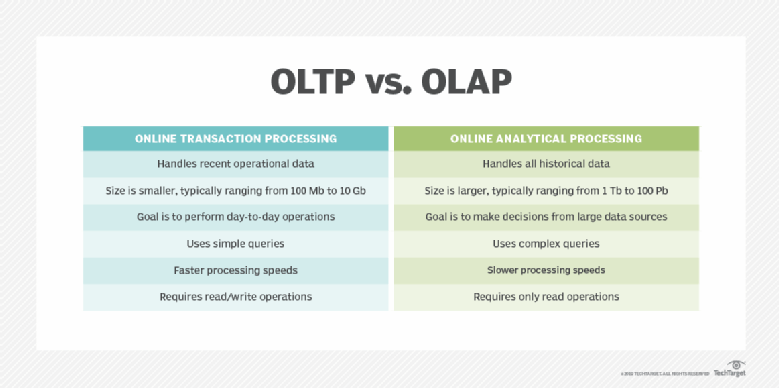
This created a lot of complexity. Data had to be periodically moved from the OLTP system to the OLAP system in a process called ETL (Extract, Transform, Load). This meant that reports were never truly real-time; they were always based on data that was hours or even days old. This separation also created immense data redundancy, with information duplicated across multiple databases.
Furthermore, the OLAP system required pre-calculated aggregate tables and complex indexes to make queries run at an acceptable speed. These aggregates took up massive amounts of storage and needed to be constantly updated, adding another layer of maintenance and potential for error.
HANA’s architecture eliminates this entire problem. By combining an in-memory database with columnar storage and leveraging across modern multi-core CPUs, HANA can perform both transactional and analytical tasks on the same dataset in real time. This hybrid approach is sometimes called HTAP (Hybrid Transactional/Analytical Processing).
With HANA, there's no need for separate OLTP and OLAP systems. No more ETL delays. No more redundant aggregate tables or indexes. There is only a single source of truth for both transactions and analytics.
This architectural foundation is what makes S/4HANA possible. It gets rid of the limitations of older systems like SAP ECC, which were constrained by their underlying disk-based, row-oriented databases. S/4HANA leverages the power of HANA to provide real-time reporting, simplified data models, and a dramatically smaller data footprint, all on a single, unified platform.
Time to check your understanding of these core architectural concepts.
What is the primary architectural shift that gives SAP HANA its significant speed advantage over traditional databases?
A financial analyst needs to calculate the average 'Sales Amount' from millions of sales records. Why is a columnar database like HANA more efficient for this task than a traditional row-based one?
By moving data into memory and reorganizing it into columns, SAP HANA provides the architectural foundation for the real-time enterprise.