Mastering Rummikub Tactics
Advanced Rack Management
Your Rack, Your Workshop
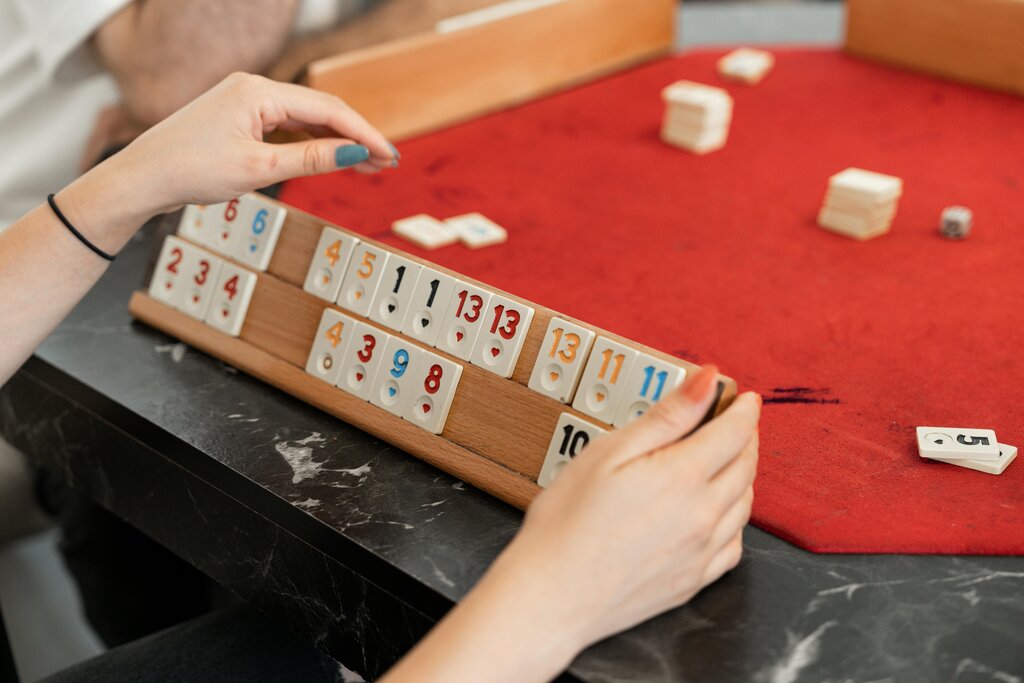
You’ve moved past simply grouping your Rummikub tiles by color and number. That’s storage. Now, it's time to think about your rack as a workshop for building a win. Advanced rack management isn't about tidiness; it's about seeing potential, maximizing your options, and hiding your intentions from your opponents.
Every player glances at their opponents' racks. They’re looking for clues. A large, neatly organized group of red tiles? They're probably building a long run. A sudden flurry of rearranging? They might have just drawn the tile they needed. Your goal is to give away as little information as possible. A disorganized-looking rack can be a strategic advantage, masking your progress and making your moves less predictable.
Organizing for Opportunity
Instead of rigid groups, organize your tiles based on their potential to be played. This means keeping tiles that work together close, regardless of color. A red 7, a blue 7, and a black 7 should sit together. A blue 4 and a blue 6 should also be neighbors, with a small gap between them, mentally reserving a space for the blue 5 you need. This proximity grouping allows you to scan the board and your rack in a single glance, spotting opportunities for complex manipulations instantly.
One powerful method for runs is the 1-2-1 strategy. If you have a blue 5, 6, and 8, don't group them as 5-6...8. Instead, place the 8 to the left of the 5 and 6 (8...5-6). This visual cue reminds you that you need two different tiles, the 7 and the 4, to complete two different runs. It breaks you out of the linear mindset and opens your eyes to more possibilities.
The most valuable tiles on your rack are often the —those that connect disparate groups. A blue 8 might not just complete your blue 6-7 run; it could also form a set with a red 8 and black 8 already on the table. Identifying these dual-purpose tiles early is critical. They are the keys that unlock multi-part moves, allowing you to play several tiles from your rack in a single turn by reconfiguring the entire board.
Flexibility Over Points
New players often make the mistake of holding onto high-value tiles (10, 11, 12) hoping to offload them for big points. This is a dangerous game. High-value tiles are inflexible; they can only end a run, not start or extend one in both directions. Low-value tiles (2, 3, 4) are far more versatile and useful for manipulating the board.
It’s often smarter to discard a high-value tile you can’t play in favor of keeping lower, more flexible options. The goal is to go out first. Getting stuck with a few low-point tiles is much better than getting caught with a handful of 11s and 12s when someone else calls “Rummikub!”
This entire philosophy prepares you for the of play. This approach views the board not as a static collection of sets and runs, but as a single, fluid puzzle. Every tile on the board is potentially in motion. Your rack isn't just a collection of your own tiles; it's a toolbox of solutions for rearranging the entire game state to your advantage.
Treat your rack like a chessboard. Every tile has a potential role, and your job is to position them for the winning move.
Time to test your knowledge of these advanced strategies.
What is the primary goal of advanced Rummikub rack management as described in the text?
Why might a player intentionally keep their rack looking disorganized?
By managing your rack with an eye for potential and flexibility, you'll transform your game, seeing moves you never noticed before.