Mastering Rotational Dynamics and Force Moments
Torque and Lever Arms
The Turning Effect
You already know that a force pushes or pulls an object in a straight line. But what happens when you want to make something rotate? Pushing a door open is a simple example. If you push on the side with the hinges, the door barely moves. If you push on the side with the handle, it swings open easily. The force you apply is the same, but the turning effect is completely different.
This turning effect is called torque. It’s the rotational equivalent of linear force. While force causes an object to accelerate, torque causes an object to have an angular acceleration, meaning it starts to spin, speeds up its spin, or slows down its spin.
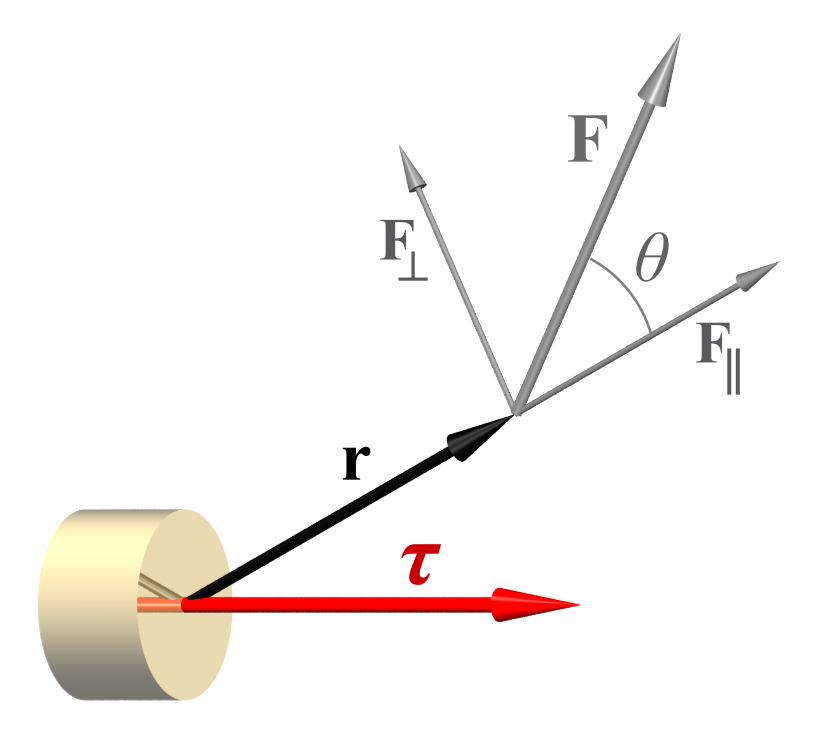
Torque depends on three things: the magnitude of the applied force, the distance from the axis of rotation where the force is applied, and the angle at which you apply that force. A push that is perpendicular to the door is most effective. A push parallel to the door (aimed at the thin edge) won't make it rotate at all.
Calculating Torque
Mathematically, torque is a vector quantity, meaning it has both magnitude and direction. We represent it with the Greek letter tau, . The magnitude of the torque is calculated using the position vector (from the axis of rotation to the point where force is applied) and the applied force vector .
The term is crucial. It tells us that the torque is maximized when the force is applied perpendicularly to the position vector (), because . Torque is zero when the force is parallel () or anti-parallel () to the position vector, since and . This matches our door example perfectly.
The Lever Arm
There's another intuitive way to think about torque. Instead of focusing on the angle, we can use the concept of a (also called the moment arm). The lever arm is the perpendicular distance from the axis of rotation to the force's —the imaginary line extending infinitely in the direction of the force.
Using the lever arm simplifies the torque equation. Instead of dealing with angles, you just multiply the force by this perpendicular distance.
This shows that both methods, using or finding the lever arm, give the same result, since .
Direction and the Cross Product
Since torque is a vector, it must have a direction. Which way does the torque vector point? It points along the axis of rotation. The standard convention is to use the to determine its direction.
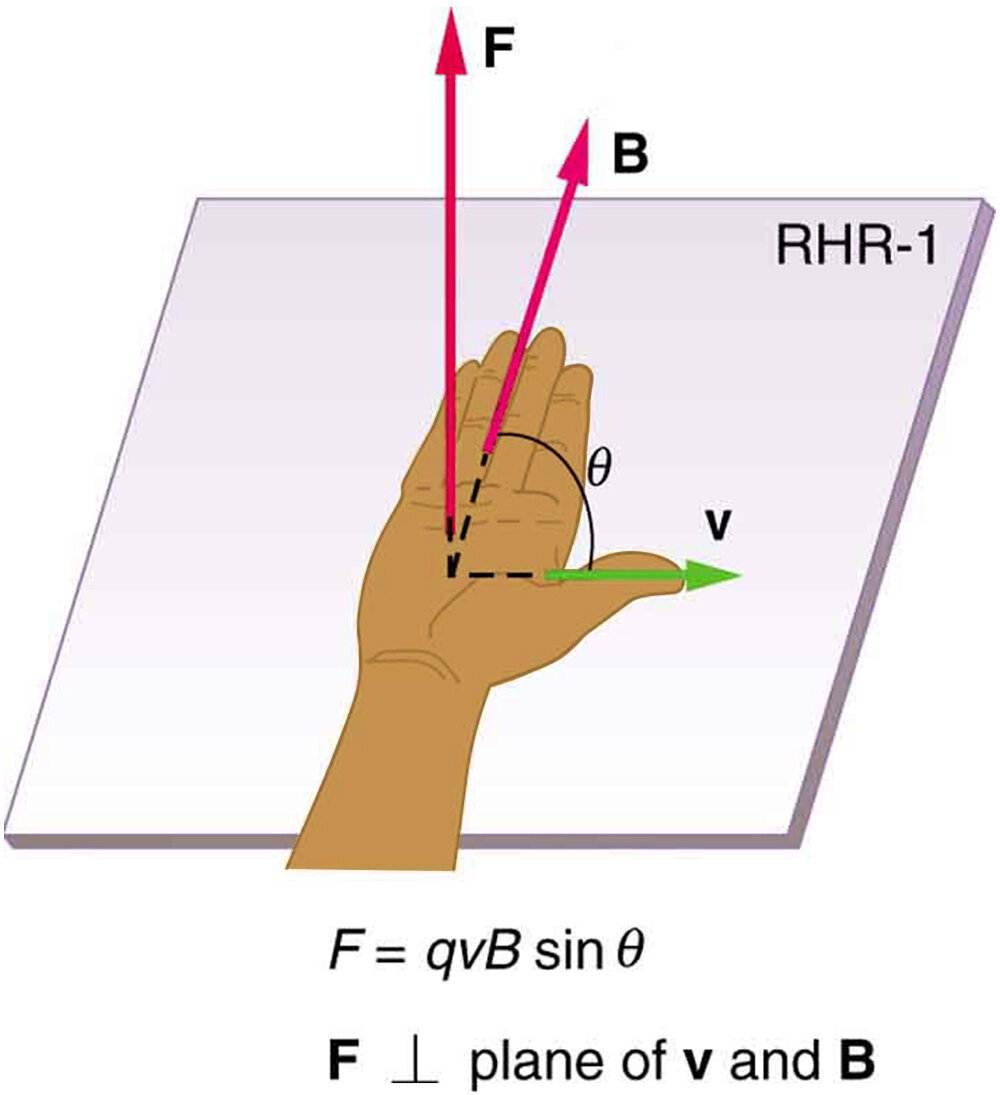
Point the fingers of your right hand in the direction of the position vector, . Curl your fingers toward the direction of the force vector, . Your thumb will then point in the direction of the torque vector, .
By convention, counter-clockwise rotation is considered positive torque, and clockwise rotation is negative. If you curl your fingers counter-clockwise, your thumb points up (or out of the page), representing a positive direction. If you curl them clockwise, your thumb points down (or into the page), which is negative.
The most precise way to define torque is with the vector cross product.
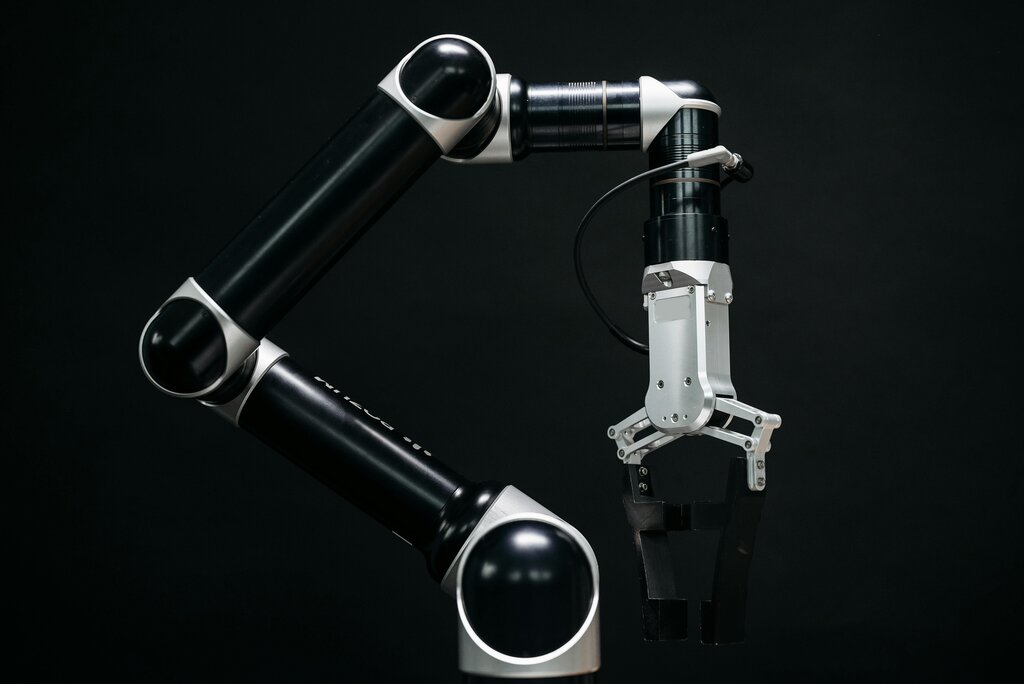
The cross product automatically handles both the magnitude and the direction. The magnitude of the resulting vector is , and its direction is perpendicular to the plane formed by and , consistent with the right-hand rule. Understanding torque as a cross product is fundamental for analyzing more complex systems in three dimensions, like gyroscopes or robotic arms.
With this foundation, you can now analyze how forces create rotation in any mechanical system.