Mastering Retrieval-Augmented Generation
Introduction to RAG
Giving AI an Open Book Test
Large language models (LLMs) are powerful, but they have a major limitation: their knowledge is frozen in time. They only know what they learned from the data they were trained on. If new information comes out tomorrow, a standard LLM won't know about it. They can also confidently invent facts, a problem known as hallucination.
Retrieval-Augmented Generation, or RAG, is a clever way to solve this. Think of it as giving an LLM access to a library during an exam. Instead of relying only on what it has memorized, the model can look up current, relevant information before answering a question. This makes its responses more accurate, trustworthy, and up-to-date.
RAG grounds the model's answers in real, verifiable data, reducing the chance of made-up information.
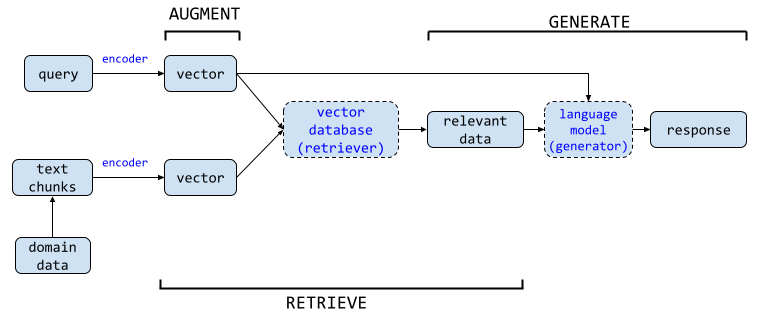
This process has two main parts working together: a retriever and a generator.
Retriever
noun
Finds and pulls relevant information from an external knowledge source, like a database, a collection of documents, or the internet.
Generator
noun
Takes the retrieved information and the original question, then synthesizes it all into a natural, human-like answer.
First, when you ask a question, the retriever springs into action. It searches its connected knowledge base for snippets of text that are relevant to your query. Then, it passes those snippets, along with your original question, to the generator (which is an LLM). The generator uses this fresh, specific context to craft a well-informed answer.
Why RAG is a Game Changer
The main advantage of RAG is that it makes LLMs more reliable. Traditional LLMs are like a brilliant student who studied hard but isn't allowed to bring any notes to the test. They have to rely solely on memory, and sometimes they misremember or fill in gaps with guesses.
A RAG system is like that same student, but now they have an open-book test. They can consult authoritative sources on the spot. This dramatically improves the factual accuracy of their answers. It also means you can often see the sources the model used, adding a layer of transparency that's missing from most LLMs.
Retrieval-Augmented Generation (RAG) is an AI framework that connects a language model to an external knowledge repository, allowing the model to fetch and include relevant information when generating an answer.
This approach also makes it easier to update the AI's knowledge. Instead of retraining the entire massive model, which is expensive and time-consuming, you can simply update the external data source. If your company launches a new product, you just add the product's documentation to the knowledge base, and the RAG system can start answering questions about it immediately.
Real-World Applications
RAG isn't just a theoretical concept; it's already powering a variety of useful tools. The basic idea is to connect a conversational AI to a specific, reliable set of information.
| Application | How RAG Helps |
|---|---|
| Customer Support Chatbots | Answers questions using a company's internal knowledge base of product manuals and FAQs, ensuring accurate and consistent support. |
| Research Assistants | Scans and synthesizes information from vast databases of scientific papers or legal documents to provide researchers with concise summaries of the latest findings. |
| Personalized Content | Acts as a smart news aggregator that pulls articles based on your interests and provides a custom-tailored summary. |
| Enterprise Search | Allows employees to ask questions in natural language and get answers pulled directly from internal company documents, reports, and emails. |
In each case, RAG helps bridge the gap between the general knowledge of an LLM and the specific, timely information needed to perform a task well.
What is the primary problem that Retrieval-Augmented Generation (RAG) is designed to solve for Large Language Models (LLMs)?
In a RAG system, what is the specific function of the 'retriever' component?
RAG represents a significant step forward in making AI more helpful and trustworthy. By combining the conversational power of LLMs with the factual grounding of information retrieval, we get the best of both worlds.