Mastering Retrieval Augmented Generation
Introduction to RAG
What is RAG?
Large language models (LLMs) are powerful, but they have a key limitation: their knowledge is frozen in time. They only know what they were taught during their training period. They can't browse the web for today's news or look up specific facts in your company's private documents. This can lead to outdated or incorrect answers, a problem often called "hallucination."
Retrieval-Augmented Generation, or RAG, is a clever way to solve this. It gives an LLM a lifeline to the outside world, connecting it to external, up-to-date knowledge sources.
Retrieval-Augmented Generation (RAG) is an AI framework that connects a language model to an external knowledge repository, allowing the model to fetch and include relevant information when generating an answer.
Think of an LLM as a brilliant student who has read an entire library but is now locked in a room with no new books. They can answer questions based on what they remember, but their knowledge will get stale. RAG is like giving that student a library card and a computer. Before answering a question, they can quickly look up the most current and relevant information, leading to a much better, more accurate response.
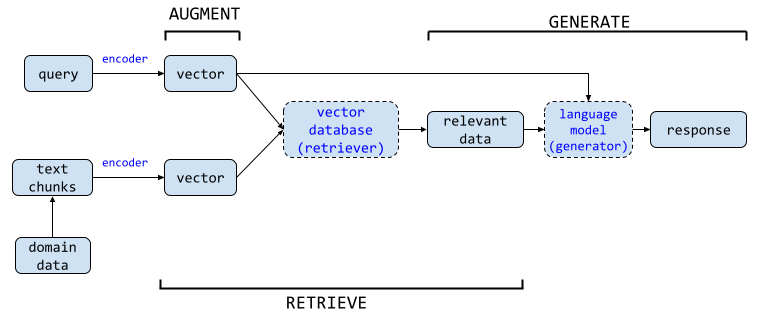
How RAG Works
The name "Retrieval-Augmented Generation" perfectly describes its two-step process. First comes retrieval, then comes generation.
-
Retrieval: When you ask a question, the RAG system doesn't immediately go to the LLM. Instead, it first searches an external knowledge base—like a collection of company documents, a website's articles, or a technical manual. It retrieves the specific snippets of information that are most relevant to your query.
-
Generation: Next, the system takes your original question and bundles it with the relevant information it just found. It hands this complete package to the LLM. The LLM now has all the context it needs to generate a well-informed, accurate, and relevant answer.
In short, RAG finds the right puzzle pieces from an external source before asking the LLM to put them together into a coherent picture.
hallucination
noun
An instance where an AI model generates text that is nonsensical or factually incorrect, yet presents it as if it were true.
Why RAG Matters
The idea of combining search with language generation isn't entirely new, but it became much more important with the rise of powerful LLMs like those behind ChatGPT. Early research in natural language processing (NLP) laid the groundwork, but the formal concept of RAG gained traction around 2020 as a way to make these new models more reliable.
By grounding LLMs in verifiable, external facts, RAG makes AI systems more trustworthy. It reduces hallucinations, allows for the use of timely information, and gives users insight into where the AI is getting its answers. This makes it a crucial building block for creating more capable and dependable AI applications.
Let's check your understanding of these core concepts.
What is the primary limitation of large language models (LLMs) that Retrieval-Augmented Generation (RAG) is designed to address?
What are the two main stages of the RAG process, in the correct order?
Now you know the fundamentals of RAG: what it is, how it works at a high level, and why it's a significant step forward for AI.