Mastering Retrieval-Augmented Generation
Introduction to Large Language Models
What Are Large Language Models?
A Large Language Model, or LLM, is a type of artificial intelligence designed to understand and generate human-like text. Think of it as a student who has read a colossal library of books, articles, and websites. By processing this vast amount of information, it learns the patterns, grammar, facts, and nuances of language.
The “large” in the name refers to two things: the immense size of the dataset it's trained on and the huge number of parameters in its underlying neural network. These parameters are like the connections between neurons in a brain, and modern LLMs can have hundreds of billions of them. This scale is what allows them to perform a wide range of sophisticated language tasks, from answering questions to writing poetry.
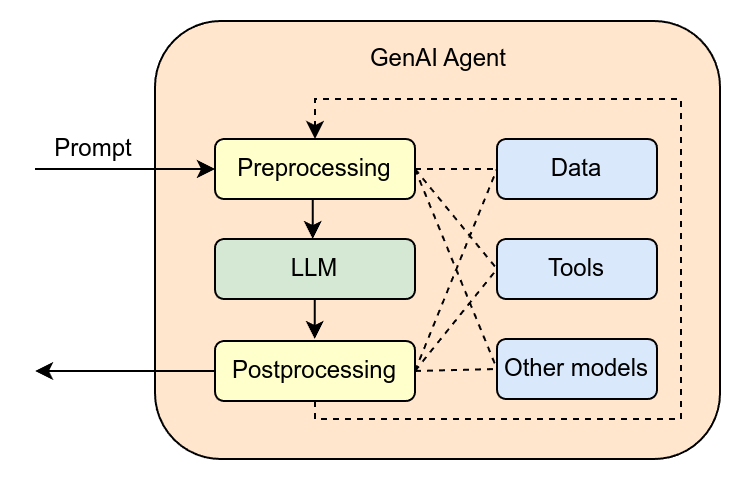
How LLMs Learn
LLMs are built on a type of neural network architecture called a Transformer. This design is particularly good at handling sequential data like text, allowing the model to weigh the importance of different words in a sentence when processing it.
Training an LLM is conceptually simple but computationally massive. The model is fed trillions of words from the internet and digital books, and its main task is to predict the next word in a sequence. For example, given the phrase “The cat sat on the…”, the model tries to guess the next word. If it guesses “mat,” it gets a small reward. If it guesses “sky,” it’s corrected. This process is repeated billions of times, and with each iteration, the model adjusts its internal parameters to get better at predicting.
Through this simple process of next-word prediction, LLMs learn grammar, acquire factual knowledge, and even pick up different reasoning styles and tones.
This self-supervised learning means LLMs can train on raw text without needing humans to manually label every piece of data. After this initial phase, many models undergo a second stage called fine-tuning, where humans provide high-quality examples and feedback to steer the model toward more helpful, accurate, and safe responses.
Common Applications
Because of their versatility, LLMs are used in a growing number of applications across many industries. Some common uses include:
- Content Creation: Writing drafts for emails, articles, and marketing copy.
- Information Synthesis: Summarizing long reports, research papers, or customer reviews to extract key insights.
- Customer Support: Powering chatbots that can answer customer questions 24/7.
- Software Development: Generating code snippets, explaining code, and finding bugs.
- Translation: Translating text between different languages with increasing accuracy and nuance.
For example, a developer could ask an LLM to write a simple program.
prompt = "Write a Python function that finds the largest number in a list."

# LLM-generated code
def find_largest(numbers):
  """Finds the largest number in a list of numbers."""
  if not numbers:
    return None
  largest_number = numbers[0]
  for number in numbers:
    if number > largest_number:
      largest_number = number
  return largest_number
The Limits of Language Models
Despite their impressive abilities, LLMs have significant limitations. Because their core function is to predict the next most probable word, they don't possess true understanding or consciousness. They are pattern-matching machines, not thinking entities. This can lead to several problems.
Hallucination
noun
A phenomenon where an AI model generates text that is plausible and grammatically correct but factually incorrect or nonsensical.
One of the most well-known limitations is the tendency to "hallucinate." An LLM can confidently state incorrect information because it sounds plausible based on the patterns it learned during training. It might invent facts, cite non-existent sources, or create details that are not grounded in reality. This happens because the model's goal is to be coherent, not necessarily truthful.
Other limitations include:
- Knowledge Cutoff: An LLM's knowledge is frozen at the time its training data was collected. It won't know about events that happened after that date.
- Bias: The model can reflect and amplify biases present in its vast training data, leading to unfair or stereotyped outputs.
- Lack of Common Sense: LLMs can struggle with basic reasoning about the physical world that a human would find obvious.
Understanding these limitations is key. LLMs are powerful tools, but they require careful use and critical evaluation of their outputs.
Let's test your understanding of these core concepts.
What is the fundamental task that a Large Language Model (LLM) is trained to perform during its initial self-supervised learning phase?
An LLM confidently provides a detailed biography of a scientist, including a list of awards they won. You later discover that both the scientist and the awards are completely fictional. This is a classic example of what limitation?
Now you have a foundational understanding of what LLMs are, how they're trained, what they're capable of, and where they fall short.