Mastering Relativity Beyond Einstein
Special Relativity Foundations
The Universe's New Rules
At the start of the 20th century, physics was in a strange place. The old rules, set down by Isaac Newton, worked perfectly for everyday things like throwing a ball or orbiting planets. But they broke down when dealing with electricity, magnetism, and light. Albert Einstein, a young patent clerk, proposed a radical new way of looking at reality, built on two simple but powerful ideas.
First, the laws of physics are the same for all observers who are not accelerating. This is called an inertial frame of reference. Whether you're standing still or cruising in a train at a constant speed, the rules of physics work the same way.
Second, the speed of light in a vacuum is constant for all observers, regardless of their motion or the motion of the light source. It’s always about 299,792,458 meters per second.
The second idea is the troublemaker. Imagine you're on a train moving at 100 km/h and you throw a ball forward at 20 km/h. To someone on the ground, the ball is moving at 120 km/h. Simple. But if you shine a flashlight forward, both you and the person on the ground measure the light's speed as exactly the same. How can this be? This single fact forces us to abandon our common-sense notions of space and time.
The Problem with 'Now'
One of the first casualties of a constant light speed is the idea of simultaneity. Events that happen at the same time for one person might not happen at the same time for another.
Let's picture a long train car moving at a high speed. A person, let's call her Anna, is sitting exactly in the middle of the car. Another person, Bob, is standing on the ground watching the train go by. Just as Anna passes Bob, two lightning bolts strike the train simultaneously, one at the very front and one at the very back.
For Bob, standing on the ground, the light from both strikes travels the same distance to reach him, so he sees them happen at the same time. They are simultaneous.
But what about Anna on the train? She is moving towards the spot where the front bolt struck and away from where the rear bolt struck. This means the light from the front of the train has a shorter distance to travel to reach her eyes than the light from the back. She will see the flash from the front bolt before she sees the flash from the back. For her, the events were not simultaneous. The front bolt struck first.
Who is right? Both of them. The concept of 'at the same time' depends on your frame of reference. There is no universal 'now' across the cosmos.
Time on the Move
If simultaneity is relative, then time itself must be relative. The classic way to see this is with a 'light clock' thought experiment. Imagine a clock made of two mirrors, with a single photon of light bouncing between them. Each time the photon hits a mirror, the clock 'ticks'.
If you are standing next to this clock, the photon travels a straight path up and down. The distance is simple, let's call it . The time for one tick is the distance divided by the speed, or .
Now, imagine this clock is on a speeding spaceship flying past you. From your perspective, the clock is moving. The photon still travels from the bottom mirror to the top, but by the time it gets there, the top mirror has moved to the right. The photon's path is now a longer, diagonal line. Since the speed of light () is constant for you, and the path is longer, the time for one tick must also be longer. From your point of view, the moving clock is ticking more slowly. This effect is called time dilation.
An object in motion experiences time more slowly than an object at rest, relative to a stationary observer.
This isn't a trick of perception; time itself is slowing down for the moving object. This effect is tiny at everyday speeds but becomes significant as you approach the speed of light.
Space Gets Squeezed
If time can stretch, then space must be able to shrink. Imagine a spaceship traveling from Earth to a distant star at a very high speed. From Earth's perspective, we can measure the distance to the star and observe how long the trip takes for the spaceship's clock. Because of time dilation, we'll see their clock run slow.
But what about the astronauts on the ship? From their perspective, their clock is running normally. Since the laws of physics are the same for them, they must also measure the speed of light as . If their time is normal, but they are covering the vast distance faster than expected (because less of their time has passed), the only way to reconcile this is if the distance itself has shrunk.
This is length contraction. To a stationary observer, an object moving at a high speed appears shorter in the direction of its motion.
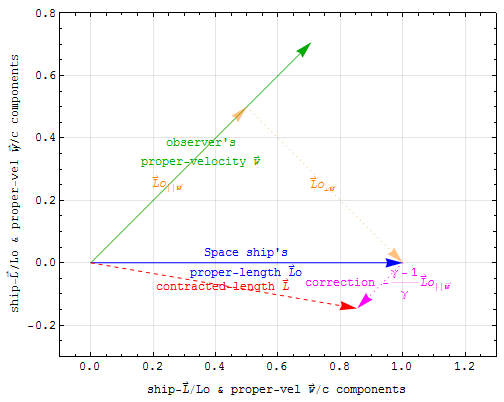
Just like time dilation, this effect is only noticeable at relativistic speeds. A speeding car is not visibly shorter, but a spaceship at 99% the speed of light would be.
The Math of Spacetime
To connect observations between different inertial frames, we can't just add and subtract velocities like in the old physics. We need a new set of equations called the Lorentz transformations. They were developed by Hendrik Lorentz before Einstein, but Einstein showed they were a fundamental feature of space and time.
These equations describe exactly how time and space coordinates in one frame relate to those in another. Let's say one frame has coordinates and another frame is moving at a velocity along the x-axis with coordinates .
The key ingredient here is the Lorentz factor, .
Notice how space and time are mixed together in the transformations for and . An event's time coordinate in one frame depends on both the time and space coordinates in the other. This is the mathematical heart of special relativity, showing that space and time are not separate but are interwoven into a single fabric: spacetime.
What fundamental principle of special relativity forces a re-evaluation of classical notions of space and time?
In the thought experiment with the train and two lightning strikes, why does Anna (in the middle of the train) observe the strikes at different times, while Bob (on the ground) sees them as simultaneous?
These ideas fundamentally changed our understanding of the universe. They paved the way for a new era of physics, revealing a reality far stranger and more wonderful than we had ever imagined.