Mastering React.js Fundamentals
Introduction to React.js
What Is React?
React is a JavaScript library for building user interfaces. Think of it as a toolkit for creating the interactive parts of a website or application—the buttons you click, the feeds you scroll through, and the forms you fill out. Created and maintained by Facebook, its main job is to make it easier to build complex, fast, and scalable UIs.
Instead of telling the browser how to change the page step-by-step, React lets you describe what the UI should look like, and it handles the rest.
Building with Components
The core idea behind React is its component-based architecture. Imagine you're building with LEGOs. Instead of creating a large, single structure from scratch, you build smaller, independent blocks that can be put together. In React, these blocks are called components.
A component is a self-contained, reusable piece of the user interface. A web page can be broken down into many components: a navigation bar, a search box, a user profile, a list of items. Each component manages its own logic and appearance. You can then assemble these components to create a complete page.
This approach makes your code cleaner and easier to manage. If you need to update the search box, you only need to work on the search box component without touching the rest of the application.
The Virtual DOM
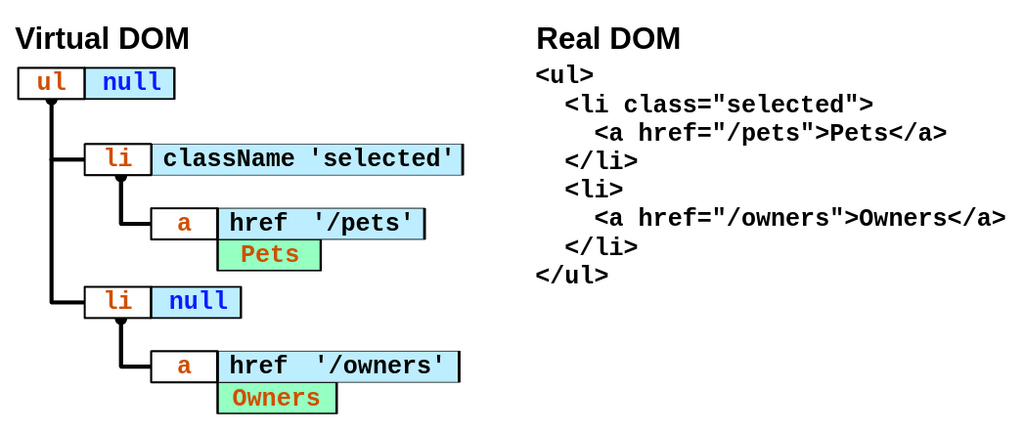
Web browsers use something called the Document Object Model, or DOM, to represent the structure of a webpage. Directly manipulating the DOM can be slow, especially for complex applications with lots of updates, like a real-time feed.
React solves this problem with the Virtual DOM. It's a lightweight copy of the real DOM that exists only in memory. When data in your application changes, React first updates this virtual copy. Then, it compares the new Virtual DOM with the old one to find the exact differences—a process called "diffing."
Finally, React updates only the changed parts in the real DOM. This process is much faster than re-rendering the entire page, leading to a smoother and more responsive user experience.
Unidirectional Data Flow
In React, data flows in one direction, from top to bottom. This is often called a "one-way data flow." Data is held by parent components and passed down to child components.
This predictable flow makes applications easier to understand and debug. When something goes wrong, you can trace the data's path from its source (the parent) down through the component tree. A child component cannot directly change its parent's data. This restriction prevents messy, unpredictable changes and keeps the application's state more stable.
By combining these three core concepts—components, the Virtual DOM, and a one-way data flow—React provides a powerful and efficient way to build modern web applications.