Mastering RAGAS for RAG Evaluation
Introduction to RAG Systems
Giving AI an Open Book
Large Language Models (LLMs) are powerful. They can write essays, code, and poetry. But they have a major limitation: they only know what they learned during their training. Think of it like a student taking a closed-book exam. They can only answer questions based on the information they've already memorized. If the information is outdated or was never in their textbook, they're stuck. They might even make up an answer.
Hallucination
noun
When an AI model generates false, nonsensical, or factually incorrect information but presents it as if it were true.
This is where Retrieval-Augmented Generation, or RAG, comes in. RAG gives the AI an open-book exam. Instead of relying solely on its internal memory, a RAG system first looks up relevant, up-to-date information from an external source. Then, it uses that information to create a better, more accurate answer.
Retrieval-Augmented Generation (RAG) is an AI framework that connects a language model to an external knowledge repository, allowing the model to fetch and include relevant information when generating an answer.
How RAG Works
A RAG system is made of two main parts: a retriever and a generator. They work together in a simple, powerful sequence.
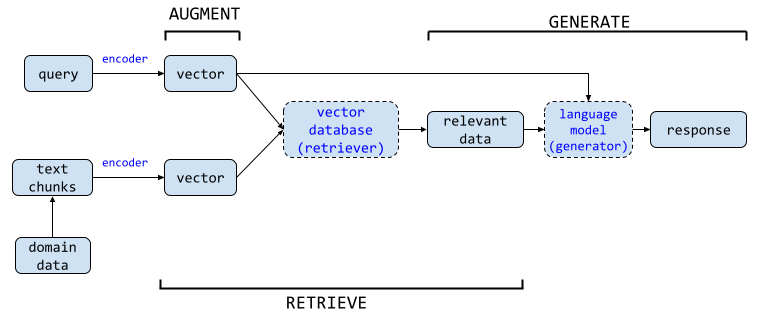
1. The Retriever: When you ask a RAG system a question, the retriever gets to work first. Its job is to search a specific knowledge base, like a company's internal documents, a set of legal papers, or a curated news archive. It finds the snippets of text that are most relevant to your query.
2. The Generator: The generator is the LLM. It takes your original question and combines it with the relevant information found by the retriever. With this new, context-rich prompt, it generates a final answer. The retrieved text acts as a cheat sheet, guiding the LLM to a factual and relevant response.
This process ensures the answer isn't just pulled from the LLM's vast but generic memory. It's grounded in specific, provided data.
Why Bother with RAG?
Integrating retrieval with generation has several key benefits. First, it dramatically improves accuracy and reduces hallucinations. The model's answers are based on real data, not just statistical patterns.
Second, it allows LLMs to use current information. A model trained in 2022 has no knowledge of events from 2024. With RAG, it can access a database of recent articles and answer questions about the present day.
Finally, it provides transparency. A RAG system can cite its sources, showing you exactly where it got its information. This is crucial for building trust and verifying facts.
Common applications include customer support chatbots that use company manuals, research tools that search scientific papers, and enterprise assistants that can answer questions about internal policies.
By connecting generative models to live knowledge sources, RAG makes AI more reliable, relevant, and useful for specific, real-world tasks.