Mastering RAG Systems
Introduction to RAG
What is Retrieval-Augmented Generation?
Large language models (LLMs) are powerful, but they have a fundamental limitation: they only know what they were taught during their training. Their knowledge is frozen in time and doesn't include private, specialized, or real-time information. If you ask a standard LLM a question about an internal company document or an event that happened yesterday, it won't have an answer.
Retrieval-Augmented Generation, or RAG, solves this problem. It’s a technique that gives an LLM access to external information before it generates a response. Think of it like an open-book exam. Instead of relying solely on its memory (pre-trained knowledge), the LLM can first look up relevant information from a specific knowledge source.
RAG enhances an LLM by connecting it to an external, up-to-date, or private knowledge base.
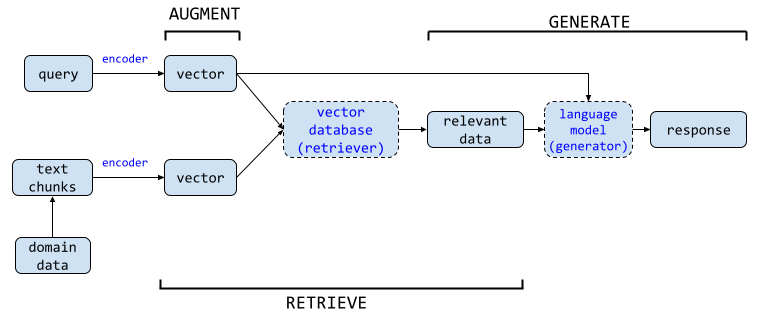
The process has two main steps:
- Retrieval: When you ask a question, the system first searches a knowledge base (like a collection of company documents, articles, or a database) for information relevant to your query.
- Generation: The relevant information found in the first step is then given to the LLM along with your original question. The LLM uses this new context to generate a comprehensive and accurate answer.
This simple, two-step process makes the LLM's responses much more reliable and grounded in specific facts.
Key Benefits of RAG
Integrating a retrieval step before generation offers several major advantages, transforming how we use LLMs.
Access to Current Information LLM training is expensive and time-consuming, so models aren't constantly updated. RAG allows an LLM to access the latest information. For example, a financial chatbot could use RAG to retrieve real-time stock prices and news to answer questions about today's market, something its base training wouldn't cover.
Reduced Hallucinations When an LLM doesn't know an answer, it sometimes makes one up, a phenomenon known as hallucination. By providing the model with factual documents to base its answer on, RAG significantly reduces the risk of these fabrications. The model is anchored to the provided text, making its answers more trustworthy.
Domain-Specific Expertise An LLM can't be an expert in everything. RAG allows it to become a specialist by connecting it to a specific knowledge base. A law firm could use RAG with its internal case files, enabling a chatbot to answer detailed questions about past precedents. Similarly, a hospital could use it to query a database of medical research papers.
Transparency and Trust Because the RAG process starts by finding source documents, the system can cite where it got its information. This allows users to verify the answer and builds trust in the application. You can see the exact source text that informed the model's response.
Common Applications
RAG is not just a theoretical concept; it's already powering a wide range of practical applications across different industries.
One of the most common uses is for advanced question-answering systems. Customer support chatbots can use RAG to provide instant, accurate answers based on a company's product manuals and help articles. This is far more effective than a traditional chatbot that relies on a limited set of pre-programmed responses.
In the world of research and development, RAG acts as a powerful assistant. Scientists, engineers, and academics can use it to quickly search and synthesize information from millions of research papers, technical documents, or patents, accelerating discovery and innovation.
By grounding language models in specific, verifiable information, RAG makes them more powerful, reliable, and useful in professional and everyday contexts. It's a key step in moving from generalist models to specialized AI assistants.
Let's check your understanding of these core concepts.
What is the primary limitation of a standard Large Language Model (LLM) that Retrieval-Augmented Generation (RAG) is designed to solve?
The RAG process consists of two main steps: first, the system ____ relevant information from a knowledge base, and then it ____ a response based on that information.
Now you know the fundamentals of how Retrieval-Augmented Generation works to make LLMs smarter and more trustworthy.