Mastering RAG Implementation
Introduction to RAG
Beyond the Training Data
Large language models (LLMs) are powerful. They can write essays, generate code, and answer complex questions. But they have a fundamental limitation: they only know what they were taught during their training. Think of a standard LLM as a brilliant student who has memorized an entire library of books but is then locked in a room with no new information. The library's contents, once comprehensive, slowly become outdated.
When you ask this student a question about a recent event, they can't give you an accurate answer. They might even try to piece together old information to invent a plausible, yet incorrect, response. In the world of AI, this is called a hallucination.
Hallucination
noun
An instance where a large language model generates text that is nonsensical, factually incorrect, or disconnected from the provided context.
This is where Retrieval-Augmented Generation, or RAG, comes in. RAG gives the locked-in student a key to a live, constantly updated library. Instead of relying solely on its memorized knowledge, the model can first retrieve relevant, up-to-date information from an external source and then use that information to craft an answer. It bridges the gap between the LLM's static training data and the dynamic, real world.
How RAG Works
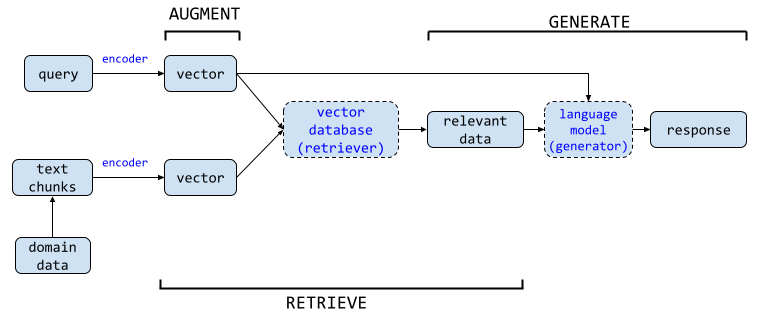
The process is a simple, two-step dance: retrieve, then generate. It turns a closed-book exam into an open-book one, where the model has permission to look up the facts before answering.
First, the retriever acts like a super-fast librarian. When you ask a question, the retriever scans a specific knowledge base, like a company's internal documents or a collection of recent news articles. It finds the most relevant snippets of text that could help answer your query.
Next, the generator (the LLM itself) takes over. It receives your original question along with the relevant information unearthed by the retriever. With this fresh context, it formulates a comprehensive and accurate answer. The retrieved text grounds the model in reality, drastically reducing the chance of hallucination.
This simple architecture gives RAG some powerful advantages.
Up-to-Date Knowledge: Models can answer questions about recent events or data without needing to be completely retrained, which is a costly and time-consuming process.
Domain-Specific Expertise: A company can point a RAG system to its own internal manuals, reports, and databases, creating an expert chatbot that knows its specific products and policies inside and out.
Improved Trust and Transparency: Because the model's answers are based on specific retrieved documents, many RAG systems can cite their sources. This allows users to verify the information and trust the output more.
RAG in the Real World
The applications for this technology are broad and practical. Think of a customer service chatbot for an e-commerce site. Without RAG, it can only answer generic questions based on its training. With RAG, it can access the company's real-time inventory and shipping database to tell you exactly when your package will arrive or if a specific item is in stock.
In the legal field, a RAG system can quickly sift through thousands of legal precedents and case files to help a lawyer build an argument, providing citations along the way. In healthcare, it could provide doctors with the latest research relevant to a patient's specific condition, drawing from a trusted medical database.
By connecting powerful language models to curated, up-to-date knowledge, RAG makes AI more reliable, accurate, and useful for specialized tasks.