Mastering Quantum Physics
Introduction to Quantum Mechanics
A Weird New World
At the scale we live our lives, the world is predictable. A dropped ball falls, a pushed car moves, and planets orbit the sun in neat, calculable paths. This is the realm of classical physics, a set of rules that works beautifully for big things. But as scientists in the early 20th century zoomed in on the world of atoms and electrons, those reliable rules started to break down.
They found a world that operated on a completely different logic. Particles could be in multiple places at once. Energy wasn't smooth and continuous but came in chunky, discrete packets. The very act of observing something could change what was happening. This strange new set of rules is called quantum mechanics.
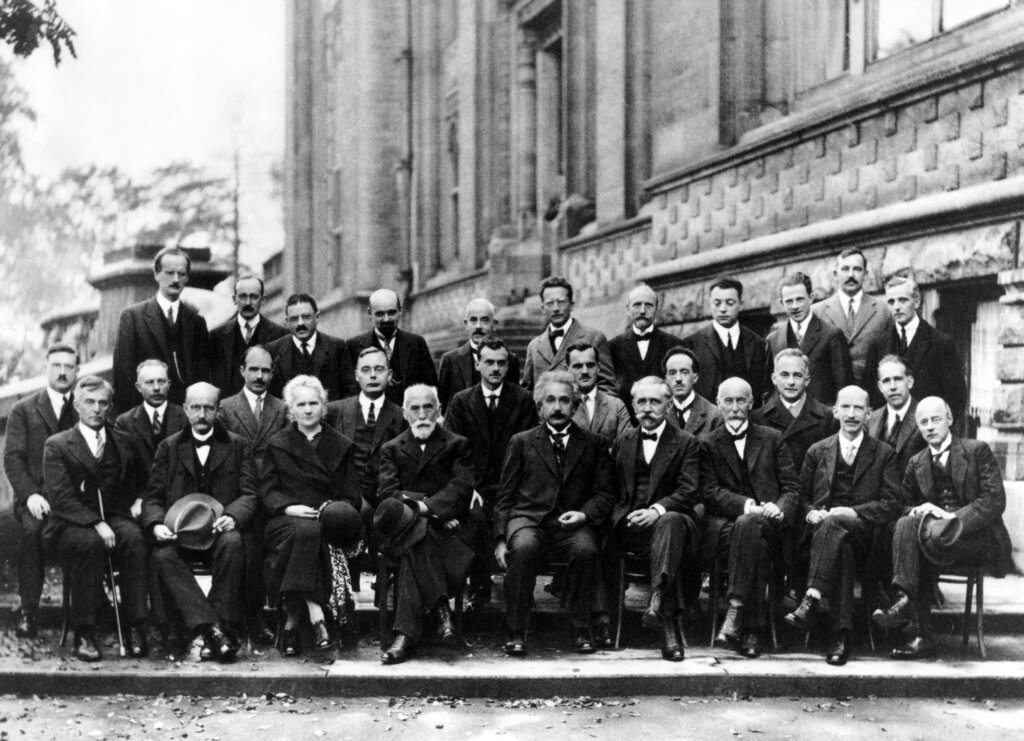
It began with a puzzle about heat. Classical physics predicted that a hot object should radiate an infinite amount of energy at high frequencies, a result so wrong it was called the "ultraviolet catastrophe." In 1900, Max Planck solved it by making a radical suggestion: what if energy could only be emitted or absorbed in discrete packets, which he called quanta? This was the first hint that the subatomic world was not a smaller version of our own.
The Dual Personality of Matter
One of the most mind-bending ideas in quantum mechanics is that things aren't always what they seem. Is an electron a particle, like a tiny billiard ball? Or is it a wave, like a ripple spreading across a pond? The astonishing answer is: it's both. This is called wave-particle duality.
For centuries, light was understood as a wave. Experiments showed it could bend, spread out, and interfere with itself, all classic wave behaviors. But then the photoelectric effect came along. When light hits a metal surface, it can knock electrons loose. Albert Einstein explained this by proposing that light itself is made of particle-like packets of energy, now called photons. The brighter the light, the more photons it has, but the energy of each photon depends only on its frequency (its color).
This duality isn't just for light. In 1924, Louis de Broglie proposed that all matter, including electrons, has a wave-like nature. This was experimentally confirmed just a few years later. The smaller the object, the more obvious its wave properties become.
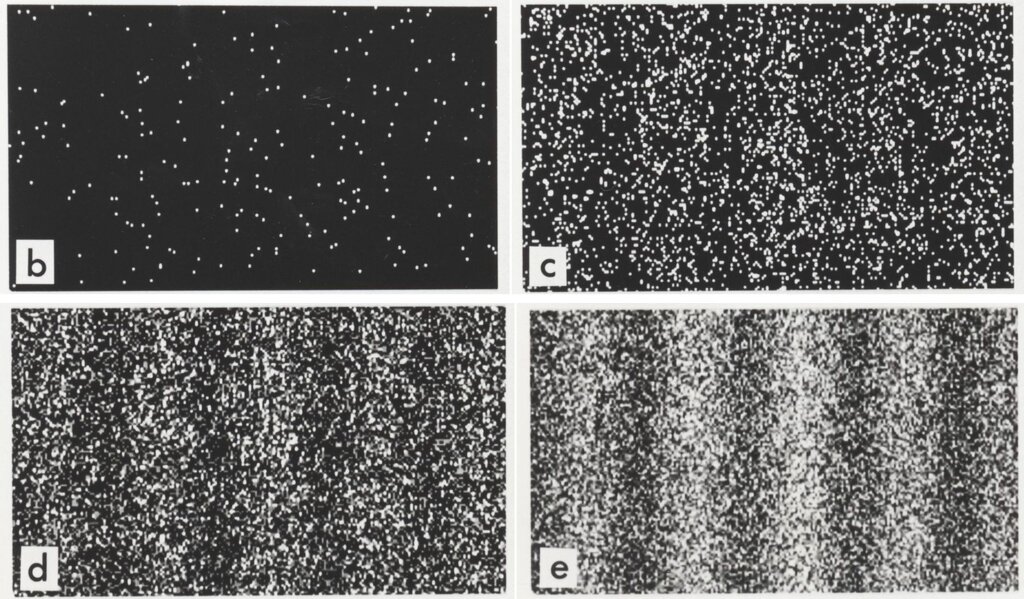
Think of the famous double-slit experiment. If you shoot tiny particles like marbles at a wall with two slits, you expect to see two bands on the detector screen behind it, right where the marbles went through. But if you do this with electrons, one by one, you see something bizarre. An interference pattern of many bands appears, as if each single electron passed through both slits at once and interfered with itself, like a wave.
However, if you place a detector at the slits to see which one the electron goes through, the interference pattern vanishes. You're left with just two bands, as if you were shooting marbles. The act of measuring forces the electron to "choose" a path and behave like a particle.
A quantum object exists as a wave of possibilities until it's measured. The measurement forces it into a single, definite state.
Energy on a Ladder
In the classical world, energy is continuous. A car can have any speed from zero up to its maximum; it can have 30.1 mph, 30.11 mph, or 30.111 mph. But in the quantum world, energy is quantized. This means it can only exist in certain discrete levels, like steps on a ladder.
Consider an electron orbiting the nucleus of an atom. It can't just be at any distance with any energy. It can only occupy specific energy levels. To move from a lower level to a higher one, it must absorb a photon with the exact amount of energy needed to make the jump. It can't absorb half the required energy. When it falls back to a lower level, it emits a photon with that same specific energy.
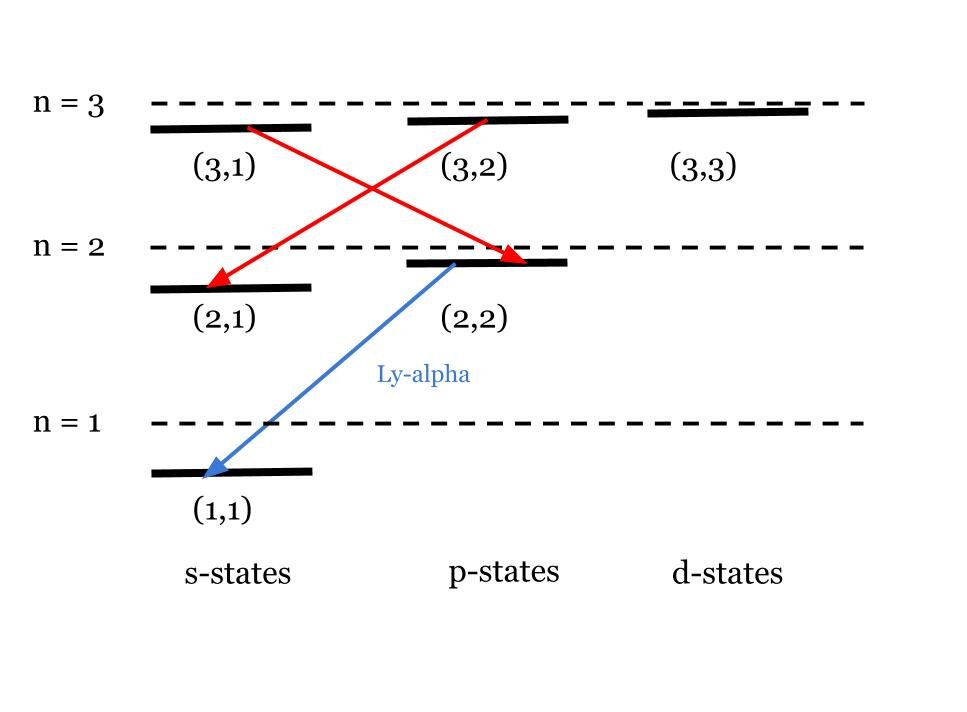
This quantization of energy explains why different elements glow with specific colors when heated. Each color corresponds to a specific energy of photon, released when electrons fall between the unique energy levels of that element's atoms. It's like a unique barcode of light for every element in the universe.
The Science of Maybe
Perhaps the biggest departure from classical physics is that quantum mechanics is fundamentally probabilistic. You can never know with absolute certainty both the exact position and the exact momentum of a particle at the same time. This is Werner Heisenberg's famous Uncertainty Principle. The more precisely you know one, the less precisely you know the other.
Instead of giving definite answers, quantum mechanics provides probabilities. Erwin Schrödinger developed a mathematical tool, the wave function (represented by the Greek letter psi, ), that describes the state of a quantum system. The wave function itself doesn't tell you where a particle is. Instead, its magnitude squared gives you the probability of finding the particle at any given point in space.
Before a measurement is made, a particle exists in a superposition of all its possible states at once, described by its wave function. When you measure it, the wave function "collapses," and you find the particle in one single, definite state. We can't predict which state it will be, only the probability of finding it in that state.
This isn't because our measuring tools are clumsy. It's a fundamental feature of reality at the quantum level. The universe doesn't seem to keep track of a particle's exact properties until it is forced to by an interaction or measurement. Until then, it's all just a wave of possibilities.
Quantum mechanics introduces probability, wave functions, and fundamental limits on what we can know.
Now let's check your understanding of these core ideas.
What problem in classical physics, known as the "ultraviolet catastrophe," led Max Planck to first propose that energy is quantized?
In the famous double-slit experiment, what happens to the interference pattern if you place a detector at the slits to determine which one each electron passes through?
These concepts might feel strange, but they are the bedrock of our modern understanding of the universe. They describe the behavior of every particle that makes up you and everything around you.