Mastering Quality Certification
Quality Management Fundamentals
What Is Quality, Really?
When we talk about a 'quality' product or service, what do we actually mean? It’s more than just being fancy or expensive. In the world of business, quality has a specific definition: meeting or exceeding customer expectations. It’s about delivering what you promised, consistently and reliably.
Think about your favorite coffee shop. The quality isn't just in the taste of the coffee. It’s in the friendly service, the clean tables, and the fact that your order is correct every time. This consistency builds trust. When an organization focuses on quality, it’s not just trying to prevent mistakes. It's building a reputation, fostering customer loyalty, and ultimately, ensuring its own long-term success.
Quality is the foundation of customer satisfaction and a key driver of profitability. It’s about doing the right things right, from the start.
How We Got Here
The way we think about quality has changed over time. Decades ago, the main approach was inspection. Companies would make a batch of products and then check them at the end of the line, weeding out the bad ones. This was inefficient and wasteful.
Later, the focus shifted to quality control. This involved monitoring the production process itself to catch and fix problems as they happened. It was a step forward, but still reactive.
Today, the leading approach is quality management. This is a proactive, organization-wide strategy. Instead of just catching defects, it aims to build a system that prevents them from happening in the first place. It involves everyone, from top leadership to frontline staff, in a continuous effort to improve.
The Guiding Principles
A strong quality management system isn't built on random rules. It’s guided by a set of core principles that provide a framework for decision-making and action. There are seven recognized principles that form the basis of modern quality management.
| Principle | What It Means |
|---|---|
| Customer Focus | Understand current and future customer needs to exceed their expectations. |
| Leadership | Create a unified purpose and direction where people are engaged in achieving goals. |
| Engagement of People | Involve everyone at all levels. Competent, empowered people create value. |
| Process Approach | View activities as interrelated processes. Consistent results are achieved more effectively. |
| Improvement | Maintain a constant focus on improving. Successful organizations are always evolving. |
| Evidence-Based Decision Making | Base decisions on the analysis and evaluation of data and information. |
| Relationship Management | Manage relationships with interested parties, like suppliers, for sustained success. |
These principles aren't just abstract ideas. They are meant to be put into action. One of the simplest and most powerful tools for doing this is a framework for continuous improvement.
A Cycle of Improvement
The Plan-Do-Check-Act (PDCA) cycle is a four-step method for carrying out change. It’s a simple loop that helps teams avoid recurring mistakes and improve processes. The goal is to make small, incremental changes, test them, learn from the results, and then adjust.
Here’s how it works:
- Plan: Identify an opportunity for improvement and plan a change.
- Do: Implement the change on a small scale.
- Check: Observe and analyze the results. Did the change work? What did you learn?
- Act: If the change was successful, implement it more broadly and standardize the new process. If not, begin the cycle again with a new plan.
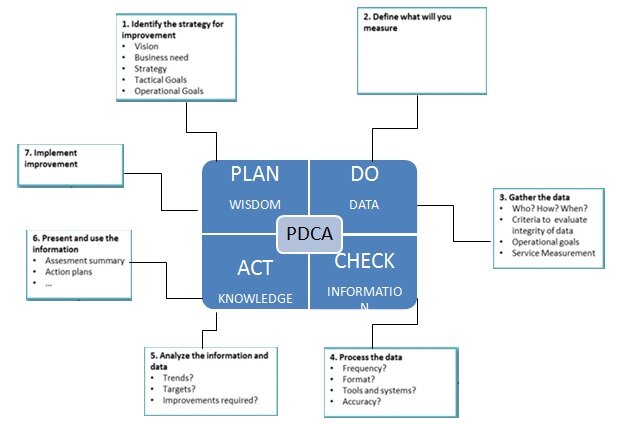
By repeating this cycle, organizations can foster a culture of continuous improvement, where everyone is empowered to make things better. It’s a fundamental tool for bringing the principles of quality management to life.
In a business context, what is the most accurate definition of 'quality'?
Which approach to quality is considered the most proactive and involves the entire organization?
Understanding these core concepts—what quality is, its guiding principles, and the tools for improvement—provides the foundation for building successful, resilient organizations.