Mastering Quadratic Equations
Quadratic Equations
The Anatomy of a Quadratic
A quadratic equation is a type of polynomial with a simple, recognizable structure. Its highest power is two, which is where the name “quadratic” comes from, derived from the Latin word for square.
The standard form of a quadratic equation is: ax² + bx + c = 0
In this form, is our variable, and , , and are coefficients—they are known numbers. The only rule is that cannot be zero. If were zero, the term would disappear, and we'd be left with a linear equation, not a quadratic one.
Let’s look at an example: . Here, we can identify the coefficients:
• • •
Notice that we include the negative sign with the coefficient. If a term is missing, its coefficient is zero. For instance, in the equation , the term isn't there, so , , and .
The Discriminant
Hidden within the standard form is a powerful expression that tells us about the equation's solutions, or roots, without actually solving for them. This expression is called the discriminant.
By calculating the value of the discriminant, we can predict the nature of the roots. Will the equation have two different real solutions, just one, or no real solutions at all? The discriminant gives us the answer.
| Discriminant Value | Nature of the Roots |
|---|---|
| Positive () | Two distinct, real roots |
| Zero () | One repeated, real root |
| Negative () | Two complex roots (no real roots) |
Let's put this into practice. Consider the equation .
First, identify the coefficients:
Next, calculate the discriminant:
Since the discriminant is 16, which is positive, we know this equation has two distinct real roots.
What about the equation $9x² - 6x + 1 = 0$?
Here, $a = 9$, $b = -6$, and $c = 1$.
The discriminant is: $b² - 4ac = (-6)² - 4(9)(1) = 36 - 36 = 0$
A discriminant of zero tells us there is exactly one real root.
Finally, let's look at .
Our coefficients are , , and .
The discriminant is:
Because the discriminant is negative, this equation has no real roots. Its solutions exist in the realm of complex numbers, a topic for another time.
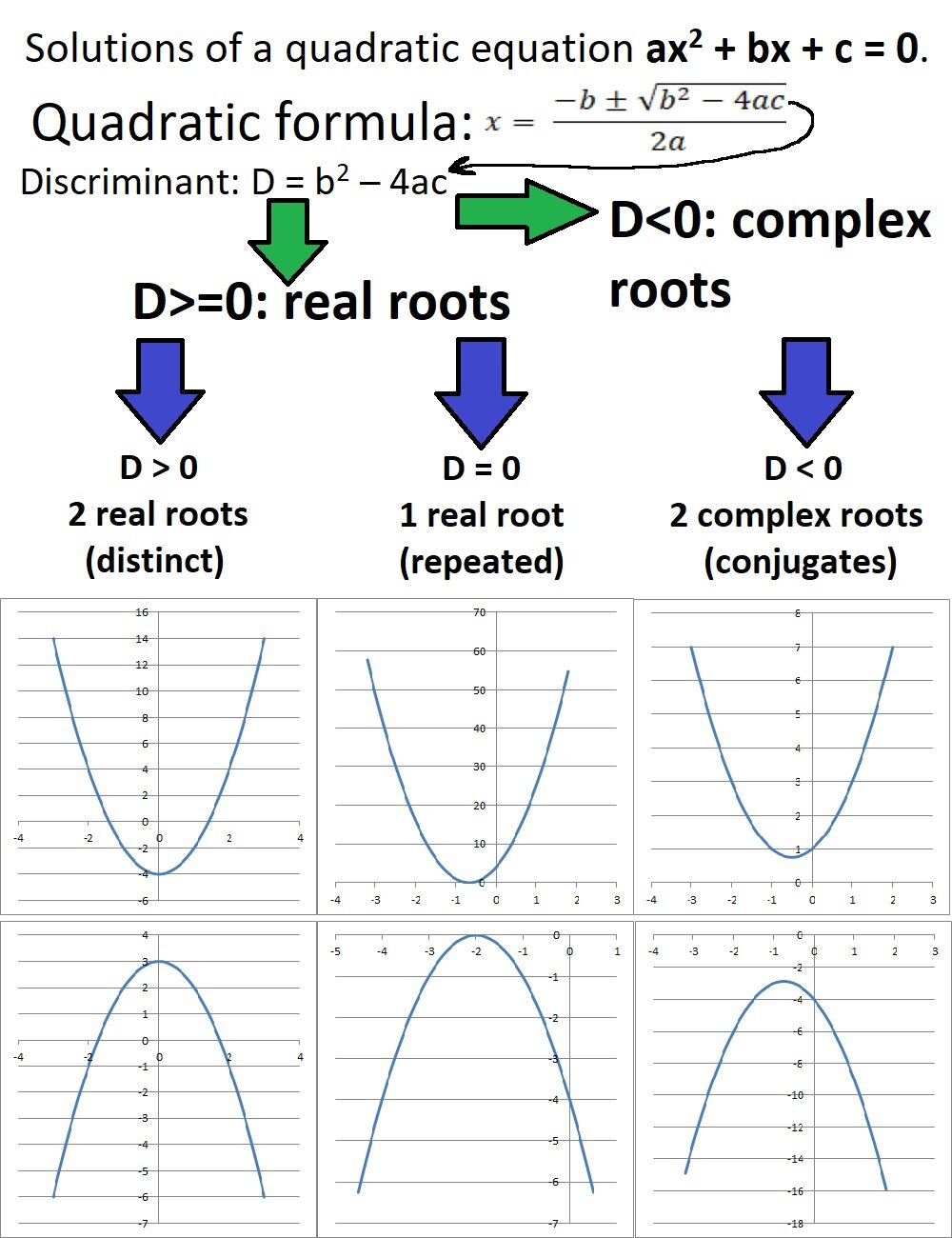
Understanding the discriminant is a key first step. It provides a quick snapshot of what to expect from a quadratic equation before you dive into solving it.