Mastering Quadratic Equations
Quadratic Equations
Meet the Quadratic Equation
Beyond simple linear equations, we have quadratic equations. These are a staple in algebra and describe a huge range of phenomena, from the arc of a thrown ball to the shape of a satellite dish. The word "quadratic" comes from the Latin quadratus, meaning square, because the variable gets squared (like ).
quadratic equation
noun
A polynomial equation of the second degree, meaning it contains a term where the variable is raised to the power of two.
Every quadratic equation can be written in a standard form, which makes it easier to work with. This form is:
Here, is our variable, and , , and are coefficients—they are known numbers. The only rule is that cannot be zero. If were zero, the term would disappear, and we'd be left with a linear equation, .
A Peek Inside the Roots
Solving a quadratic equation means finding its "roots." The roots are the values of that make the equation true. For example, in the equation , the roots are and , because and .
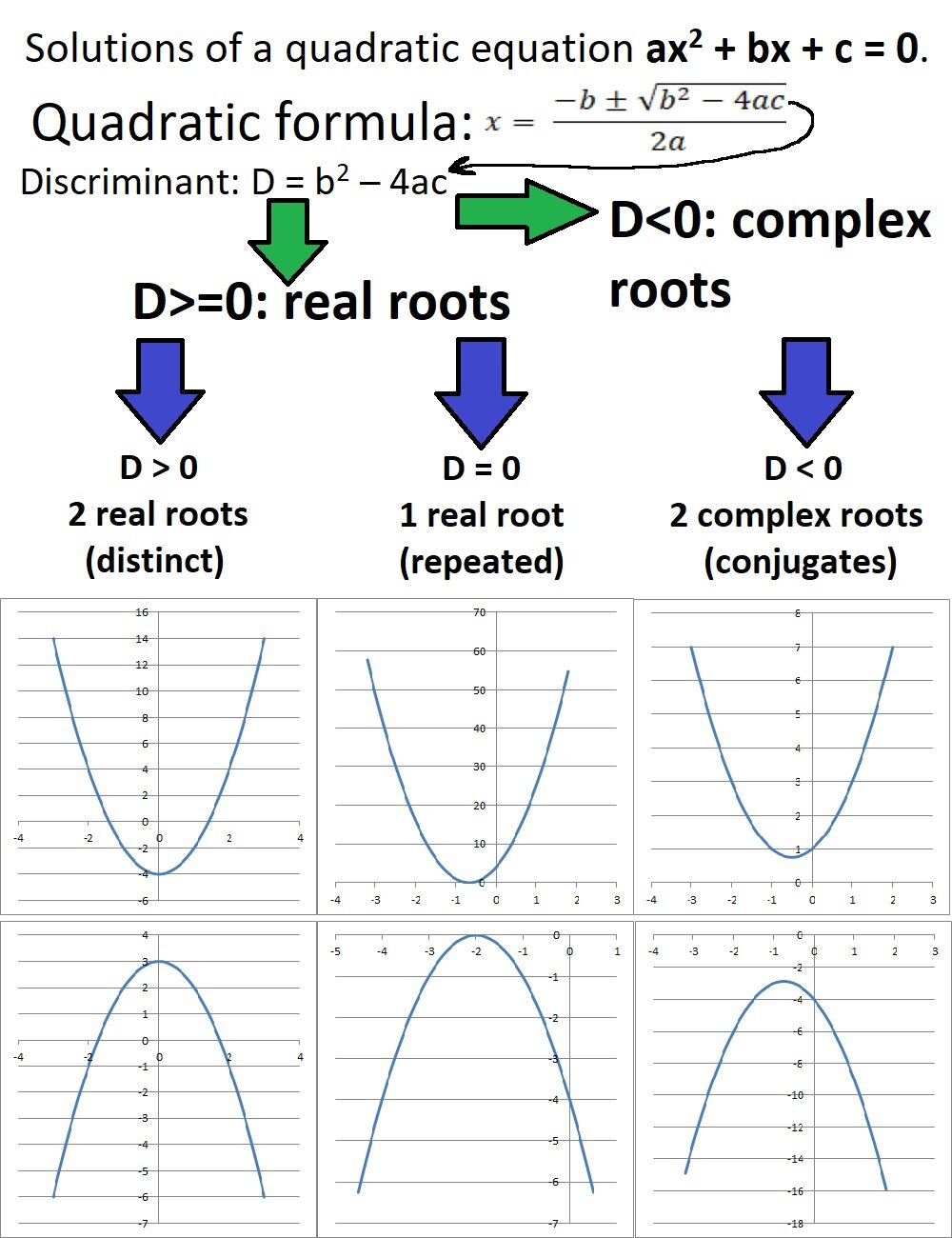
But how many roots does an equation have? And are they real numbers or something else? We can find out without actually solving the equation. The secret is a special formula called the discriminant.
The discriminant tells us about the nature of a quadratic equation's roots before we do the work of finding them.
The discriminant is represented by the Greek letter delta, , and is calculated from the coefficients , , and .
The value of the discriminant falls into one of three categories, each telling a different story about the roots:
| Discriminant Value | Nature of the Roots |
|---|---|
| (Positive) | Two distinct, real roots. |
| (Zero) | Exactly one real root. |
| (Negative) | Two complex roots. |
Let's look at an example. For the equation , we have , , and . Let's find the discriminant.
Since the discriminant is , which is positive, we know this equation has two different real roots. We don't know what they are yet, but we know they exist.
Quadratics in the Real World
Quadratic equations aren't just abstract math problems; they model many real-world situations.
One of the most common applications is in physics, describing projectile motion. When you throw a ball, its path through the air is a parabola, which can be described by a quadratic equation. The equation helps predict the ball's maximum height, how far it will travel, and when it will hit the ground.
They also appear in problems involving area. If you have a certain amount of fencing and want to enclose the largest possible rectangular garden, a quadratic equation can help you find the optimal dimensions. Engineers use them to design curved structures like bridges and satellite dishes, ensuring they have the right shape for strength and function.
What is the standard form of a quadratic equation?
The values of x that make a quadratic equation true are called its ____.
Understanding the structure of a quadratic equation and the information hidden in its discriminant is the first step toward mastering them.