Mastering Professional Presentations
Narrative Frameworks
Start with the Story, Not the Slides
The most common mistake in creating a presentation is opening PowerPoint or Keynote first. Before you choose a template or a font, you need to find your story. This starts with identifying the single most important message you want your audience to remember. This is your 'Big Idea'.
Your Big Idea is the one thing you want your audience to remember a week later. It should be a complete sentence with a clear point of view. For example, instead of "Q3 Sales Data," your Big Idea might be "Our new social media strategy drove a 15% increase in Q3 sales, validating our investment in the platform."
Everything in your presentation—every slide, every data point, every anecdote—must support this core message. If a piece of content doesn't reinforce your Big Idea, it doesn't belong. This ruthless focus is what separates a clear, persuasive presentation from a rambling one.
Building Your Narrative Arc
Once you have your Big Idea, you need a structure to deliver it. A simple yet powerful narrative framework is Situation-Complication-Resolution (SCR). It's a classic storytelling structure that creates a natural flow and builds tension.
Here's how it works:
- Situation: Start with a shared understanding. Describe the current state of affairs that your audience can agree on. "For the last two years, our user growth has been flat."
- Complication: Introduce the disruption, the problem, or the opportunity. This is the catalyst for your story. "Our main competitor just launched a new feature that our users have been requesting for months."
- Resolution: This is your Big Idea in action. Present your solution to the complication. "We can rapidly deploy a superior version of this feature within six weeks, capturing the market and reigniting our growth."
This structure transforms a list of facts into a persuasive argument.
Frameworks as Creative Constraints
Sometimes, the best way to spark creativity is to impose limits. Two contrasting frameworks offer powerful constraints for building presentations: the 10/20/30 Rule and the Lessig Method.
The 10/20/30 Rule was created by venture capitalist for entrepreneurs pitching for funding, but its principles are universally useful. It's a simple recipe for a clear and concise presentation.
| Rule | Guideline | Purpose |
|---|---|---|
| 10 Slides | Your presentation should contain no more than ten slides. | Forces you to focus only on the most critical points. |
| 20 Minutes | You should be able to deliver your presentation in twenty minutes. | Respects the audience's time and leaves room for discussion. |
| 30-Point Font | The smallest font on your slides should be 30 points. | Ensures readability and prevents you from cramming too much text onto a slide. |
On the other end of the spectrum is the , named after Harvard law professor Lawrence Lessig. This style is characterized by a large number of simple, fast-paced slides, often with just a single word or a powerful image. The slides act as punctuation for the speaker's words, not as a teleprompter.
Choosing between these frameworks depends on your context. The 10/20/30 Rule is excellent for formal business pitches and reports where clarity and brevity are paramount. The Lessig Method is highly effective for persuasive, keynote-style talks where emotional impact and engagement are the primary goals.
Mapping It All Out
Regardless of the framework you choose, you must map out your narrative before you start designing slides. The best way to do this is with a . A storyboard is a visual outline of your presentation, showing the flow of your ideas slide by slide.
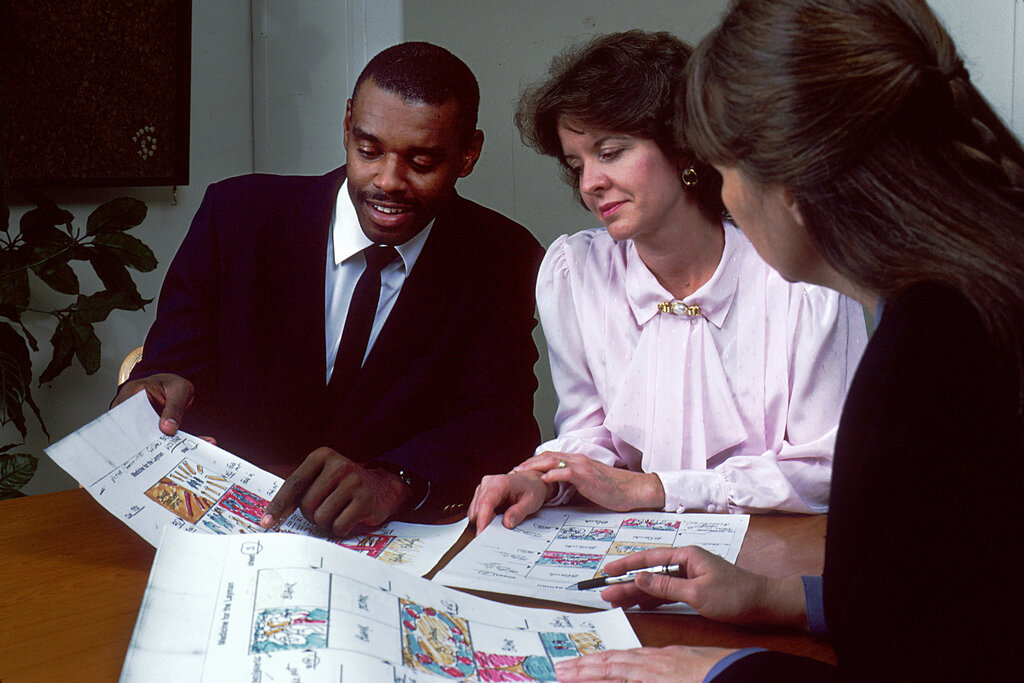
Your storyboard doesn't need to be artistic. You can use sticky notes on a wall, index cards on a table, or simple boxes in a document. For each 'slide,' sketch a rough visual concept and write the single, core point it will communicate. This process helps you see the entire presentation at a glance, allowing you to easily rearrange sections, identify gaps in your logic, and ensure a cohesive flow.
Only when your story is solid on paper should you open your presentation software. At that point, the work is no longer about what to say, but simply how to best visualize the story you've already built.
According to the provided text, what is the most common mistake people make when preparing a presentation?
The primary purpose of a 'Big Idea' in a presentation is to: