Mastering Professional Presentations
Narrative Storyboarding
Story, Not Slides
The biggest mistake in presentation design is opening the software first. Before you choose a font or a color palette, you need a message. Great presentations aren't just a series of slides; they are stories. They have a beginning, a middle, and an end. They present a challenge and offer a solution. This is the 'Message-First' approach.
Instead of building a presentation slide by slide, you first build the logical and emotional arc of your argument. This process, called storyboarding, ensures your message is clear, persuasive, and memorable before you ever think about visuals. It's the difference between a lecture and a narrative.
Finding Your Big Idea
Every powerful presentation can be distilled into a single, declarative sentence. This is your 'Big Idea' statement. It's the one thing you want your audience to remember. For example, instead of a title like "Q3 Marketing Update," your Big Idea might be: "Our shift to video content has increased lead generation by 40%, and doubling down will secure our market leadership."
This statement becomes your filter. For every slide, chart, or talking point you consider adding, you must ask: "Does this directly support my Big Idea?" If the answer is no, it doesn't belong in the presentation.
To craft a compelling Big Idea, you first need to understand who you're talking to. What do they care about? What are their pain points? What is their current perspective on your topic?
This is where audience persona mapping comes in. Before you write your story, sketch out your typical audience member. Are they an executive focused on the bottom line? An engineer interested in technical details? A customer looking for a solution? Tailoring your narrative to their perspective is critical for making your message resonate.
Structuring the Narrative
Once you have your Big Idea and understand your audience, you need a structure to hang your story on. The most timeless structure is the three-act play. It’s been used for thousands of years for a reason: it works.
| Act | Purpose | In a Presentation... |
|---|---|---|
| Act I: The Setup | Establish the context | You describe the current situation, the status quo. You create common ground with the audience. This is the 'what is'. |
| Act II: The Confrontation | Introduce conflict | You introduce the problem or opportunity. Here you present your data, analysis, and evidence that shows why the status quo isn't working or could be better. |
| Act III: The Resolution | Offer a solution | You reveal your proposed solution and its benefits. You end with a clear and definitive call to action. This is the 'what could be'. |
Another powerful model is Nancy Duarte's Sparkline. This structure creates momentum by oscillating between the reality of 'what is' and the promise of 'what could be'. You start by describing the current state, then paint a picture of a better future. You return to the present to highlight a specific problem, then show how your solution addresses it. This back-and-forth builds tension and makes the final call to action feel both urgent and achievable.
Analog Storyboarding
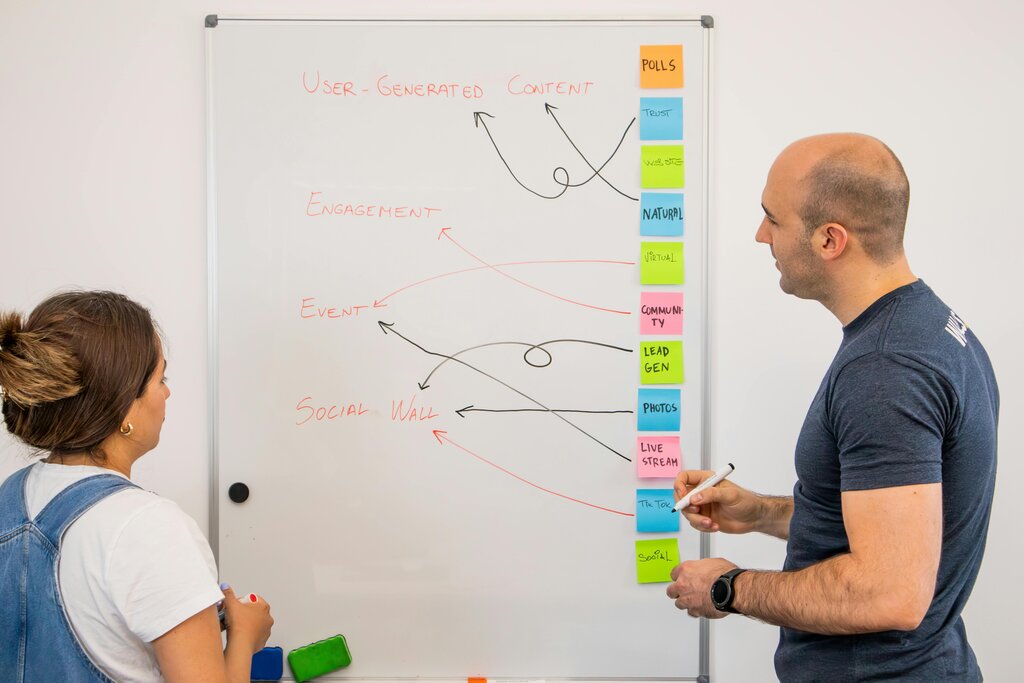
Now, it's time to map your story. The best tools for this are not digital. Grab a stack of sticky notes and a pen, or use a whiteboard. Each sticky note represents a single idea or a single slide. The goal is to get your ideas out quickly and focus on the flow, not the formatting.
Arrange your [{
}] on a wall. Step back. Does the story flow logically? Can you see the three acts? Move notes around, discard some, add others. This physical process encourages flexibility and helps you see the big picture.
Only when your story is solid, cohesive, and persuasive should you open your presentation software. By then, the hard work is already done. The software is just a tool to illustrate the powerful narrative you've already built.
According to the 'Message-First' approach, what is the biggest mistake to avoid when starting a new presentation?
What is the primary function of a 'Big Idea' statement in a presentation?