Mastering Professional Piano Performance
Advanced Piano Techniques
Expanding Your Palette
You've mastered the fundamental scales and feel comfortable at the keyboard. Now it's time to move beyond the basics and unlock a new level of expression. Advanced piano techniques aren't just about playing faster; they're about adding new colors, textures, and emotional depth to your music. We'll explore complex scales that challenge your coordination, exercises to make your fingers truly independent, and creative techniques that can make two hands sound like three.
Complex Scales and Arpeggios
Going beyond standard major and minor scales opens up a world of technical and musical possibilities. Complex scales challenge your brain and hands in new ways, building coordination and a deeper understanding of the keyboard's geography.
Consider playing scales in contrary motion, where your hands start on the same note and move in opposite directions. This is a fantastic exercise for hand independence. Another variation is playing scales in thirds or sixths, where your hands play the same scale pattern but start on different notes, creating harmony as you practice.
Advanced arpeggios also move beyond simple triads. Practice playing dominant seventh () and diminished seventh () arpeggios across multiple octaves. These require you to cross your fingers and thumbs in less common ways and navigate the keyboard fluidly. They are a staple of Romantic and virtuosic piano literature.
Building Finger Independence
At an advanced level, you need to think of each finger as an independent voice. True finger independence allows you to hold one note while playing a moving line with other fingers in the same hand, or to bring out a melody that's embedded within a series of chords. It’s the key to playing complex counterpoint, like a Bach fugue, with clarity and control.
Imagine each finger is a separate musician. Your job is to conduct them all to play together perfectly.
A classic exercise for this is to hold down one or more notes with certain fingers while playing a simple five-note pattern with the remaining fingers. For example, hold down C with your thumb and E with your third finger, and practice playing patterns with your second, fourth, and fifth fingers. The goal is to make the moving notes sound clear and even, without any tension from the fingers that are holding notes down. Do this slowly and with complete control.
Creative Effects
Once you have a high degree of technical control, you can start exploring more specialized, coloristic techniques that add unique textures to your playing. These aren't just tricks; they are tools used by composers to create specific moods and sounds.
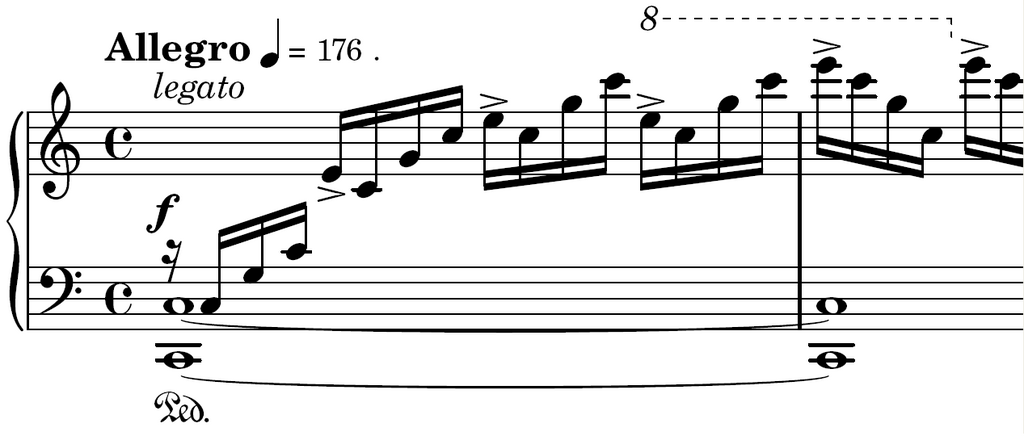
One such technique is the three-hand effect. This illusion makes it sound as if three hands are playing instead of two. It's typically created by playing a melody in the middle of the keyboard and using rapid, wide leaps with the left and right hands to play bass notes and high-register chords or arpeggios around it. The sustain pedal is crucial here, as it blends the different registers into a seamless whole.
Another powerful textural tool is the tone cluster. This is a chord made up of several adjacent notes played simultaneously. You can play them with your fingers, the flat of your hand, or even your forearm. Tone clusters can sound dissonant and aggressive or, if played softly in the high register, shimmering and ethereal. They were used extensively by 20th-century composers like Henry Cowell and Béla Bartók to create sounds that imitate percussion or dense natural textures.
Experiment with tone clusters. Play a small cluster of C, C♯, and D softly with the pedal down. Notice the complex wash of sound it creates. Now try a larger cluster in the low register played loudly. The effect is completely different.
Ultimately, technique serves the music. Mastering these advanced skills is not the end goal. The real artistry lies in integrating them into your playing to create more expressive, nuanced, and compelling performances. Use your newfound control to shape phrases more delicately, to create more dramatic contrasts, and to bring the composer's vision to life with your own unique voice.
What is the primary benefit of practicing scales in contrary motion?
An exercise where a pianist holds down a key with one finger while playing a pattern with the other fingers of the same hand is specifically designed to develop what skill?