Mastering Professional Audio Design
Introduction to Sound
What is Sound?
At its core, sound is simple: it’s a vibration. Imagine dropping a pebble into a calm pond. Ripples spread out from where the pebble landed. Sound works in a similar way. When an object vibrates, like a guitar string being plucked, it creates waves of pressure in the air around it.
These waves need something to travel through, which is called a medium. Air is the most common medium, but sound can also travel through water or solid objects like a wall. In the vacuum of space, there's no medium, which is why there's no sound.
As the sound wave travels, it pushes air molecules together, creating areas of high pressure called compressions. Between these compressions are areas where the molecules are spread apart, called rarefactions. This alternating pattern of high and low pressure is what a sound wave is.
Pitch and Loudness
Sound waves have two key properties that determine what we hear: frequency and amplitude.
Frequency
noun
The number of compressions (or cycles) of a sound wave that pass a point per second. It is measured in Hertz (Hz).
Frequency determines a sound's pitch. A high-frequency wave vibrates quickly, creating a high-pitched sound like a bird's chirp. A low-frequency wave vibrates slowly, resulting in a low-pitched sound like the rumble of thunder.
The other key property is amplitude.
Amplitude
noun
The intensity or 'size' of the vibrations in a sound wave. It corresponds to the amount of pressure change.
Amplitude determines a sound's loudness. A high-amplitude wave has a lot of energy and sounds loud, like a jet engine. A low-amplitude wave has less energy and sounds quiet, like a whisper. Loudness is measured in decibels (dB).
Harmonics and Overtones
Most sounds in the real world aren't pure tones with a single frequency. Instead, they are complex mixtures of a primary frequency and many other, quieter frequencies. The main, lowest frequency is called the fundamental.
The additional frequencies are called overtones. When these overtones are whole-number multiples of the fundamental frequency (2x, 3x, 4x, etc.), they are called harmonics. For example, if a cello plays a note with a fundamental of 100 Hz, its harmonics would be at 200 Hz, 300 Hz, 400 Hz, and so on.
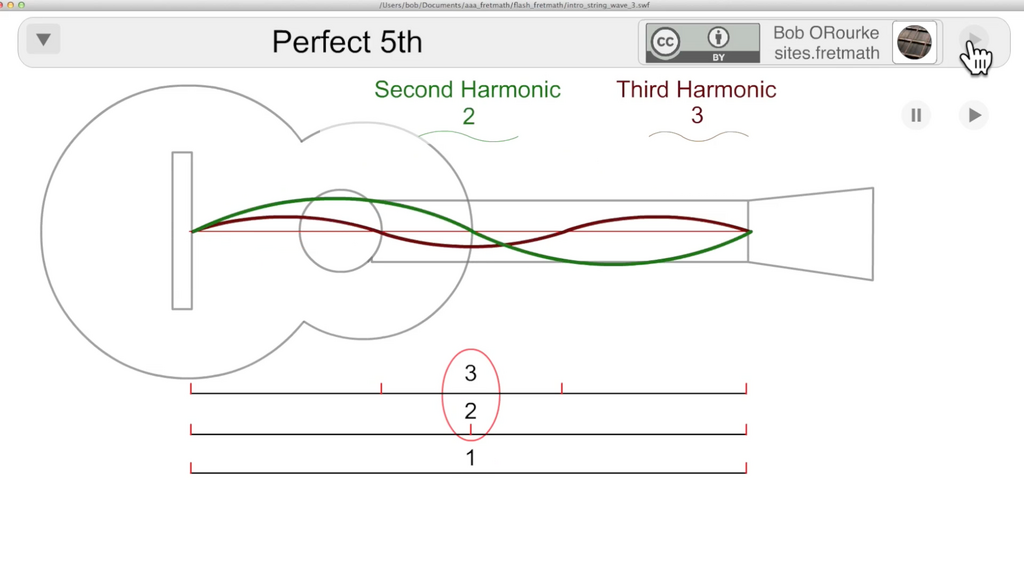
The specific blend of the fundamental and its harmonics is what gives an instrument its unique sound, or timbre. It's why a violin and a trumpet playing the exact same note (same fundamental frequency) sound so different from each other. Each instrument emphasizes a different set of harmonics.
How We Hear
The journey of sound doesn't end until it reaches our ears and brain. The human auditory system is a remarkable biological machine that converts pressure waves in the air into electrical signals our brain can understand.
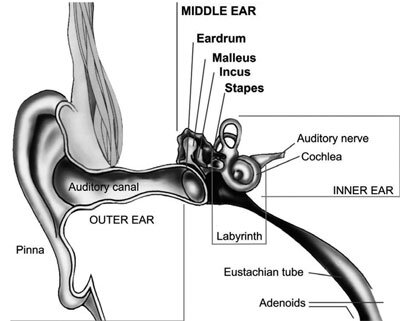
It starts with the outer ear, which funnels sound waves toward the eardrum. The vibrations of the eardrum are then transferred through three tiny bones in the middle ear. These bones amplify the vibrations and send them to the inner ear, specifically to a snail-shaped, fluid-filled structure called the cochlea.
Inside the cochlea, thousands of tiny hair cells are stimulated by the fluid's vibrations. These cells act like a frequency analyzer, with different cells responding to different pitches. They convert the physical vibrations into electrical signals.
Finally, the auditory nerve carries these signals to the brain, which interprets them as speech, music, or noise. This entire process happens so fast that it feels instantaneous. Understanding this chain, from vibrating source to brain perception, is the first step in mastering audio.
Let's test your knowledge of these foundational concepts.
What is the fundamental nature of sound?
A sound's pitch is determined by its wave's __________, while its loudness is determined by its __________.
With these basics in hand, you're ready to explore how sound is captured, manipulated, and reproduced in the world of audio design.