Mastering Product Management Interviews
Product Management Fundamentals
What Is a Product Manager?
Think of a product manager (PM) as the director of a film. They don't write the script, shoot the scenes, or act, but they hold the vision for the final movie. They ensure the writers, actors, and camera crew are all working together to create a single, cohesive story that audiences will love.
In the tech world, a PM guides a product from a simple idea to a successful launch and beyond. They are at the center of the action, connecting the dots between different teams like engineering, design, marketing, and sales. Their primary job is to answer three critical questions:
- What should we build?
- Why should we build it?
- How will we measure success?
To answer these, PMs spend a lot of time talking to users to understand their problems. They research the market, analyze data, and keep a close eye on business goals. With this information, they define the product's vision and create a roadmap, which is a high-level plan of what features to build and when.
The role of a product manager is to bring together stakeholders, to align and focus the team, and to collaborate for the best possible outcome for the customer and the business.
A key part of the job is prioritization. There are always more ideas than there is time or money to build them. The PM decides which features will deliver the most value to users and the business, and which ones can wait. This involves making tough choices and communicating them clearly to everyone involved.
From Idea to Decline
Every product, from a new smartphone app to a car model, goes through a predictable journey known as the product lifecycle. This cycle helps companies understand where a product is in its life and make smart decisions about how to manage it. The lifecycle is typically broken down into four stages.
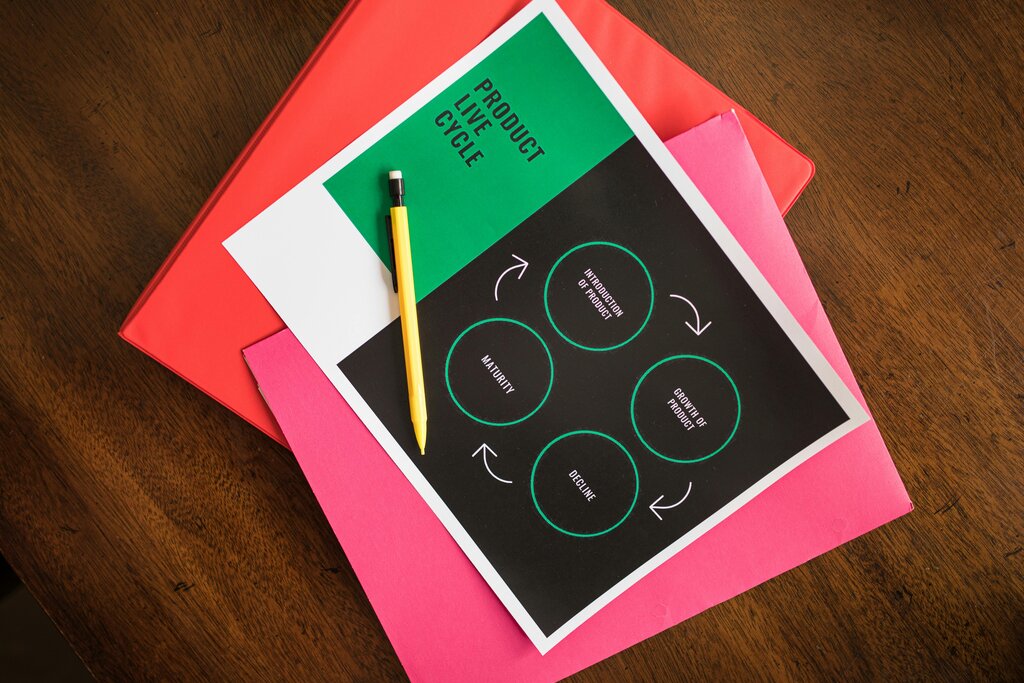
1. Introduction: This is the launch phase. The product is new to the market, and the main goal is to build awareness and encourage early adoption. Sales are typically slow as the company works to find its footing.
2. Growth: If the product catches on, it enters the growth stage. Sales and user numbers begin to climb rapidly. Competitors may start to appear. The focus here is on scaling the product, adding new features, and capturing as much of the market as possible.
3. Maturity: Eventually, growth slows down. The product has reached most of its potential customers, and the market is saturated. At this stage, the company focuses on defending its market share, optimizing existing features, and maximizing profit.
4. Decline: In the final stage, sales begin to fall. This could be due to new technology, changing customer tastes, or stronger competition. The company must decide whether to discontinue the product, sell it, or try to reinvent it for a new purpose.
How Modern Products Are Built
In the past, many products were built using a rigid, linear approach called the Waterfall method. Teams would spend months gathering requirements, then design the entire product, build it, test it, and finally release it. The problem? If the initial assumptions were wrong, you wouldn't find out until the very end, after wasting enormous amounts of time and money.
To solve this, modern product teams use a more flexible approach called Agile.
Agile
adjective
A project management philosophy that emphasizes iterative development, collaboration, and responding to change. It's about building and releasing software in small, functional pieces rather than all at once.
Instead of a single, massive launch, Agile teams work in short cycles, often called iterations or sprints. In each cycle, they build, test, and release a small part of the product. This allows them to get feedback from real users early and often, so they can adapt their plans based on what they learn. It's a continuous loop of building, measuring, and learning.
Agile isn't a strict set of rules, but rather a mindset. It values individuals and interactions over processes, working software over comprehensive documentation, customer collaboration over contract negotiation, and responding to change over following a plan.
One of the most popular frameworks for implementing Agile is Scrum.
Scrum organizes work into sprints, which are fixed-length periods, usually two to four weeks long. Here's a quick look at the key elements:
- Product Backlog: A prioritized list of everything that might be needed in the product. The Product Manager owns and manages this list.
- Sprint Planning: At the start of a sprint, the team selects a chunk of work from the top of the Product Backlog to complete during that sprint.
- Daily Scrum: A short, 15-minute daily meeting for the team to sync up on progress and identify any roadblocks.
- Sprint Review: At the end of the sprint, the team demonstrates what they built to stakeholders and gets feedback.
- Shippable Increment: The usable piece of the product created during the sprint.
By working this way, teams can consistently deliver value to users and adapt quickly to new information, which is essential in today's fast-moving markets.
Which statement best captures the primary role of a Product Manager?
A new social media app has moved past its initial launch. User numbers and sales are climbing rapidly, and several competing apps have just appeared. Which stage of the product lifecycle is the app in?
Understanding these core concepts is the first step toward thinking like a product manager.