Mastering Precalculus for Advanced Studies
Advanced Function Analysis
The Anatomy of a Function
We often think of functions as simple input-output machines. You put a number in, and you get a number out. But to truly understand calculus, we need to analyze their behavior more deeply. It’s not just about what comes out, but how the inputs and outputs relate to each other. Some functions are very particular about their relationships.
A function is injective, or one-to-one, if every output value is linked to a unique input value. No two inputs produce the same output.
Think of it like a coat check. When it's working properly, each ticket corresponds to exactly one coat. You wouldn't want two different tickets leading to the same coat. The function is injective; no two different numbers, when cubed, give the same result. However, is not injective because both and produce the output .
A function is surjective, or onto, if its range is equal to its codomain. In simpler terms, every possible output value is actually hit by at least one input.
Imagine a vending machine where every single item has a button. There are no buttons for items that are out of stock. The function is surjective for real numbers, as you can get any real number output (positive, negative, or zero) by cubing some other real number. But is not surjective if the codomain is all real numbers, because you can never get a negative output.
When a function is both injective and surjective, it is called . This is the gold standard for a 'well-behaved' function. A bijective function creates a perfect, reversible pairing between two sets. For every input, there is one unique output, and for every output, there is one unique input it came from. This property is crucial for creating inverse functions, which essentially run the original function in reverse.
Composing Functions
Functions can be combined in a process called composition. This is where the output of one function becomes the input for another. We write this as , which is pronounced "f of g of x" and means . You work from the inside out: first, you apply to , and then you apply to the result of that.
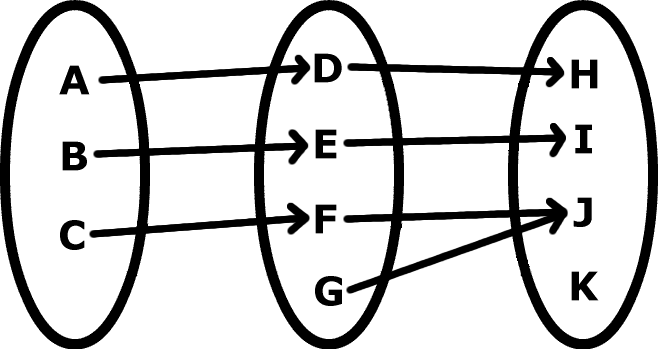
Determining the domain of a composite function requires careful thought. An input is only in the domain of if two conditions are met:
- must be in the domain of the inner function, .
- The output, , must be in the domain of the outer function, .
Let's find the domain of where and .
First, the domain of is all real numbers, so there are no restrictions there.
Next, the output of , which is , must be a valid input for . The function requires its input to be greater than or equal to 1. So, we must solve the inequality: This is a non-linear inequality. To solve it, we first treat it like an equation:
These critical values, and , divide the number line into three intervals: , , and . We test a point from each interval in our inequality, .
- Test : . Since , this interval works.
- Test : . Since is not , this interval fails.
- Test : . Since , this interval works.
So, the domain of our composite function is .
Symmetry in Functions
The shape of a function's graph can reveal deep properties about the function itself. One of the most important graphical properties is symmetry. Functions can be categorized based on their symmetry, or .
Even Function
adjective
A function is even if its graph is symmetric with respect to the y-axis. Algebraically, a function is even if for all in its domain.
Odd Function
adjective
A function is odd if its graph has rotational symmetry about the origin. Algebraically, a function is odd if for all in its domain.
Most functions are neither even nor odd. For example, is not symmetric about the y-axis or the origin. Knowing a function's parity can simplify calculations, especially in calculus. For example, the integral of an odd function over a symmetric interval like is always zero.
Time to test your understanding of these advanced function properties.
A function is described as "injective". What does this mean?
Consider the function where the domain and codomain are all real numbers. Is this function surjective?
Mastering these concepts—mapping properties, composition, and symmetry—provides the analytical tools needed to dissect complex functions and predict their behavior, a cornerstone of calculus.