Mastering Practical AI Architectures
Neural Architectural Nuances
Matching Architecture to Data
Not all data is structured the same. A photograph is a grid of pixels where nearby pixels are related—a spatial hierarchy. A sentence is a sequence of words where order matters—a sequential hierarchy. Neural network architectures are specialized to exploit these different structures.
For spatial data like images, Convolutional Neural Networks (CNNs) are the classic choice. They use filters that slide across an image, recognizing patterns like edges or textures regardless of where they appear. This property, called , makes them incredibly efficient for visual tasks. A cat is a cat whether it's in the top-left or bottom-right corner of a photo, and CNNs inherently get that.
For sequential data like text or time series, Recurrent Neural Networks (RNNs) and their more advanced cousins, LSTMs, were the standard. They process data one step at a time, maintaining an internal memory of what they've seen before. This works, but it's slow. Since each step depends on the last, you can't process the sequence in parallel. They also struggle to connect words that are far apart in a long sentence.
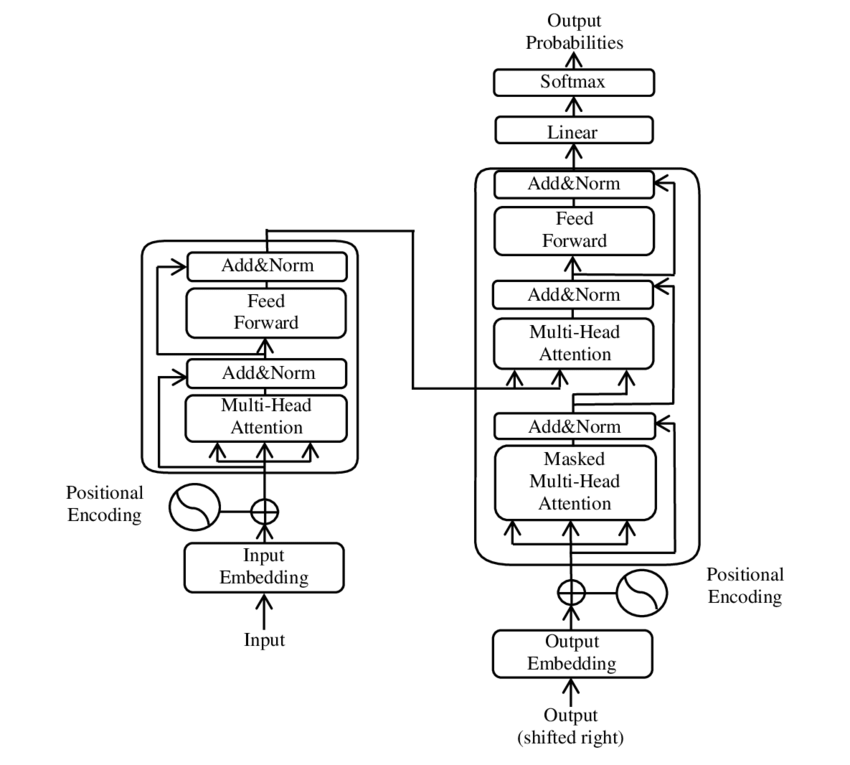
Enter the Transformer. Originally designed for machine translation, this architecture processes all parts of a sequence at once using a mechanism called self-attention. It directly measures the importance of every word to every other word in the sentence, giving it a powerful grasp of global context. This parallel approach makes it much faster to train on massive datasets and better at capturing long-range dependencies.
Blurring the Lines
The lines between these architectural families are getting blurry. Ideas from one are often borrowed to improve another, leading to powerful hybrid designs.
Take sequential data. Instead of a slow RNN, you can use a Temporal Convolutional Network (TCN). A TCN applies 1D convolutions to a sequence, allowing it to process the entire sequence in parallel just like a CNN handles an image. By stacking layers, a TCN can build a very large receptive field, enabling it to see relationships between distant points in time without the sequential bottleneck of an RNN.
This cross-pollination goes both ways. The ConvNeXt architecture, for example, is a pure CNN that was systematically updated to incorporate design principles from modern Transformers. Researchers started with a standard ResNet (a popular CNN model) and progressively modified it, adopting strategies like using fewer activation functions and larger kernel sizes, mirroring choices made in Transformer design. The result was a simple, efficient CNN that outperformed Transformers on many standard image recognition benchmarks.
Training Stability and Layer Norm
Building deeper networks allows models to learn more complex patterns, but it comes with a major challenge: the . During training, information about the error is passed backward through the network to update the weights. In a very deep network, this signal can shrink exponentially until it's too small to make meaningful updates to the early layers, effectively halting learning.
This issue is particularly relevant in Transformers, which can be hundreds of layers deep. The solution lies in a subtle but critical architectural detail: Layer Normalization. This technique rescales the outputs of a layer to have a consistent mean and variance, which helps keep the gradient signals stable. The question is, where do you put it?
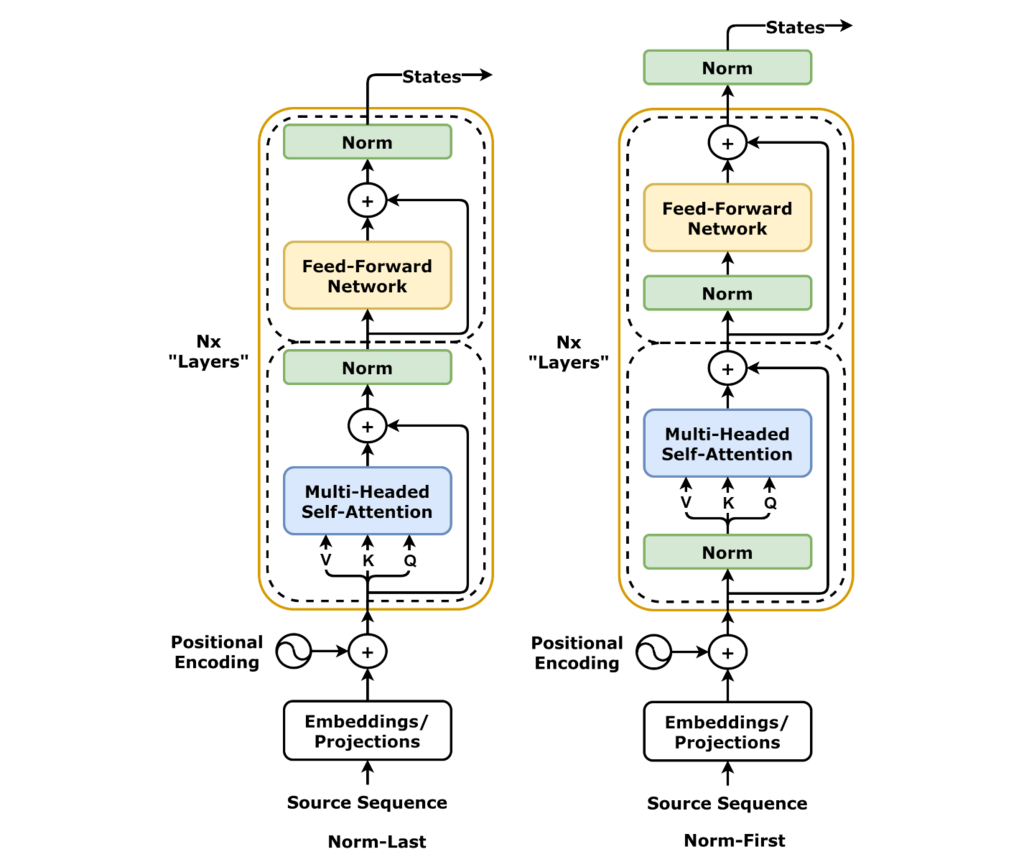
- Post-LN (Post-Layer Normalization): The original Transformer paper placed normalization after the main operations (self-attention, feed-forward network). This often leads to slightly better final performance but can be very difficult to train. The gradients can explode early in training, requiring careful learning rate adjustments.
- Pre-LN (Pre-Layer Normalization): A later innovation placed normalization before the main operations. This acts as a safeguard, stabilizing the inputs to each block and ensuring gradients flow smoothly. Pre-LN models are significantly more stable and easier to train, especially for very deep architectures, even if they sometimes lag slightly in raw performance.
Deployment Realities
The "best" architecture doesn't exist in a vacuum. It depends heavily on the deployment target. A model destined for a massive cloud server has very different constraints than one that needs to run on a smartphone.
For high-performance cloud environments, size is less of an issue. Here, you can deploy massive, multi-billion parameter Transformer models that require powerful GPUs. These models offer state-of-the-art performance but are slow and energy-intensive.
For edge devices like phones, smart cameras, or microcontrollers, efficiency is everything. Memory, processing power, and battery life are severely limited. In this context, highly optimized and lightweight CNNs like MobileNets are often preferred. These architectures use techniques like depthwise separable convolutions to dramatically reduce the number of parameters and computations. Even if a Transformer is more accurate, its computational cost might make it unusable on the edge. The trade-off between accuracy and efficiency is a constant balancing act for engineers.
What property of Convolutional Neural Networks (CNNs) makes them highly effective for image recognition, allowing them to identify an object regardless of where it appears in the image?
What is the primary advantage of the Transformer architecture over traditional Recurrent Neural Networks (RNNs) for processing long sequences?
Choosing the right architecture involves understanding the nature of your data and the constraints of your deployment environment. It's a game of trade-offs between performance, efficiency, and stability.