Mastering Poker Game Solves
Introduction to Game Theory
The Rules of the Game
Game theory is the study of how people make decisions when their choices affect others. It's not just about chess or board games. It applies to economics, politics, and even biology. At its core, it analyzes strategic situations where the outcome for each participant depends on the choices of all.
To understand any game, we need three things: the players, the strategies available to each player, and the payoff each player receives for every possible outcome. Let's start with a simple type of game.
Zero-Sum Game
noun
A situation in which one person's gain is equivalent to another's loss, so the net change in wealth or benefit is zero.
Imagine two players, Player 1 and Player 2, playing a simple coin-matching game. Each player secretly chooses to show either heads (H) or tails (T). If the coins match, Player 1 wins $1 from Player 2. If they don't match, Player 2 wins $1 from Player 1.
Player 1's gain is always Player 2's loss, and vice versa. The total amount of money between them never changes. This is a classic two-player zero-sum game. We can map out the outcomes in a payoff matrix.
| Player 2: Heads | Player 2: Tails | |
|---|---|---|
| Player 1: Heads | (1, -1) | (-1, 1) |
| Player 1: Tails | (-1, 1) | (1, -1) |
The numbers in each cell show the payoffs, with Player 1's outcome listed first. For example, if both choose Heads, Player 1 gets +1 and Player 2 gets -1.
Finding the Balance
In a strategic game, each player wants to choose their best move, but their best move depends on what the other player does. So, where does it end? The goal is to find a stable point where neither player has a reason to change their mind. This stable point is called a Nash equilibrium.
An equilibrium is a stable state where no player has an incentive to unilaterally change their strategy, given the strategies of the other players
Let's look at our coin game again. Does it have a Nash equilibrium? Suppose Player 1 decides to always play Heads. Player 2 would quickly realize this and start playing Tails every time to win $1. But then Player 1 would want to switch to Tails to counter. There's no single choice (like always playing Heads) that's stable.
In this game, the Nash equilibrium is for both players to play Heads 50% of the time and Tails 50% of the time, completely at random. If Player 1 plays randomly, there's nothing Player 2 can do to get an edge. And if Player 2 plays randomly, Player 1 can't improve their outcome by changing their own strategy. Neither player can do better by unilaterally changing their strategy.
A Nash equilibrium is a set of strategies, one for each player, where no player can get a better payoff by changing only their own strategy.
Let's consider a different game where a stable outcome is easier to see. Two companies are deciding whether to set a high price or a low price. The payoff matrix below shows their profits.
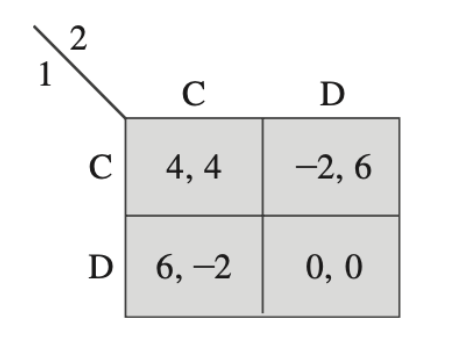
In this game, if both players choose D, they each get a payoff of 0. If Player 1 is playing D, can Player 2 do better by switching? No, switching to C would result in a payoff of -2. If Player 2 is playing D, can Player 1 do better? No, switching to C would also give them -2. Since neither player can improve their outcome by changing their strategy alone, (D, D) is a Nash Equilibrium.
Now, let's test your understanding of these core concepts.
What is the primary focus of game theory?
Which of the following are the three essential components required to define any strategic game?
Understanding these basic building blocks is the first step in analyzing more complex strategic interactions.