Mastering PLC Programming Logic and Systems
Program Architecture and I/O
Beyond a Single File
Writing your first PLC program often feels straightforward. It's a single, linear file that reads top to bottom, executing instructions one after another. This works perfectly for a simple conveyor belt or a single pump. But industrial automation is rarely that simple. A real manufacturing line involves dozens of motors, sensors, safety circuits, and operator controls all working in concert.
A linear, top-down program for a complex process quickly becomes a tangled mess. If a single part of the process changes, a programmer might have to search through thousands of lines of code to update every related instruction. Troubleshooting becomes a nightmare, as a fault in one area can have ripple effects that are difficult to trace.
This is why professionals use modular programming. Instead of one massive file, we break the program into smaller, self-contained blocks of logic. One block might handle motor control, another manages alarms, and a third handles a specific machine sequence. The main program routine simply calls these blocks when they're needed. It's like building a car from pre-assembled components like an engine and transmission, rather than forging every single part from scratch on the assembly line.
Modular code isolates problems. If a motor isn't working, you debug the motor control block, not the entire program.
The I/O Abstraction Layer
Organizing the code is only half the battle. A PLC program needs to interact with the real world through its input and output modules. A sensor is wired to a physical input terminal, and the PLC's logic reads its state. The logic then decides to turn on a motor, which is wired to a physical output terminal.
The naive way to program this is to use the physical address directly in your logic. For example, your code might say, "If input %I0.1 is on, then turn on output %Q0.3." This creates a rigid, brittle program. What happens if the maintenance team needs to move the sensor's wire to a different terminal, say %I0.2, because the original point failed? A programmer would have to find every single instance of %I0.1 in the code and change it. In a large program, this is a recipe for mistakes.
The professional solution is to create an abstraction layer through I/O mapping. Instead of using the physical address, we assign it a logical name, or tag. We create a dedicated section of our program, or a special data file, that maps the physical address %I0.1 to a descriptive tag like Conveyor_Photoeye_1. Now, the rest of our program logic never mentions %I0.1; it only references Conveyor_Photoeye_1. If the wiring changes, we only need to update the mapping in one single place. The core logic of the program doesn't change at all.
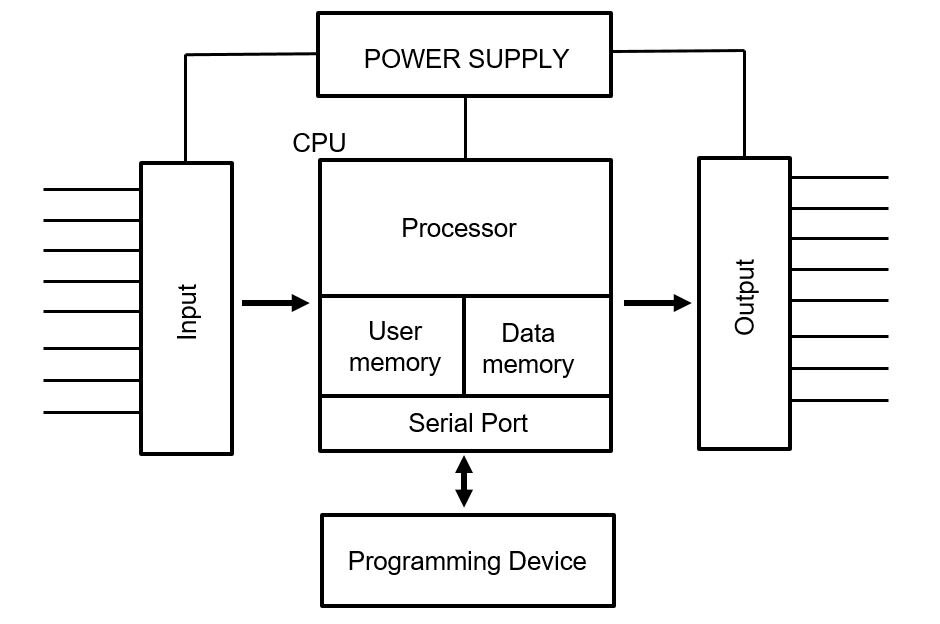
This mapping is the foundation of a robust and maintainable system. It decouples the software logic from the physical hardware, allowing each to be changed independently. This practice, often called creating aliases, is critical for any industrial-scale project.
Structuring Data
How a PLC handles these logical tags and other internal data varies between manufacturers. The two most common approaches are seen in Rockwell's Studio 5000 and Siemens' TIA Portal.
Rockwell PLCs use a tag-based database. Think of it as a giant, flat spreadsheet of all the data in your project. You create a tag (e.g., Motor1_Speed) and define its data type (e.g., a real number). This tag can then be used anywhere in your program. If the tag is defined at the controller scope, it's global, accessible by all program blocks. If it's defined within a specific program or routine, its scope is local, meaning it can only be seen and used there.
Siemens, on the other hand, uses a more structured approach with Data Blocks (DBs). A DB is a dedicated block of memory used to store specific data. You might create a Global_DB to hold data that needs to be accessed everywhere, like system status or alarm information. For machine-specific data, you can create separate DBs, like Station10_DB, which would contain all the variables related only to that station.
This difference reflects a philosophical choice. Rockwell's tag database is often seen as more flexible and faster for initial development. Siemens' Data Block approach requires more upfront planning but can result in a more organized and encapsulated program, which can be a significant advantage in very large, complex systems.
| Feature | Rockwell (Studio 5000) | Siemens (TIA Portal) |
|---|---|---|
| Primary Method | Tag-based database | Data Blocks (DBs) |
| Global Data | Controller-scoped tags | Global DBs |
| Local Data | Program-scoped tags | Local instance DBs / Temp variables |
| Organization | Flat structure, organized by scope | Hierarchical, encapsulated blocks |
| Flexibility | High; tags can be created on-the-fly | Moderate; requires more structure upfront |
To recap, think about memory this way: global data is like a public announcement board that everyone in the factory can see. Local data is like a private note passed between two workers on a specific assembly station. Using local data whenever possible prevents one part of your program from accidentally changing a value needed by a completely different part of the system. This practice, known as encapsulation, is a cornerstone of reliable software design.
When programming a PLC in a modular architecture, consider defining logic at the module level (e.g., “Motor control module”, “Conveyor module”, “Alarm management module”), use consistent interface definitions for each module, and ensure the base module remains decoupled from future expansions.
Now, let's test your understanding of these architectural concepts.
What is the primary drawback of using a single, linear program for a complex manufacturing line?
What is the professional practice used to avoid hard-coding physical I/O addresses like %I0.1 directly into PLC logic?
Proper program architecture isn't about fancy coding tricks. It's about building a foundation that is easy to understand, debug, and expand for years to come. By abstracting I/O and carefully managing data, you create a system that is robust, flexible, and ready for the demands of a modern factory.