Mastering PID Control Systems
PID Control Basics
Correcting for Error
Imagine you're driving a car with cruise control set to 60 mph. If you start going up a hill, the car slows down. The cruise control system notices this difference—this error—and gives the engine more gas. When you go downhill, the car speeds up, and the system reduces the gas. This constant cycle of measuring, comparing, and adjusting is the core of a control system.
A PID controller is a popular and powerful type of control system. The name stands for Proportional-Integral-Derivative. It's a strategy for minimizing error by considering three things: the present error, the accumulated past error, and the predicted future error.
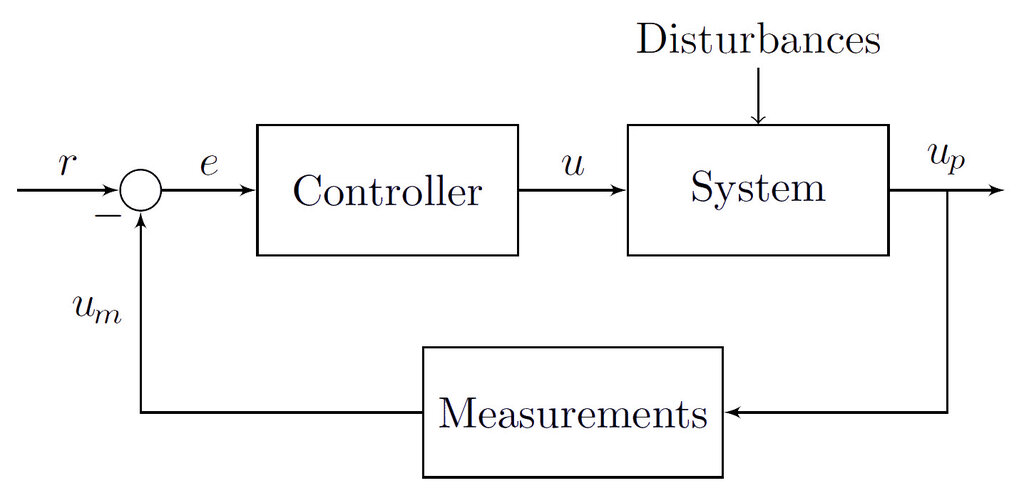
Each part of the PID controller—P, I, and D—acts like a different kind of expert, and they work together to bring the system to its desired state quickly and smoothly.
The Three Components
Let's break down how each component contributes to the decision-making process.
Proportional (P) Control This part looks at the present error. Its rule is simple: the bigger the error, the bigger the correction. If your car is 10 mph below the setpoint, the proportional controller applies much more gas than if it's only 1 mph below.
This is a great start, but P-control alone often isn't enough. It usually leads to a steady-state error, where the system gets close to the target but never quite reaches it. The correction becomes too small to overcome opposing forces, like friction or gravity.
Proportional control responds to the current size of the error. It provides the primary corrective force.
Integral (I) Control This component addresses the shortcomings of P-control by looking at the past. It sums up the error over time. If a small steady-state error persists, the integral term grows larger and larger, eventually applying enough correction to eliminate that gap.
Think of it as the controller's memory. It notices that the system has been consistently below the target for a while and says, "We've been off for too long, let's add a bigger push." The downside is that this can cause the system to overshoot the target, as the accumulated correction might be too large by the time the error reaches zero.
Integral control responds to the accumulated error over time. It eliminates small, persistent errors.
Derivative (D) Control This component tries to predict the future by looking at how quickly the error is changing. If the error is shrinking rapidly, it means the system is rushing toward the setpoint. The derivative controller then applies a braking force to prevent overshoot and dampen oscillations.
It’s like seeing a stop sign ahead. You don't wait until you're at the sign to brake; you start braking in advance based on your speed. This makes the system's response smoother and more stable. However, derivative control can be sensitive to noise in the measurement, as noise often looks like a series of rapid changes.
Derivative control responds to the rate of change of the error. It acts as a damper to prevent overshoot.
Putting It All Together
A full PID controller combines the outputs of these three components to determine the final action. The controller's output, , is a weighted sum of the proportional, integral, and derivative terms. The error is represented as .
The constants , , and are the "tuning knobs." Finding the right balance between these three values is key to making a PID controller work well for a specific system. A well-tuned controller can get a system to its setpoint quickly, with minimal overshoot, and hold it there steadily.
This might seem abstract, but PID controllers are everywhere. They are used in industrial manufacturing to control temperature and pressure, in drones to maintain stability, in chemical processes to regulate flow rates, and in countless other applications where precise control is needed.
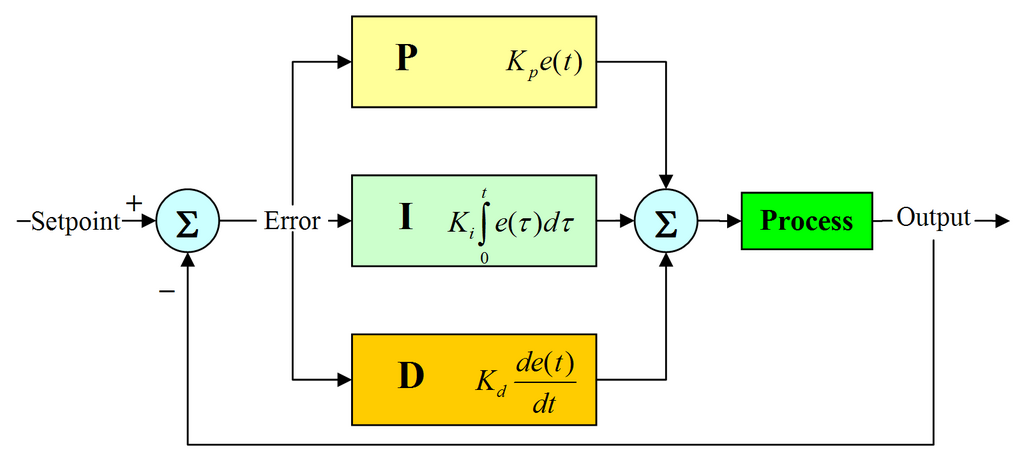
By balancing its reaction to the present, past, and future, the PID controller provides a robust and flexible way to automate complex systems.
What is the primary role of the Proportional (P) component in a PID controller?
A control system is consistently failing to reach its exact target, remaining slightly off. This persistent, small gap is known as...