Mastering Pickleball Techniques
Pickleball Basics
The Playing Field
A pickleball court looks a bit like a small tennis court. It’s a rectangle measuring 44 feet long and 20 feet wide, with a net in the middle that hangs 36 inches high at the sidelines and 34 inches in the center.
The court is divided into zones. The most important one to know is the non-volley zone, an area extending 7 feet from the net on both sides. This area is nicknamed “the kitchen,” and it has its own special rule we’ll cover in a bit.
Gear Up
You don't need much to play pickleball. The essentials are a paddle, a ball, and a net.
Pickleball paddles are solid, without strings like a tennis racket. They're typically made from composite materials like graphite or fiberglass. The ball is plastic with holes, similar to a wiffle ball, which makes it fly slower and bounce lower than a tennis ball.
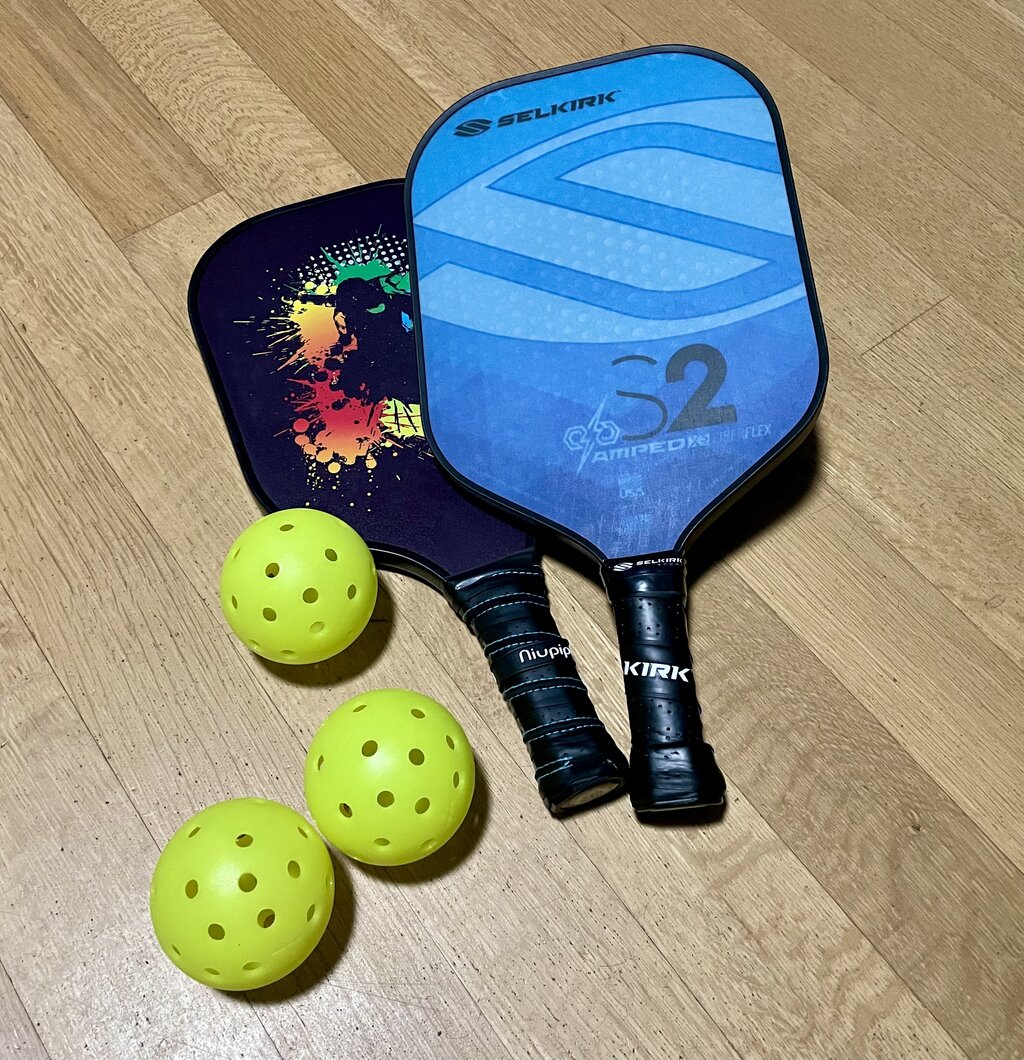
You'll also want comfortable athletic clothes and supportive court shoes. Since you’ll be making quick side-to-side movements, shoes with good lateral support are a smart choice to protect your ankles.
How to Play
The main goal is simple: hit the ball over the net so your opponent can't legally return it. Points begin with a serve.
The serve must be hit underhand, with the paddle contacting the ball below your waist. You have to stand behind the baseline and hit the ball diagonally into the opposite service court. You only get one attempt.
A key rule for beginners is the two-bounce rule. After the serve, the receiving team must let the ball bounce once before returning it. Then, the serving team must also let it bounce once before hitting it back. After those two bounces, players are free to hit the ball before it bounces (a volley) or after one bounce.
This rule prevents teams from rushing the net and smashing the ball right after the serve, which encourages longer, more strategic rallies.
Now, let's talk about the kitchen. The official name is the non-volley zone. The rule is straightforward: you cannot stand inside the kitchen to hit a volley. A volley is a shot where you hit the ball out of the air before it bounces. If you do, it's a fault. Your momentum can't carry you into the kitchen after a volley, either. You can, however, step into the kitchen at any time to hit a ball that has already bounced.
Keeping Score
Pickleball scoring has a few quirks. Games are typically played to 11 points, and you must win by at least 2.
The most important thing to remember is that you can only score a point when you or your team is serving. If you win a rally when the other team is serving, you don't get a point. Instead, you win the right to serve.
In doubles, the score is announced as three numbers: the serving team's score, the receiving team's score, and the server number (either 1 or 2). For example, a score of "5-3-2" means the serving team has 5 points, the receiving team has 3, and it's the second server's turn to serve.
When a game starts, the score is 0-0-2. This is so the first team to serve only gets one service turn. After that, both players on a team get a chance to serve before the ball goes to the other side.
Ready to test what you've learned? Let's see.
What are the dimensions of a standard pickleball court?
What is the primary rule regarding the non-volley zone, also known as 'the kitchen'?
With these fundamentals down, you're ready to grab a paddle and get on the court.