Mastering Piano Technique and Musicality
Keyboard Topography
The Keyboard's Landscape
You know the names of the keys and how they correspond to notes on a staff. Now, it's time to think of the keyboard differently: not as a collection of individual notes, but as a physical landscape. Mastering this topography—its hills (black keys) and valleys (white keys)—is the key to moving from playing notes to making music. It's about efficiency, comfort, and control.
The goal is to make the keyboard an extension of your hands, so you can focus on the music, not the mechanics.
Your Hand's Natural Shape
Before playing a single note, let's focus on your primary tool: your hands. Proper ergonomics are not just about preventing injury; they are the foundation of good tone and technique. Sit at the piano and let your arms hang loosely at your sides. Now, bring your hands to the keyboard. They should maintain a natural, relaxed curve, as if you're gently holding a ball.
Your wrist should be level with your forearm, flexible but not bent at a sharp angle. Avoid letting it drop below the keys or arch too high. Power and control don't come from your fingers alone. They originate from your shoulders and are channeled through your arms. Think of your arm's natural weight as the source of your sound. By relaxing and letting arm weight do the work, you produce a fuller, richer tone with far less effort.
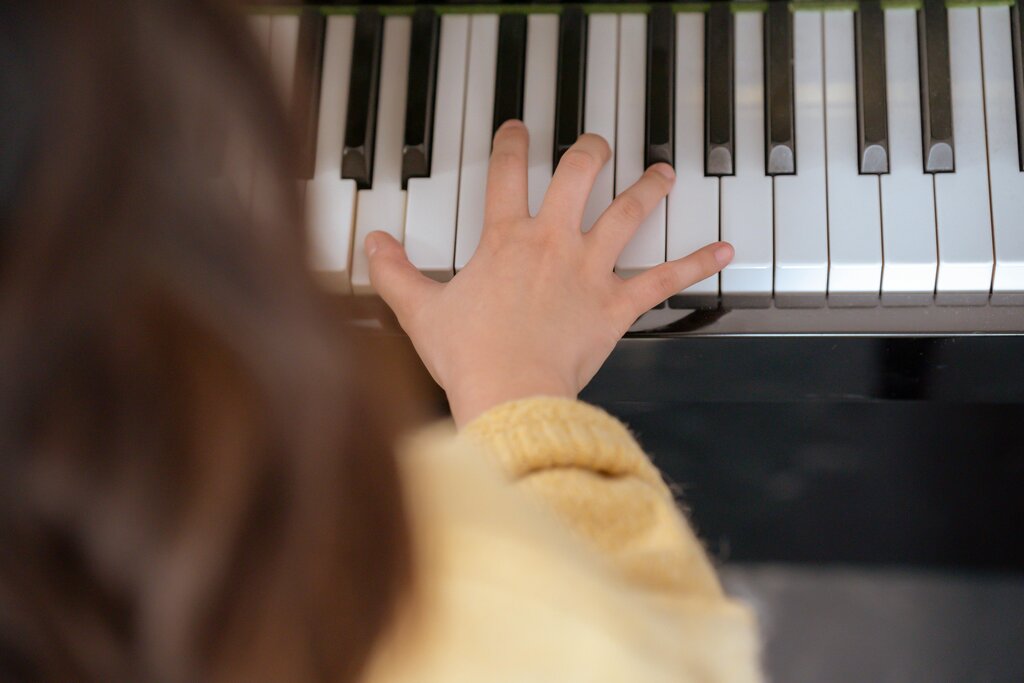
Tension is the enemy of fluidity. If you feel your fingers, wrists, or shoulders tightening, stop. Shake out your hands. The goal is to play with a relaxed strength, not a rigid force. This allows you to move quickly and accurately across large intervals without straining.
The Black Key Advantage
Beginners often see the black keys as obstacles. Intermediate players see them as anchors. Because they are raised and narrower, the black keys provide crucial tactile landmarks that help you navigate without looking. Your hand can feel its position on the keyboard by referencing the pattern of two and three black keys.
Furthermore, playing into the keyboard is often more stable than staying on the edge of the white keys. When a passage involves black keys, let your fingers move deeper between them. This position gives you more leverage and security. For example, playing a B major scale is often more comfortable than a C major scale for many hand shapes, precisely because the fingers can anchor themselves on the black keys.
Use the black keys as your guideposts. They tell you where you are, where you've been, and where you're going.
Seeing Shapes, Not Notes
As you advance, you need to stop thinking note by note and start seeing chord shapes. Your hand learns to form the shape of a chord before it even touches the keys. We'll use seventh chords to explore this, as their four notes create distinct and memorable shapes.
A C Major 7th chord (C-E-G-B) in root position feels different from its first inversion (E-G-B-C). The spacing, the finger placement, and the position of the black keys all change. The goal is to internalize the physical sensation of each inversion.
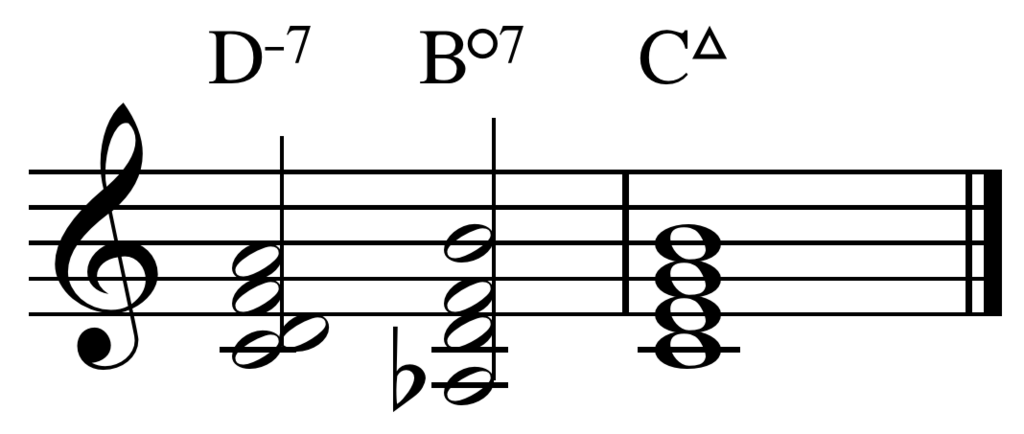
Look at the four basic inversions of a C Major 7th chord. Notice how the physical shape your hand must make evolves for each one. The distance between your thumb and pinky changes, and the inner fingers must adjust accordingly. Practicing these shapes helps build spatial awareness across the entire keyboard.
Try this exercise: Play a common ii-V-I progression (for example, Dm7 - G7 - Cmaj7) in the key of C. Start with all chords in root position. Then, play the entire progression using only first inversion chords. Continue for second and third inversions. You'll quickly discover how some transitions are much more efficient and ergonomic than others. This is the beginning of intelligent fingering and voicing.
According to the principles of good piano ergonomics, where does the power for producing a full, rich tone primarily originate?
How should an advancing piano player view the black keys?
By combining a relaxed physical approach with a geometric understanding of the keyboard, you build the foundation necessary for tackling more complex music. It’s no longer about finding the right notes, but about moving your hands with grace and efficiency.